
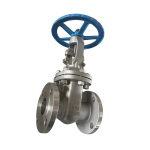
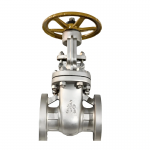
Specification
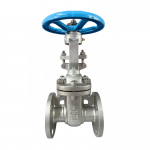
Forged Steel and Stainless Steel Wedge Gate Valves: Precision Fluid Control Solutions for High-Pressure Applications
I. Product Overview
II. Core Features: Dual Technical Breakthroughs in Material and Structure
-
High-Performance Material Combination
- A105 Forged Carbon Steel: Subjected to 1100°C high-temperature forging and normalizing-tempering treatment, achieving tensile strength ≥485MPa, grain size up to Grade 6, and impact toughness 30% higher than cast steel components. Ideal for high-temperature and high-pressure steam pipelines (e.g., main steam systems in thermal power plants).
- 304/316 Stainless Steel: Using AISI 304 (0Cr18Ni9) or 316 (0Cr17Ni12Mo2) materials, passing intergranular corrosion tests (ASTM A262 E method). The 316 grade resists corrosion from seawater with chloride content ≤200ppm and molybdenum-containing media, suitable for offshore platforms and chemical pickling lines.
-
Wedge-Type Sealing System Design
- Metal Hard Seal: The gate and seat sealing surfaces are overlay welded with Stellite alloy, hardness ≥HRC55, and precision ground to surface roughness Ra≤0.8μm, meeting API 598 bubble-tight standards (leakage ≤0.01×DN mm³/s).
- Back-Seal Structure: The stem uses trapezoidal threads with flexible graphite packing. When the valve is fully open, medium pressure assists in enhancing sealing to prevent external leakage, ensuring operational safety (complying with ISO 15848-1 low-leakage standards).
-
Structural Optimization and Operational Performance
- Outside Stem and Yoke (OS&Y): Visually indicates the opening/closing status via stem extension. Combined with a copper alloy nut and molybdenum disulfide grease, it reduces opening/closing torque by 25%, with manual operation force ≤200N·m (DN100 specification).
- Pressure Self-Tightening Bonnet: In high-pressure conditions (e.g., above PN100), medium pressure pushes the bonnet to automatically compress the sealing gasket, avoiding leakage risks from bolt fatigue and enhancing system reliability.
-
Full Working Condition Adaptability
- Temperature Range: From -29°C low-temperature liquefied natural gas (LNG) pipelines (A105 material passes -46°C low-temperature impact test with impact energy ≥27J) to 425°C high-temperature thermal oil systems (stainless steel maintains oxidation resistance for ≥1000 hours).
- Pressure Class: From PN16 low-pressure steam pipelines to PN160 high-pressure hydrogenation units, customizable forged steel or stainless steel material combinations balance strength and corrosion resistance.
III. Key Attributes: Technical Parameters and Standard Compliance
| Attribute Category | Specific Parameters |
|---|---|
| Nominal Diameter Range | DN15~DN600 (1/2″~24″), supporting non-standard customization (minimum DN10, maximum DN800) |
| Pressure Class | PN16/25/40/63/100/160 (corresponding to Class 150/300/600/900/1500/2500) |
| Body Material | A105 forged carbon steel (high-temperature/high-pressure), 304 stainless steel (general corrosion resistance), 316 stainless steel (acid/alkali/seawater resistance) |
| Seal Material | Stellite alloy (metal hard seal), PTFE (soft seal, -40°C~260°C), reinforced graphite (high-temperature seal) |
| Actuation Method | Manual (gear-driven), electric (intelligent actuator), pneumatic (double-acting cylinder), hydraulic (high-pressure scenarios) |
| Connection Type | Flange (RF/RTJ face), welding (BW butt weld), thread (NPT/PT), compliant with ANSI B16.5, GB/T 9113 standards |
| Execution Standards | Design: API 600, ASME B16.34; Testing: API 598, ISO 5208; Materials: ASTM A105, A351 |
| Suitable Media | Crude oil, natural gas, superheated steam, acid-base solutions, liquefied petroleum gas (LPG), seawater, etc. |
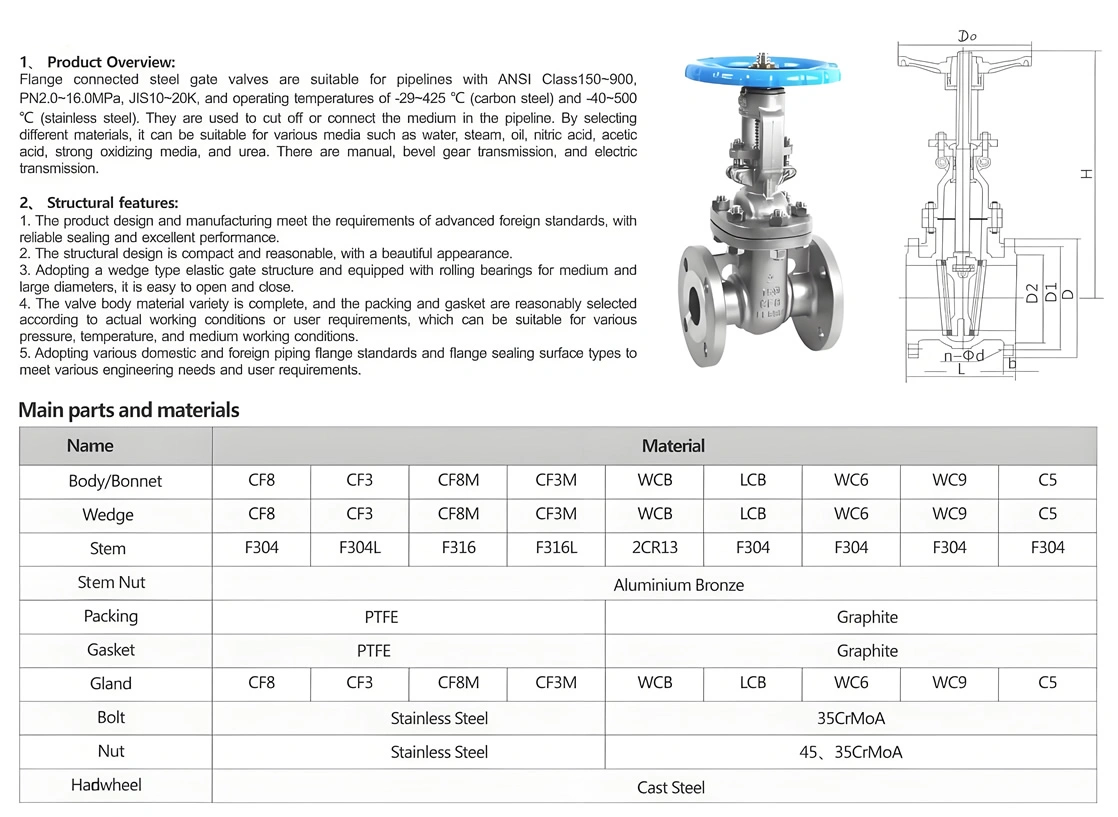
Product Overview
IV. Manufacturing Processes: Full-process Precision Control from Forging to Finished Product
-
Forging and Heat Treatment Processes
- A105 Forging: Steel ingots are forged by a 3000-ton hydraulic press, eliminating internal defects through upsetting-drawing processes. Forgings undergo ultrasonic testing (UT) to ensure no defects ≥2mm equivalent diameter.
- Stainless Steel Forming: 304/316 materials use precision casting or forging processes. Castings undergo solution treatment (1050°C holding + water quenching) to enhance corrosion resistance, with grain size ≥Grade 5.
- Heat Treatment Control: A105 valve bodies are normalized at 900°C + tempered at 650°C, hardness controlled at HB170~220; stainless steel components undergo stress relief annealing to reduce machining deformation risks.
-
Precision Machining and Surface Treatment
- Seal Surface Machining: Using 5-axis CNC grinders, valve seats and gates are ground in pairs with parallelism error ≤0.01mm, forming high-precision seal pairs.
- Stem Treatment: Surface chrome plating (thickness 0.02~0.05mm) or ceramic coating, hardness ≥HRC60, wear resistance increased 5 times, ensuring 100,000 cycles without jamming.
- Anti-Corrosion Treatment: Stainless steel valve bodies are electropolished (Ra≤0.2μm), A105 valve bodies are sprayed with epoxy resin (thickness ≥200μm), passing salt spray tests ≥1000 hours without rust.
-
Quality Control System
- Material Traceability: Each batch of steel provides chemical composition analysis (e.g., A105’s C≤0.35%, Mn 0.6~1.05%) and mechanical property reports (yield strength ≥250MPa).
- Pressure Testing: Shell pressurized to 1.5x nominal pressure (e.g., 6.0MPa for PN40 valves) for 15 minutes with no visible leakage; seal testing pressurized to 1.1x nominal pressure for 5 minutes with zero leakage.
- Nondestructive Testing: Welding interfaces undergo 100% radiographic testing (RT), forged components magnetic particle inspection (MT), and key dimensions 100% coordinate measuring (accuracy ±0.02mm).
Valve Details
V. Product Advantages: Core Competitiveness in Harsh Conditions
-
High-Pressure Reliability and Long Life
Forging processes eliminate material porosity, doubling fatigue life compared to cast steel valves. Data from a refinery hydrogenation unit shows TIANYU stainless steel gate valves operating stably for 8 years in 10MPa, 300°C hydrogen media with no seal failures. -
Customized Solutions
- Material Customization: Flexibly configured based on medium corrosiveness (e.g., 316L + hard alloy overlay for H₂S-containing conditions) and temperature-pressure (cryogenic types use nickel-based alloy seals).
- Functional Expansion: Optional anti-static devices (conductive paths between stainless steel components), fire-safe structures (API 607 certified, maintaining sealing for 30 minutes during fires), and signal feedback modules (4~20mA opening output).
-
Efficiency and Cost Balance
The wedge structure reduces the flow resistance coefficient (Cv value 10% higher than similar products), minimizing pipeline pressure drop; modular design shortens replacement time for vulnerable parts like seals and stems by 50%, reducing maintenance costs by 30%. -
Global Service Support
Products are certified by API, CE, and SGS, compatible with multi-national standards; 7×24-hour technical response, 48-hour delivery for regular accessories, and on-site installation debugging for overseas projects ensure project cycles.
Application
VII. TIANYU Brand Customization Advantages: Deep Integration of Technology and Service
- Technical Expertise: Holding 23 valve invention patents, the self-developed “gradient heat treatment process” increases A105 valve body strength by 15% and reduces thermal expansion coefficient by 8%, applied in key projects like Shenhua Ningxia Coal and Saudi Yanbu.
- Flexible Manufacturing: Equipped with 1000-ton forging lines and intelligent machining centers, supporting custom orders from 1 piece, with regular products delivered in 15 days and urgent orders expedited within 72 hours.
- Quality Traceability: Each valve is embedded with an RFID chip, scanning to view full-process data from steelmaking to testing, achieving 100% traceability of material batches, processing parameters, and inspection reports.
- Global Adaptation: Exported to over 50 countries, validated in harsh conditions at Russia’s Arctic LNG project and Qatar World Cup venue heating systems, providing multilingual technical documentation and localized services.
RELATED
-
API 602 ASME B16.34 GB/T 12235 CE DN65 PN25 WCB Flanged Cast Carbon Steel Manual Handwheel Operated, with F6a Stem & LNT+13Cr Globe Valve
I. Product Description & Key Specifications A. Core Compliance & Identification The TIANYU Cast Carbon Steel Globe Valve is a precision-engine…
GLOBE VALVE 05/15/2026 -
API 602 ASME B16.34 CE 4″ 300LB Carbon Steel WCB Flanged Angle Type Manual Bellows Seal Globe Valve
I. Product Description & Key Specifications A. Core Identification & Compliance This TIANYU Bellows Seal Globe Valve is engineered to meet the…
Bellow Seal Globe Valve 04/20/2026 -
API 609 ASME B16.34 CE DN100 150LB WCB Body Cr13 Seat Wafer Type Metal Hard Seal Single Plate Check Valve
API 609 ASME B16.34 CE DN100 150LB WCB Body Cr13 Seat Wafer Type Metal Hard Seal Single Plate Check Valve Product Overview In modern industrial fluid …
CHECK VALVE 04/16/2026 -
API 6D ASME B16.34 API 607 CE 4” 150LB A105 Carbon Steel Body PTFE Soft Seated RF Flanged Floating Ball Valve
I. Product Overview & Core Specifications The TIANYU 4” 150LB floating ball valve stands as a precision-engineered, cost-effective fluid control s…
BALL VALVE 04/16/2026 -
API 6D ASME B16.34 API 607 CE 3” 1500LB F22 Alloy Steel Body 304 Stainless Steel Seat Hard Seated RF Flanged Gear Operated Double Block and Bleed (DBB) Trunnion Mounted Ball Valve
API 6D ASME B16.34 API 607 CE NACE MR0175 Certified 3” 1500LB F22 Alloy Steel Body 304 Stainless Steel Seat Hard Seated RF Flanged Gear Operated Doubl…
BALL VALVE 04/05/2026 -
ANSI 150LB Stainless Steel 304 316 JIS 10K Pn10-16 WCB Hard Sealing Worm Wheel Three Eccentric Wafer Butterfly Valve Industrial Water & Eccentric Wafer Type
High – Performance ANSI 150LB Stainless Steel 304/316 Valve by TIANYU: A Comprehensive Guide I. Title Incorporating Key Attributes “ANSI 1…
BUTTERFLY VALVE 04/02/2026


