
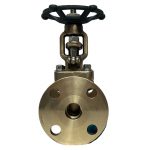
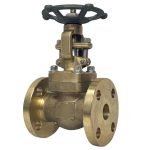
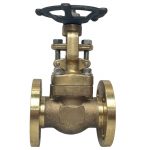
I. Important Attribute Specifications
A. Material Composition
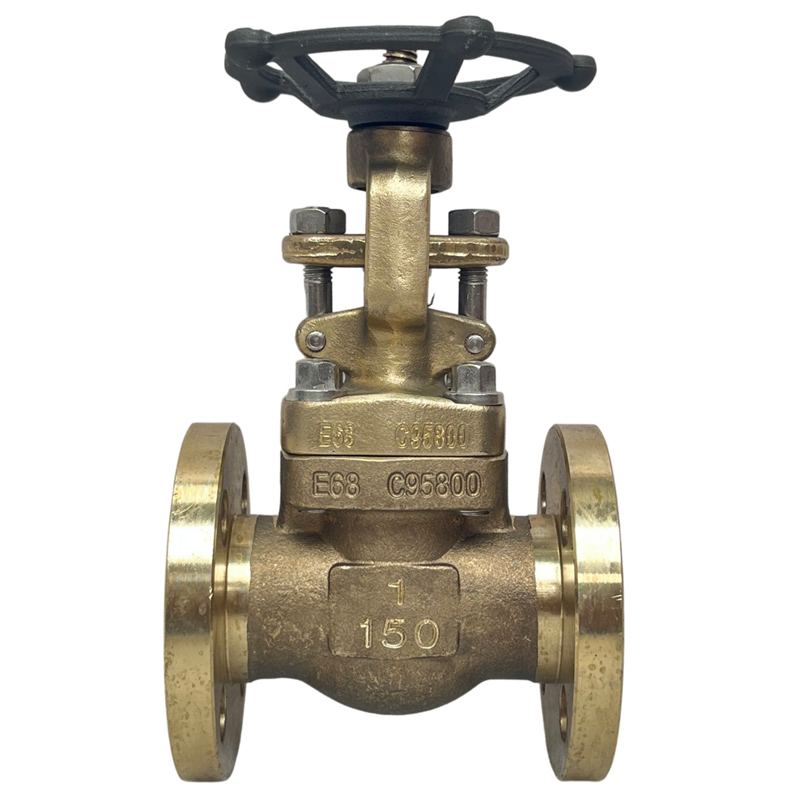
TIANYU flexible wedge gate valves are engineered with a material matrix carefully selected for seawater corrosion resistance, structural strength, and long-cycle isolation performance in aggressive fluid service. Every pressure-retaining and wear-critical component is traceable to mill test documentation and verified through incoming inspection before entering the production workflow.
- Valve Body: ASTM B148 Grade C95800 nickel aluminum bronze casting. C95800 is the industry benchmark copper-alloy grade for marine and seawater valves, with a nominal composition of approximately 81% Cu, 9.5% Al, 4.5% Ni, and 4% Fe. It delivers minimum tensile strength of 620 MPa, minimum yield strength of 275 MPa, and elongation of at least 15%, combined with outstanding resistance to seawater erosion, cavitation, chloride pitting, crevice corrosion, and microbiologically influenced corrosion (MIC). The body casting is shot-blasted and fully machined to remove riser pads, sand inclusions, and casting flash, leaving a smooth internal flow path that reduces sediment accumulation.
- Valve Wedge (Disc): ASTM B148 C95800 nickel aluminum bronze, matching the body alloy to eliminate galvanic corrosion between mating sealing surfaces. The wedge is a flexible, split-back design rather than a solid wedge, allowing minute elastic deflection to conform to the body seats. Sealing faces are precision machined and lapped to a surface roughness of Ra 0.8 μm or better, forming a tight metal-to-metal seal against integral body seats.
- Valve Stem: ASTM B150 C63000 aluminum bronze or stainless steel 416 per ASTM A276, selected for high torsional strength, galling resistance, and corrosion resistance in seawater and humid salt-spray atmospheres. The stem is precision trapezoidal ACME threaded, with a polished finish to reduce packing friction. An anti-blowout shoulder is machined into the lower stem, engaging a bonnet bushing to prevent ejection under internal pressure.
- Body Seats: Integrally machined into the body, with sealing faces lapped to match the wedge. The seat angle is held to tight geometric tolerance to ensure full circumferential contact with the flexible wedge when fully closed.
- Bonnet: ASTM B148 C95800 casting, bolted to the body flange with alloy steel studs. A spiral-wound graphite gasket with 304 stainless steel winder is compressed between the body and bonnet flange faces, providing pressure-tight sealing across the rated temperature range.
- Stem Packing: Multi-ring flexible graphite packing, reinforced with inconnel wire, fitted into a bonnet stuffing box with a cast iron or steel gland flange. The packing is self-lubricating and suitable for temperatures up to 450 °C, with adjustable gland bolts to compensate for wear and control stem leakage.
- Yoke & Handwheel: Cast iron yoke supports the stem nut, transmitting handwheel torque into linear stem motion. The handwheel is a heavy-duty cast iron spoked wheel, black-painted, sized for comfortable manual operation. An outside screw and yoke (OS&Y) arrangement isolates stem threads from the process fluid, protecting threads from corrosion, scaling, and suspended solids.
- Fasteners: ASTM A193 B7 alloy steel studs with A194 2H heavy hex nuts for the bonnet joint, zinc or hot-dip galvanized for atmospheric corrosion protection. Gland studs are stainless steel 304 for improved resistance to salt spray.
B. Dimensional & Pressure-Temperature Parameters
- Nominal Size: NPS 1 inch (DN25), as the reference product configuration.
- Pressure Class: Class 150 (PN20), per ASME B16.5 pressure-temperature rating for C95800 nickel aluminum bronze. At ambient temperature, the valve is rated for a maximum working pressure of 20 bar; the allowable pressure derates predictably as temperature rises, following the ASME B16.34 rating curve for copper alloy valves.
- End Connections: Flanged per ASME B16.5 Class 150, Raised Face (RF). The flange face is machined to a 2 mm raised face with a surface finish of Ra 3.2–6.3 μm, compatible with standard spiral-wound or corrugated stainless steel flexible graphite gaskets.
- Face-to-Face Dimension: Compliant with ASME B16.10 for Class 150 flanged gate valves, ensuring direct interchangeability with other manufacturers’ valves meeting the same standard.
- Flow Path: Full bore, with no flow restriction when the valve is fully open. The wedge retracts completely above the flow centerline, leaving an unobstructed cylindrical passage that minimizes pressure drop, turbulence, and erosion.
- Stem Type: Outside Screw and Yoke (OS&Y), rising stem. The stem rises above the handwheel as the valve opens, providing unambiguous visual position indication for field operators.
- Wedge Type: Flexible wedge (single disc with split-back flexibility), the preferred design for thermal cycling and piping stress applications.
- Bonnet Type: Bolted bonnet, with a bolted gland flange for packing access.
- Temperature Range: Suitable for continuous service from approximately −10 °C to 200 °C, depending on packing and gasket selection. The C95800 alloy retains mechanical strength and corrosion resistance across this range.
- Media Compatibility: Seawater, brackish water, brine, freshwater, cooling water, fire-fighting water, mild alkaline solutions, and other non-oxidizing aqueous media commonly encountered in marine and coastal industrial systems.


C. Operational Performance Parameters
- Sealing Performance: Metal-to-metal seat shut-off meeting API 598 leakage acceptance criteria for gate valves. The lapped C95800 wedge-to-seat contact achieves bubble-tight closure for liquid service, with no visible leakage during the hydrostatic seat test.
- Shell Test Pressure: 1.5 times the 20 °C rated pressure, held for a minimum duration per API 598, with no visible weeping, sweating, or deformation permitted on any pressure-retaining surface.
- Seat Test Pressure: 1.1 times the rated pressure, applied from the upstream side with the valve fully closed, held for the standard acceptance period with no leakage detected at the downstream seat.
- Operating Torque: Manual handwheel operation requires only moderate hand force. The ACME stem thread provides mechanical advantage, and the flexible wedge design reduces seating torque compared to rigid solid wedge alternatives.
- Cycle Life: Designed for on-off isolation duty, with a recommended service interval of 2 to 3 years between packing adjustments and 5 to 10 years between major overhauls under normal seawater service.
- Stem Leakage: Controlled by the graphite packing set; gland bolts can be tightened gradually to arrest minor weepage without shutting down the line.
- Fire-Safe Rating: The all-metal bonnet gasket and graphite packing provide inherent fire resistance. For applications requiring formal certification, TIANYU valves can be supplied with API 607 fire-safe test documentation.
D. Certifications & Compliance
- Design Standard: API 600 (Steel Gate Valves for Petroleum, Petrochemical and Allied Industries), adapted for nickel aluminum bronze trim per the applicable material class provisions.
- Flange Standard: ASME B16.5 Pipe Flanges and Flanged Fittings; face-to-face per ASME B16.10.
- Pressure Rating: ASME B16.34 Valves — Pressure-Rating per Temperature.
- Testing Standard: API 598 Valve Inspection and Testing.
- Material Standard: ASTM B148 Standard Specification for Copper Alloy Sand Castings for Valve Parts; C95800 composition and mechanical properties.
- Marking Standard: MSS SP-25 Standard Marking for Valves, Flanges, and Fittings.
- Quality Management: ISO 9001-certified manufacturing system.
- Material Documentation: EN 10204 3.1 material test certificates supplied with each valve, confirming C95800 chemistry and mechanical properties.
II. Feature Description
A. Flexible Wedge Design
The defining feature of this TIANYU gate valve is its flexible wedge construction. Unlike a solid wedge, which is machined as a single rigid disc that can bind or leak when the valve body distorts under thermal cycling or piping strain, the flexible wedge is split into two contact faces separated by a thin, flexible web. This geometry allows the two sealing faces to pivot by a fraction of a degree independently, conforming to the angle of the integral body seats even when the body has slightly distorted from pipeline stress.
In seawater cooling systems, pipelines experience significant thermal expansion and contraction as ambient and water temperatures change. Flange bolting loads, foundation settlement, and adjacent equipment vibration can also introduce small angular misalignments between the body seats. A rigid wedge gate valve under these conditions may either bind in the closed position, preventing tight shut-off, or ride unevenly on one edge of the seat, leading to accelerated wear and eventual leakage. The flexible wedge resolves this by distributing contact pressure evenly across both seat faces, maintaining a uniform sealing line and eliminating point loading that would scratch or gall the lapped surfaces.
When the valve is fully open, the wedge lifts completely above the bore centerline. Because the C95800 wedge retracts out of the flow stream, the sealing faces are not exposed to continuous impingement from flowing seawater, suspended sand, shell fragments, or marine biomass. This dramatically reduces erosion and wear compared to globe valves or check valves, whose sealing elements remain in the flow path. The wedge-to-stem connection uses a T-slot or retained nut arrangement, allowing the wedge to rotate slightly as it seats, which helps the lapped faces self-align without imposing bending stress on the stem.
B. Nickel Aluminum Bronze Body Construction
The valve body is cast from ASTM B148 C95800 nickel aluminum bronze, the most widely specified copper alloy for seawater service valves. C95800 combines the corrosion resistance of copper alloys with the mechanical strength comparable to cast steel, making it uniquely suited for marine and offshore applications.
C95800 exhibits outstanding resistance to seawater corrosion across a broad range of velocities. Unlike standard brass, which suffers dezincification in saline environments, nickel aluminum bronze contains essentially no zinc, eliminating dezincification as a failure mode. The alloy also resists impingement corrosion at flow velocities up to approximately 4 m/s, handles moderate sediment loads without rapid erosion, and tolerates anaerobic conditions that cause MIC in stainless steels. In coastal atmospheres laden with salt spray, the body develops a stable protective patina that does not flake or spall, extending exterior service life without painting or coating.
The body casting is produced in resin-bonded sand molds to ensure dimensional stability and surface finish. Internal flow passages are fully machined to remove sand pockets and riser remnants, reducing areas where marine organisms or sediment could accumulate. The flanged ends are faced to ASME B16.5 raised-face dimensions, with bolt holes drilled through on the proper bolt circle. The body is marked with the TIANYU logo, size, class, and material grade, as required by MSS SP-25.
C. Bolted Bonnet & OS&Y Rising Stem
The bonnet is bolted to the body with a pattern of alloy steel studs and heavy hex nuts, clamped to a spiral-wound graphite gasket. This bolted bonnet design is the industry standard for gate valves in industrial and marine service because it allows the bonnet to be removed for in-line inspection, repacking, or wedge replacement without cutting the valve from the pipeline.
The outside screw and yoke (OS&Y) arrangement positions the stem threads above the bonnet, outside the pressure boundary. In many older gate valve designs (inside screw and yoke, ISY), the stem threads are immersed in the process fluid, where seawater and suspended solids cause corrosion, pitting, and thread binding over time. The OS&Y design eliminates this failure mode by keeping threads clean, dry, and visible. Field operators can lubricate the threads periodically, inspect them for wear, and immediately see whether the valve is open (stem extended) or closed (stem retracted) — a critical safety indicator in marine fire-fighting and bilge systems.
The yoke is a cast iron bridge that supports the stem nut and handwheel. It transfers axial closing force into the bonnet and body flange rather than into the stem threads, protecting the threads from compressive overload. The handwheel is sized so that a single operator can fully close the valve against line pressure using normal hand force, without a wrench or cheater bar.
D. Stem Packing & Gland Seal
Sealing around the rising stem is provided by a multi-ring flexible graphite packing set installed in the bonnet stuffing box. Flexible graphite is chosen over PTFE or asbestos packing for marine service because it tolerates elevated temperatures, resists seawater immersion, and does not harden or crack after years of thermal cycling. The packing is compressed by a two-piece gland flange held by two adjustable gland studs. As the packing wears over time, operators can tighten the gland nuts a quarter turn at a time to arrest minor stem weepage, extending packing life without a shutdown.
The bonnet-to-body gasket is a spiral-wound graphite gasket with a 304 stainless steel winder and inner/outer rings. This gasket type maintains a resilient seal under the thermal cycling and bolt load relaxation typical of seawater systems, and it provides fire-resistant backup performance if exposed to elevated temperatures during a fire incident.
E. Flanged End Connections
Both ends are ASME B16.5 Class 150 raised-face flanges, drilled to the standard bolt circle for NPS 1. The raised face provides a controlled compression area for the spiral-wound gasket, and the flange thickness and hub dimensions are sized to withstand Class 150 pressure without yielding. Flanged ends are preferred over threaded or socket-weld ends for marine seawater valves because they allow easy removal for maintenance, accommodate gasket sealing, and avoid crevices where corrosion can initiate. The flange faces are protected with plastic or wooden shipping caps during transit to prevent damage to the machined RF surface.
III. Manufacturing Process & Product Advantages
A. Raw Material Procurement & Verification
TIANYU sources C95800 nickel aluminum bronze castings from foundries that operate under an ISO 9001 quality system and routinely supply material to marine and offshore valve OEMs. Each incoming batch of castings is accompanied by a mill test report (EN 10204 3.1) that documents the heat number, chemical composition, tensile strength, yield strength, and elongation. Before castings are released to machining, TIANYU’s incoming inspection laboratory performs its own verification:
- Spectrometric analysis confirms that aluminum, nickel, iron, and copper percentages fall within the C95800 specification range.
- Visual and dye-penetrant inspection identifies surface cracks, shrinkage, or sand inclusions that could compromise pressure integrity.
- Sample castings from each heat are sectioned and macro-etched to check for soundness at the gate and wall sections.
- Mechanical test coupons cast with the heat are tensile-tested to verify minimum 620 MPa ultimate strength and 275 MPa yield strength.
Castings that fail any of these checks are returned to the foundry and do not enter production.
B. Precision Machining
All pressure-retaining and sealing surfaces are machined on CNC lathes and vertical machining centers:
- Body flanges: Machined to ASME B16.5 raised-face dimensions, with bolt holes drilled and reamed on the correct bolt circle. Flange face flatness and surface finish are controlled to ensure good gasket seating.
- Body bores: The full bore is machined to the nominal pipe inside diameter, and the integral seat pockets are cut to the seat angle. The seat faces are then rough-ground and lapped to a mirror finish.
- Wedge: The wedge casting is machined to match the body seat angle. Both sealing faces are precision ground and then hand-lapped against the body seats in matched pairs, ensuring that each wedge conforms to its own body seats. This matched-pair lapping is critical for achieving bubble-tight shut-off.
- Stem: The ACME threads are precision ground on a thread grinder to ensure smooth, backlash-free engagement with the stem nut. The stem ends are turned to fit the wedge T-slot and the handwheel keyway, and the anti-blowout shoulder is turned to diameter.
- Bonnet: The bonnet flange face, stuffing box bore, and yoke mounting face are machined to tight tolerances. The bonnet bore is sized to provide clearance for the rising stem.
C. Assembly & Pressure Testing
After machining, all components are ultrasonically cleaned to remove chips, cutting fluid, and machining residue. Assembly follows a controlled sequence:
- The body seats are inspected for lapping quality.
- The wedge is inserted into the body from the bonnet end, and the stem is threaded through the bonnet to engage the wedge T-slot.
- The spiral-wound bonnet gasket is positioned, and the bonnet is aligned to the body flange.
- Studs are inserted and nuts tightened in a crisscross pattern to a specified torque sequence, ensuring uniform gasket compression.
- Graphite packing rings are inserted into the stuffing box, and the gland flange is fitted and lightly compressed.
- The handwheel and stem nut are installed, and the valve is cycled several times to confirm smooth operation.
Every completed valve then undergoes pressure testing per API 598:
- Shell hydrostatic test: The body cavity is filled with water and pressurized to 1.5 times the 20 °C rated pressure. The valve is held under pressure for the required duration, and the body, bonnet joint, and flange faces are inspected for weeping, sweating, or deformation.
- Seat hydrostatic test: The valve is fully closed, and pressure is applied to one end at 1.1 times the rated pressure. The downstream side is observed for leakage through the seat. The test is repeated in the reverse direction to verify bidirectional shut-off.
- Operational check: The valve is stroked open and closed several times under pressure to confirm smooth stem movement, no binding, and correct wedge seating.
Valves that leak during shell or seat testing are disassembled, and the source of leakage is corrected (re-lapped seat, replaced gasket, repacked stem) before re-testing. Only valves that pass all tests proceed to final marking and packaging.
D. Product Advantages
- Superior Seawater Corrosion Resistance: C95800 nickel aluminum bronze outperforms brass, bronze, cast iron, and even many stainless steels in seawater service. It resists pitting, crevice corrosion, impingement attack, and MIC, providing a service life of 10 to 15 years in continuous seawater immersion — far longer than carbon steel valves, which would require expensive epoxy lining or cathodic protection.
- Flexible Wedge Solves Thermal Binding: The split-back flexible wedge maintains tight shut-off under thermal cycling and piping strain, eliminating the binding and leakage problems common with solid wedge gate valves. This is particularly valuable in marine systems where pipe temperatures swing between cold seawater and warm engine-room cooling water.
- Full-Bore, Low-Loss Flow: When fully open, the wedge is completely withdrawn from the flow path, leaving an unobstructed bore. This minimizes pressure drop, reduces pumping energy, and allows mechanical pigging or cleaning where required.
- OS&Y Visible Position: Operators can instantly see whether the valve is open or closed by observing the stem position, improving safety and reducing human error in emergency shut-down scenarios.
- In-Line Maintainability: The bolted bonnet allows repacking, wedge inspection, and gasket replacement without removing the valve from the pipeline, reducing ship downtime and maintenance labor cost.
- Proven Standard Compliance: API 600 design, ASME B16.5 flanges, ASME B16.34 pressure ratings, and API 598 testing make the valve universally acceptable to shipyards, EPC contractors, and class societies such as ABS, DNV, LR, BV, and CCS.
- Handwheel Simplicity: No external power supply, air supply, or electrical control is required. The valve operates reliably in remote, unpowered locations and in explosive atmospheres without explosion-proof actuators.
- Long Service Life & Low Total Cost: The combination of corrosion-resistant C95800, lapped metal seats, graphite packing, and OS&Y thread protection yields a long service interval with minimal maintenance, reducing the total cost of ownership compared to less alloyed alternatives.
IV. Product Applications
A. Marine & Shipbuilding
On commercial vessels — container ships, bulk carriers, oil tankers, chemical tankers, and offshore support vessels — TIANYU C95800 flexible wedge gate valves are installed in seawater cooling systems, ballast water lines, bilge and ballast manifolds, fire-main isolation loops, deck wash systems, and anti-fouling treatment lines. The valves withstand continuous seawater immersion, salt-splash decks, and vibration from propulsion machinery. Shipyards value the ASME B16.5 flange compatibility and the ability to deliver valves with material certificates acceptable to major classification societies.
B. Offshore Oil & Gas Platforms
On fixed offshore platforms, floating production storage and offloading (FPSO) vessels, and subsea-related topsides, these gate valves isolate seawater lift pumps, firewater deluge systems, cooling heat exchangers, and utility water branches. The C95800 alloy resists the splash-zone and atmospheric corrosion of offshore environments, and the fire-safe graphite gasket and packing provide an added layer of protection on hazardous-area topsides.
C. Seawater Desalination
In reverse osmosis (RO) and multi-stage flash (MSF) desalination plants, large volumes of raw seawater are pumped from open intakes. TIANYU nickel aluminum bronze gate valves serve as isolation valves on intake headers, pre-treatment filter banks, backwash lines, and brine discharge piping. The full bore reduces friction loss in high-volume lines, and the corrosion-resistant body handles chlorinated seawater that would rapidly corrode unprotected steel.
D. Coastal Power Generation
Coastal thermal power plants and combined-cycle gas turbines rely on seawater for condenser cooling. C95800 gate valves isolate condensers, cooling water pump discharge branches, and emergency fire protection loops. The valve’s ability to operate reliably after long idle periods (a common issue with cooling water valves that sit open for months) is enhanced by the corrosion-resistant alloy and protected OS&Y threads.
E. Coastal & Harsh-Environment Industrial Piping
Chemical plants located near coasts, salt-manufacturing facilities, fish-processing plants, and coastal municipal water treatment plants use these valves for brine transfer, salt solution dosing, and seawater intake. The nickel aluminum bronze body resists the chloride-laden atmosphere and the aggressive process fluids, while the bolted bonnet simplifies maintenance in corrosive environments.
TIANYU ASTM B148 C95800 flexible wedge flanged gate valves deliver a proven combination of seawater corrosion resistance, bubble-tight metal seat shut-off, visible OS&Y position indication, and in-line maintainability. Built to API 600, ASME B16.5/B16.10, and API 598 standards, with EN 10204 3.1 material traceability, these valves are the trusted isolation choice for marine, offshore, desalination, coastal power, and industrial seawater piping systems where long service life and low maintenance downtime are essential.
RELATED
-
API 609 ASME B16.5 Class150 NPS10 ASTM B148 C95800 Nickel Aluminum Bronze Manual Double Offshore Eccentric Flanged Butterfly Valve
I. Important Attribute Specifications A. Material Composition TIANYU double eccentric butterfly valve is constructed with corrosion-resistant alloy ma…
-
API594 ASME 6“ Class150LB Replaceable Rubber Liner & SS304 Blade Ductile Iron Wafer Manual Slurry Knife Gate Valve
I. Important Attribute and Specification Description A. Global Standard Compliance & Product Core Definition The TIANYU Wafer Slurry Knife Gate Va…
-
API 600 ASME CE DN80 Class 300LB WC6 Cr-Mo Alloy Steel Manual Flanged Rising Stem Wedge Gate Valve
I. Important Attribute and Specification Description A. Global Standard Compliance & Product Core Definition The TIANYU Rising Stem Gate Valve is …
-
API 602 ASME DN80 Class 300LB ASTM A216 WCB Manual Flanged Straight Pattern Globe Valve With Metal-to-Metal Trim with Flexible Graphite Stem Packing
I. Important Attribute and Specification Description A. Global Standard Compliance & Product Core Definition The TIANYU Straight Pattern Globe Val…
-
API 594 ASME B16.5 CE DN80 Class 150LB ASTM A216 WCB Flanged Swing Check Valve
I. Important Attribute and Specification Description A. Global Standard Compliance & Product Core Definition The TIANYU Swing Check Valve is a bol…
-
API 609 ASME B16.34 ASME B16.5 CE 4 Inch Class 600LB UNS S32750 4A Wafer Type Triple Eccentric Butterfly Valve
I. Important Attribute and Specification Description A. Global Standard Compliance & Product Definition Developed and fabricated under the full su…