
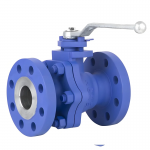
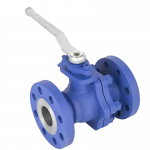
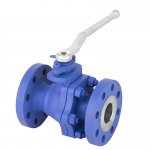
Specification
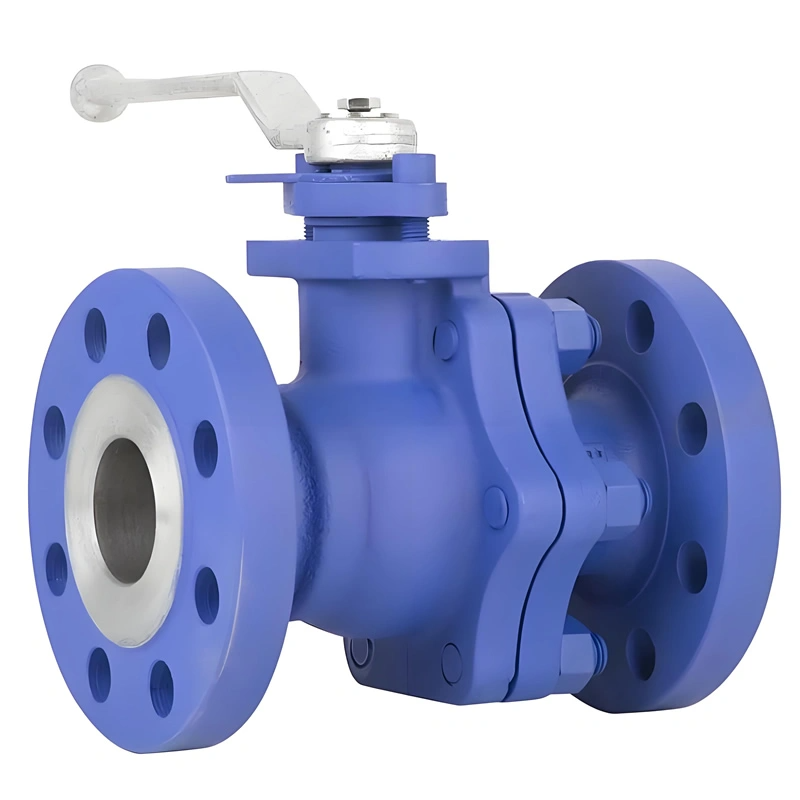
DN15~DN600 Class 150~900 PTFE/PFA/FEP Lined Stainless Steel Floating Ball Valve
I. Product Overview
II. Key Attribute Parameters
- Size Range: DN15~DN600 (1/2″~24″), covering small to large-diameter pipelines for diverse corrosive media applications.
- Pressure Range: Class 150~900 (2.0MPa~15.0MPa), adapting to low to high pressure systems such as chemical reactors and high-pressure solvent transfer lines.
- Temperature Range: -20℃~200℃ (depending on lining material), with PTFE suitable for general corrosives, PFA for higher temperatures, and FEP for enhanced flexibility.
- Material Configuration:
- Body: Cast steel (WCB), stainless steel (CF8/CF8M), or alloy steel (WC6)—providing structural strength while the lining isolates corrosive media.
- Lining: PTFE/PFA/FEP, forming a complete barrier between media and metal body to resist acids, alkalis, and organic solvents.
- Ball: Stainless steel (304/316) with fluoropolymer coating, ensuring smooth rotation and compatibility with lined seats.
- Stem: Stainless steel (316) with anti-blowout design, preventing ejection under pressure and resisting corrosion.
- Seat: Lined with PTFE/PFA, achieving tight shut-off and low friction for easy operation.
- Connection Type: Flange (per ASME B16.5) or Welding (per ASME B16.25), enabling secure integration with pipeline systems.
- Actuation: Manual (lever/worm), pneumatic, or electric—manual for simple on-off, automated options for remote or precise control.
- Design Standards: API 608, API 6D, ASME B16.34, ensuring compliance with global industrial and safety specifications.
Product Overview
III. Features Description
- Fluoropolymer Lining Corrosion Resistance: The PTFE/PFA/FEP lining forms a seamless barrier (thickness 2~3mm) that isolates the metal body from corrosive media. Chemically inert to 95% of industrial chemicals—including sulfuric acid, sodium hydroxide, and acetone—it eliminates metal corrosion, a common failure point in unlined valves.
- Floating Ball Design: The ball “floats” against the seat under media pressure, ensuring uniform sealing contact across the entire seat surface. This design adapts to minor pressure fluctuations, achieving ANSI/FCI Class VI leakage (near-zero) even in high-pressure (Class 900) applications.
- Anti-Blowout Stem: A one-piece stem with a retention shoulder prevents ejection under pressure, enhanced by PTFE packing that maintains sealing integrity without media contamination. This meets API safety standards for hazardous fluid handling.
- Versatile Actuation: Manual lever/worm operation for simple systems; pneumatic actuators for fast on-off in automated lines; electric actuators for precise throttling (0~90° rotation) in pharmaceutical or chemical dosing systems. All options integrate via ISO 5211 mounting pads.
- Fire-Safe Compliance: Optional fire-safe design (per API 607/6FA) ensures the valve maintains sealing after a fire, with metal backup seats preventing media release—a critical feature for petroleum and chemical plants.
IV. Manufacturing Processes
- Lining Preparation: Fluoropolymer resins (PTFE/PFA/FEP) are molded into liners matching the valve body’s internal shape. The lining is sintered (380℃~400℃ for PTFE) to achieve density ≥2.1g/cm³, ensuring no pores that could trap corrosive media.
- Body & Ball Machining: The metal body is sandblasted to roughen the surface, improving lining adhesion. The ball is precision-ground to Ra ≤0.8μm, then coated with fluoropolymer via electrostatic spraying for uniform thickness (0.1~0.2mm).
- Lining Integration: The sintered liner is inserted into the body and bonded using high-temperature adhesive, with pressure applied (5~10MPa) to ensure full contact. This prevents liner detachment under thermal expansion or pressure cycles.
- Assembly & Testing:
- Hydrostatic Test: Body tested at 1.5×rated pressure (water) for 30 minutes; seat tested at 1.1×rated pressure (air) to verify no leakage.
- Corrosion Test: Lined components immersed in 30% sulfuric acid for 72 hours—no lining damage or metal corrosion allowed.
- Operation Test: 1,000+ open/close cycles to confirm smooth ball rotation and consistent sealing, with special focus on low friction in manual operation.
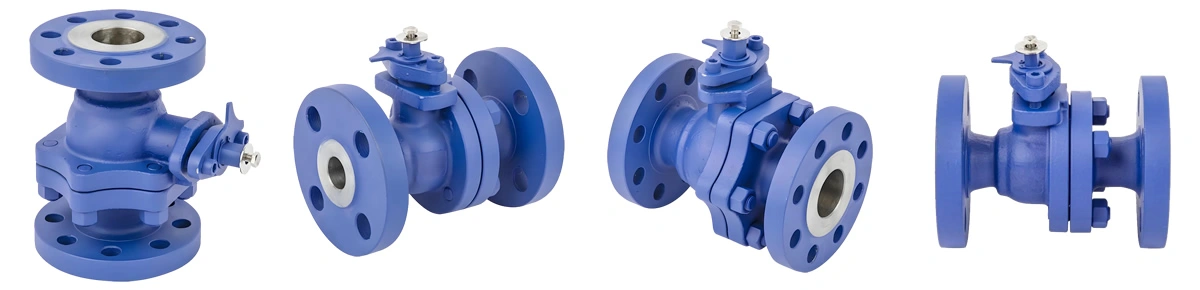
Valve Details
V. Product Advantages
- Superior Corrosion Protection: Fluoropolymer lining eliminates metal-media contact, extending valve life by 3~5 times compared to unlined stainless steel valves in corrosive applications.
- Tight & Reliable Sealing: Floating ball design and PTFE/PFA seats achieve Class VI leakage, preventing hazardous media escape in chemical and pharmaceutical systems.
- Low Maintenance: The lining’s non-stick surface resists media buildup, reducing cleaning frequency. Modular actuation allows easy replacement without removing the valve from the pipeline.
- Wide Compatibility: Handles diverse corrosive media (acids, alkalis, solvents) and adapts to pressure/temperature ranges, eliminating the need for multiple valve types in complex processes.
- Safety & Compliance: Anti-blowout stem, fire-safe options, and API/ASME compliance meet industrial safety standards, reducing accident risks in hazardous environments.
Application
VI. Application Fields
- Chemical Processing: Controls acids (nitric acid, hydrochloric acid), alkalis (sodium hydroxide), and solvents (acetone, methanol) in reaction, transfer, and storage systems—lining resists chemical attack.
- Petroleum & Refining: Manages corrosive by-products (amine solutions, sour gas) in desulfurization units, with stainless steel body and lining handling sulfur compounds.
- Pharmaceuticals: Regulates high-purity solvents and cleaning agents, with PTFE lining meeting FDA standards for non-toxicity and avoiding product contamination.
- Water Treatment: Handles chlorinated water, wastewater with heavy metals, and chemical disinfectants—preventing valve corrosion from chlorine and contaminants.
- Electroplating: Controls plating solutions (acidic electrolytes, metal salts) in coating lines, where corrosion resistance ensures consistent process quality.
RELATED
-
API 602 ASME B16.34 GB/T 12235 CE DN65 PN25 WCB Flanged Cast Carbon Steel Manual Handwheel Operated, with F6a Stem & LNT+13Cr Globe Valve
I. Product Description & Key Specifications A. Core Compliance & Identification The TIANYU Cast Carbon Steel Globe Valve is a precision-engine…
GLOBE VALVE 05/15/2026 -
API 602 ASME B16.34 CE 4″ 300LB Carbon Steel WCB Flanged Angle Type Manual Bellows Seal Globe Valve
I. Product Description & Key Specifications A. Core Identification & Compliance This TIANYU Bellows Seal Globe Valve is engineered to meet the…
Bellow Seal Globe Valve 04/20/2026 -
API 609 ASME B16.34 CE DN100 150LB WCB Body Cr13 Seat Wafer Type Metal Hard Seal Single Plate Check Valve
API 609 ASME B16.34 CE DN100 150LB WCB Body Cr13 Seat Wafer Type Metal Hard Seal Single Plate Check Valve Product Overview In modern industrial fluid …
CHECK VALVE 04/16/2026 -
API 6D ASME B16.34 API 607 CE 4” 150LB A105 Carbon Steel Body PTFE Soft Seated RF Flanged Floating Ball Valve
I. Product Overview & Core Specifications The TIANYU 4” 150LB floating ball valve stands as a precision-engineered, cost-effective fluid control s…
BALL VALVE 04/16/2026 -
API 6D ASME B16.34 API 607 CE 3” 1500LB F22 Alloy Steel Body 304 Stainless Steel Seat Hard Seated RF Flanged Gear Operated Double Block and Bleed (DBB) Trunnion Mounted Ball Valve
API 6D ASME B16.34 API 607 CE NACE MR0175 Certified 3” 1500LB F22 Alloy Steel Body 304 Stainless Steel Seat Hard Seated RF Flanged Gear Operated Doubl…
BALL VALVE 04/05/2026 -
ANSI 150LB Stainless Steel 304 316 JIS 10K Pn10-16 WCB Hard Sealing Worm Wheel Three Eccentric Wafer Butterfly Valve Industrial Water & Eccentric Wafer Type
High – Performance ANSI 150LB Stainless Steel 304/316 Valve by TIANYU: A Comprehensive Guide I. Title Incorporating Key Attributes “ANSI 1…
BUTTERFLY VALVE 04/02/2026


