
Specification
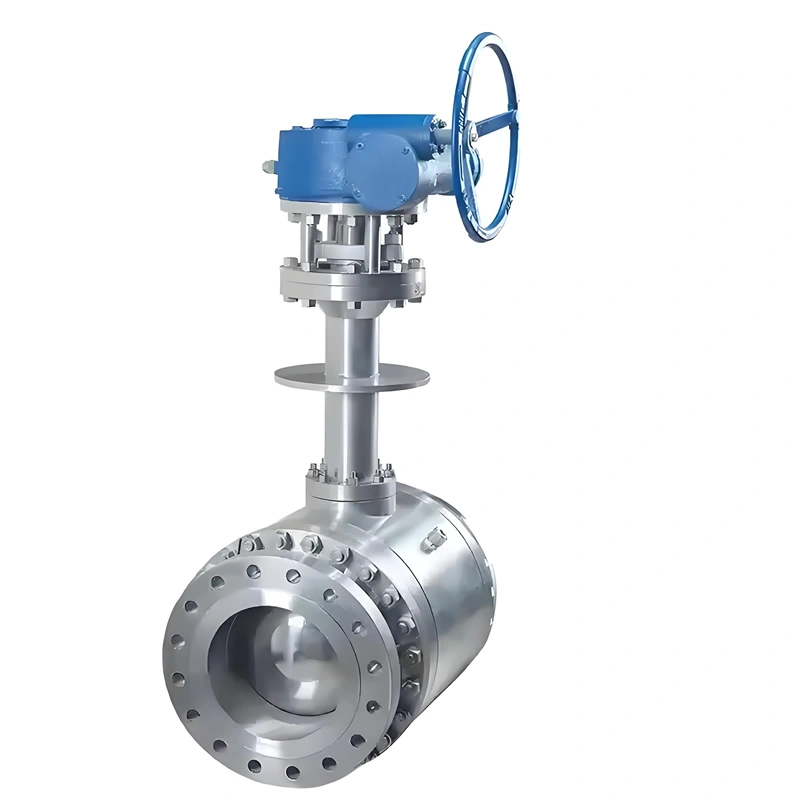
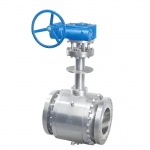
API DN300 Class 300 F316 Metal Seal Manual Three-Piece Cryogenics Temperature Trunnion Mounted Ball Valve
I. Product Overview
II. Key Attribute Parameters
- Size: DN300 (12″), optimized for large-diameter cryogenic pipelines requiring high flow capacity and robust pressure handling.
- Pressure Rating: Class 300 (5.0MPa), engineered to withstand high pressure in systems like LNG transfer lines and high-pressure cryogenic storage loops.
- Temperature Range: -196℃ ~ 150℃, validated for stable operation in extreme cryogenic conditions (liquid nitrogen, LNG) to moderate high temperatures (heated gases).
- Material Configuration:
- Body & Bonnet: F316 stainless steel (ASTM A182), a molybdenum-alloyed grade (Cr16-18%, Ni10-14%, Mo2-3%) resisting corrosion from chlorides, acids, and cryogenic media.
- Ball & Trunnions: F316 with Stellite coating (hardness 55-60HRC), enhancing wear resistance and low-temperature toughness.
- Seal: Metal-to-metal hard seal with cryogenic alloy coating, maintaining elasticity at -196℃ to prevent leakage.
- Stem: F316 with anti-blowout design, ensuring safety under high pressure and resisting cold-induced brittleness.
- Connection Type: Flanged (RF/RTJ per ASME B16.5), enabling leak-tight integration with cryogenic pipeline flanges.
- Actuation: Manual (handwheel with gearbox), reducing operating torque for smooth 90° rotation in large-diameter valves.
- Design Standards: API 6D, API 608, ISO 17292, ensuring compliance with global pipeline and cryogenic valve specifications.
Product Overview
III. Features Description
- Three-Piece Structure: The valve body is divided into three detachable sections (two end caps + middle section), allowing in-line maintenance of internal components (ball, seats, stem) without removing the valve from the pipeline. This reduces downtime in critical systems like LNG transfer lines, where shutdowns are costly.
- Trunnion Mounted Ball: The ball is supported by upper and lower trunnions, distributing pressure evenly to prevent seat extrusion under Class 300 pressure. This design eliminates “ball floating”—a common issue in high-differential-pressure systems—ensuring stable sealing even with fluctuating cryogenic media flow.
- Cryogenic Metal Seal: The metal-to-metal seal is coated with a low-temperature alloy (e.g., nickel-chromium-molybdenum) to retain elasticity at -196℃, avoiding brittleness that causes leakage in standard metal seals. Precision lapping (Ra ≤0.4μm) ensures uniform contact, achieving ANSI/FCI Class VI leakage (near-zero) in cryogenic service.
- F316 Corrosion Resistance: Molybdenum in F316 resists pitting and crevice corrosion from seawater (offshore LNG terminals) and acidic cryogens (e.g., liquid CO₂), eliminating rust-related failures and extending service life in harsh environments.
- Manual Gear Actuation: The gearbox reduces operating torque by 50%, enabling one-person operation of 12″ valves. A position indicator provides clear open/close feedback, critical for precise control in LNG loading/unloading operations.
IV. Manufacturing Processes
- Material Validation: F316 forgings undergo ultrasonic testing to detect internal defects. Charpy impact tests at -196℃ verify toughness (≥27J), ensuring resistance to cold-induced fracture. Spectral analysis confirms alloy composition to guarantee corrosion resistance.
- Three-Piece Machining: CNC lathes precision-machine body sections to tight tolerances (±0.05mm), ensuring seamless alignment when bolted. Flange faces are finished per ASME B16.5 to ensure leak-tight gasket sealing.
- Trunnion & Ball Finishing: Trunnions are ground to concentricity with the ball (±0.02mm) to minimize friction. The ball’s sealing surface is lapped with the seat under cryogenic conditions (-196℃) to simulate real-world operation, ensuring uniform contact at extreme cold.
- Seal Coating Application: The metal seal is plasma-sprayed with cryogenic alloy (100-150μm thickness), then polished to Ra ≤0.8μm to enhance sealing efficiency. This coating retains flexibility at -196℃, preventing cracking during thermal cycling.
- Testing:
- Hydrostatic Test: Body tested at 1.5×Class 300 (7.5MPa) for 30 minutes; seats tested at 1.1×Class 300 (5.5MPa) with water.
- Cryogenic Immersion Test: Valve submerged in liquid nitrogen (-196℃) for 2 hours, then operated to confirm seal integrity and smooth rotation.
- Leakage Test: Helium leak detection at -196℃ verifies rate ≤1×10⁻⁹ Pa·m³/s, meeting cryogenic safety standards.
Valve Details
V. Product Advantages
- Extreme Cryogenic Reliability: Operates at -196℃ without brittleness, outperforming standard stainless steel valves in LNG, liquid nitrogen, and liquid oxygen systems.
- In-Line Maintenance: Three-piece design allows component replacement without pipeline removal, reducing downtime by 60% compared to one-piece valves in critical cryogenic loops.
- High-Pressure Stability: Trunnion mounting prevents seat extrusion under Class 300 pressure, ensuring consistent sealing in fluctuating flow environments (e.g., LNG tank filling).
- Corrosion Resistance: F316 with molybdenum resists harsh media, extending service life by 30% in coastal or chemical cryogenic applications.
- API Compliance: Meets API 6D/608 standards, including fire-safe performance (API 6FA), ensuring compatibility with global oil & gas and cryogenic projects.
Application
VI. Application Fields
- LNG Infrastructure: Controls LNG transfer between storage tanks, trucks, and ships, withstanding -162℃ (LNG boiling point) and high transfer pressures.
- Cryogenic Processing: Regulates liquid nitrogen, oxygen, and argon in medical, metallurgical, and food freezing systems, ensuring precise flow control at extreme cold.
- Chemical Industry: Manages low-temperature reactants (e.g., liquid CO₂, refrigerants) in pharmaceutical and specialty chemical production, leveraging F316’s corrosion resistance.
- Natural Gas Processing: Handles cryogenically cooled natural gas in fractionation plants, where high pressure and low temperatures require robust sealing.
- Energy Sector: Used in LNG-fired power plants to control fuel flow from storage to combustion systems, withstanding temperature swings from -162℃ to 150℃.
RELATED
-
API 602 ASME B16.34 GB/T 12235 CE DN65 PN25 WCB Flanged Cast Carbon Steel Manual Handwheel Operated, with F6a Stem & LNT+13Cr Globe Valve
I. Product Description & Key Specifications A. Core Compliance & Identification The TIANYU Cast Carbon Steel Globe Valve is a precision-engine…
GLOBE VALVE 05/15/2026 -
API 602 ASME B16.34 CE 4″ 300LB Carbon Steel WCB Flanged Angle Type Manual Bellows Seal Globe Valve
I. Product Description & Key Specifications A. Core Identification & Compliance This TIANYU Bellows Seal Globe Valve is engineered to meet the…
Bellow Seal Globe Valve 04/20/2026 -
API 609 ASME B16.34 CE DN100 150LB WCB Body Cr13 Seat Wafer Type Metal Hard Seal Single Plate Check Valve
API 609 ASME B16.34 CE DN100 150LB WCB Body Cr13 Seat Wafer Type Metal Hard Seal Single Plate Check Valve Product Overview In modern industrial fluid …
CHECK VALVE 04/16/2026 -
API 6D ASME B16.34 API 607 CE 4” 150LB A105 Carbon Steel Body PTFE Soft Seated RF Flanged Floating Ball Valve
I. Product Overview & Core Specifications The TIANYU 4” 150LB floating ball valve stands as a precision-engineered, cost-effective fluid control s…
BALL VALVE 04/16/2026 -
API 6D ASME B16.34 API 607 CE 3” 1500LB F22 Alloy Steel Body 304 Stainless Steel Seat Hard Seated RF Flanged Gear Operated Double Block and Bleed (DBB) Trunnion Mounted Ball Valve
API 6D ASME B16.34 API 607 CE NACE MR0175 Certified 3” 1500LB F22 Alloy Steel Body 304 Stainless Steel Seat Hard Seated RF Flanged Gear Operated Doubl…
BALL VALVE 04/05/2026 -
ANSI 150LB Stainless Steel 304 316 JIS 10K Pn10-16 WCB Hard Sealing Worm Wheel Three Eccentric Wafer Butterfly Valve Industrial Water & Eccentric Wafer Type
High – Performance ANSI 150LB Stainless Steel 304/316 Valve by TIANYU: A Comprehensive Guide I. Title Incorporating Key Attributes “ANSI 1…
BUTTERFLY VALVE 04/02/2026


