
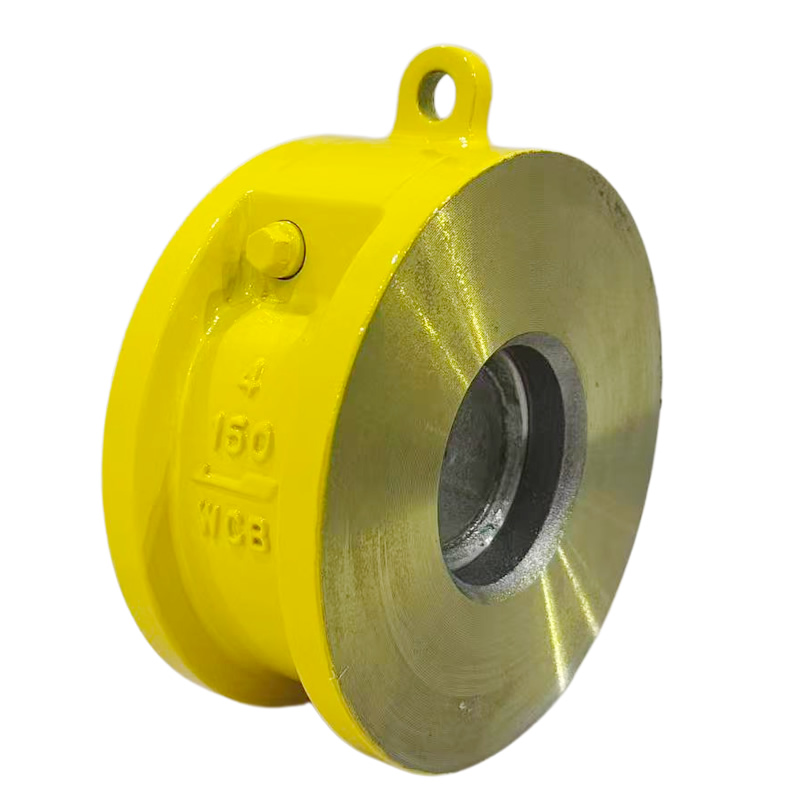
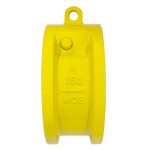
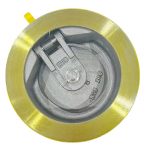
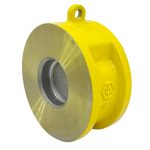
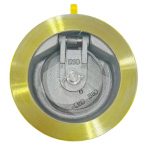
API 609 ASME B16.34 CE DN100 150LB WCB Body Cr13 Seat Wafer Type Metal Hard Seal Single Plate Check Valve
Product Overview
I. Core Design Standards & Performance Specifications
1.1 Design & Manufacturing Standards
- API 609: Standard for Lug- and Wafer-Type Butterfly Valves and Check Valves, governing structural design, pressure ratings, and performance requirements for wafer-style check valves.
- ASME B16.34: Valves – Flanged, Threaded, and Welding End, defining pressure-temperature ratings, material requirements, and dimensional tolerances for industrial valves.
- ASME B16.10: Face-to-Face and End-to-End Dimensions of Valves, standardizing the valve’s axial length for universal compatibility with pipeline flanges.
- API 598: Valve Inspection and Testing, mandating 100% shell and seat leakage testing for all production units.
- EU CE Directives: Compliance with pressure equipment safety standards for market access in the European Economic Area.
1.2 Dimensional & Pressure Specifications
- Nominal Size (DN): DN100 (standard industrial medium-flow size, balancing flow capacity and installation footprint for most process pipelines).
- Pressure Class: 150LB (ASME B16.34 Class 150), with a maximum allowable working pressure of 2.07 MPa at ambient temperature, suitable for medium-pressure industrial fluid systems.
- Face-to-Face Dimension: Compliant with ASME B16.10, ensuring interchangeability with equivalent valves from global manufacturers.
- Connection Type: Wafer-style, designed for installation between two ANSI/ASME or DIN standard pipeline flanges, eliminating the need for integral valve flanges.
1.3 Material Specifications
- Valve Body: WCB (ASTM A216 Grade WCB) cast carbon steel, the industry-standard material for industrial valves, offering:
- Tensile strength: 485–655 MPa
- Yield strength: ≥250 MPa
- Operating temperature range: -29°C to 425°C
- Excellent castability, structural rigidity, and compatibility with non-corrosive/weakly corrosive media (water, steam, oil, natural gas).
- Valve Seat & Disc: Cr13 (13% chromium martensitic stainless steel), selected for:
- Hardness: HRC 40–45 (after quenching and tempering)
- Superior wear, erosion, and high-temperature resistance
- Thermal expansion coefficient closely matched to WCB, preventing seal gap formation during thermal cycling
- Good corrosion resistance in mild industrial environments.
- Internal Components: 304 stainless steel pins and springs, for corrosion resistance and long-term mechanical reliability.
1.4 Sealing & Operational Performance
- Sealing Type: Metal-to-metal hard seal, with precision-ground sealing surfaces (Ra ≤ 0.8 μm) to achieve zero leakage per API 598 requirements.
- Closing Response Time: ≤0.5 seconds, to minimize reverse flow and water hammer risk.
- Leakage Rate: <0.1% of nominal flow rate, meeting API 598 zero-leakage standards for metal-seated check valves.
- Operation Mode: Automatic, self-actuated by medium flow and pressure, requiring no external power or manual intervention.
- Durability: 100,000+ open-close cycles with <0.1 mm sealing surface wear, ensuring 8+ years of service life under normal operating conditions.


II. Manufacturing Process & Product Advantages
2.1 Precision Manufacturing Process
- Precision Casting: WCB valve bodies are produced via investment (lost-wax) precision casting, achieving dimensional tolerances of ±0.5 mm and smooth internal flow channels to reduce pressure drop.
- Stress Relief Annealing: Castings are annealed at 600–650°C to eliminate residual stress, preventing long-term deformation or cracking under pressure and thermal cycling.
- Non-Destructive Testing (NDT): All castings undergo 100% magnetic particle testing (MT) and ultrasonic testing (UT) to detect porosity, inclusions, or cracks, ensuring structural integrity.
- CNC Machining: Critical sealing surfaces, mounting faces, and bores are machined on 5-axis CNC centers, achieving IT7-grade precision and controlling sealing surface parallelism to within 0.02 mm.
- Heat Treatment: Cr13 seats and discs are quenched at 1000–1050°C and tempered at 600–650°C to form a tempered martensitic structure, optimizing hardness, toughness, and wear resistance.
- Precision Grinding: Sealing surfaces are lapped and ground to Ra ≤ 0.8 μm, ensuring perfect metal-to-metal contact for zero-leakage sealing.
- Assembly & Testing: Valves are assembled with controlled clearances (≤0.05 mm) to ensure smooth disc operation, then tested per API 598:
- Shell pressure test: 1.5x nominal pressure (3.1 MPa for 150LB)
- Seat leakage test: 1.1x nominal pressure (2.28 MPa for 150LB)
- 10,000-cycle durability test to validate long-term performance.
- Surface Coating: Valve bodies are coated with 80–100 μm thick epoxy zinc-rich primer, providing 500+ hours of salt spray resistance for corrosion protection in harsh environments.
2.2 Key Product Advantages
A. Compact, Space-Saving Wafer Design
B. Superior Hard-Seal Performance for High-Temperature/High-Flow Conditions
- High-Temperature Resistance: Stable sealing up to 425°C, suitable for steam and hot oil applications where soft seals would degrade.
- Erosion Resistance: Hardened Cr13 sealing surfaces resist wear from high-flow, particle-laden media, extending service life by 2–3x compared to soft-seat valves.
- Thermal Stability: Matched thermal expansion between WCB body and Cr13 seat maintains seal integrity during rapid temperature fluctuations, preventing leakage in thermal cycling applications.
C. Fast Closing & Water Hammer Mitigation
D. Low Maintenance & High Reliability
E. Global Standard Compliance & Interchangeability
III. Application Fields
3.1 Oil & Gas Industry
- Upstream: Crude oil gathering pipelines, wellhead manifolds, and natural gas transmission lines, preventing reverse flow to protect pumps and compressors.
- Midstream: Pipeline transmission systems, storage terminal loading/unloading lines, and LNG regasification facilities.
- Downstream: Refinery process units (distillation, catalytic cracking), product storage, and distribution pipelines, withstanding high-temperature, high-pressure hydrocarbon media.
3.2 Petrochemical & Chemical Industry
- Process Pipelines: Chemical reactor feed lines, distillation columns, and heat exchanger circuits, preventing backflow of corrosive process fluids and maintaining process pressure stability.
- Utility Systems: Steam, cooling water, and compressed air lines, withstanding thermal cycling and chemical exposure.
3.3 Power Generation Industry
- Thermal Power Plants: Boiler feedwater lines, steam distribution networks, condensate return systems, and cooling water circuits, preventing reverse flow of high-temperature steam to protect boilers and turbines.
- Combined Cycle Plants: Gas turbine cooling systems and heat recovery steam generator (HRSG) pipelines.
- Nuclear Power Plants: Auxiliary steam and cooling water systems (for non-safety-related applications).
3.4 Metallurgical Industry
- Steel Mills: Blast furnace cooling water systems, continuous casting machine hydraulic lines, and gas transmission pipelines, resisting high-temperature, high-impurity media and thermal cycling.
- Non-Ferrous Metal Processing: Smelting furnace cooling systems and process fluid lines.
3.5 Water Treatment & Municipal Engineering
- Water Supply Networks: Potable water transmission lines, pumping stations, and elevated storage tanks, preventing backflow contamination.
- Wastewater Treatment: Sewage lift stations, sludge processing lines, and reclaimed water distribution systems.
- Desalination Plants: Seawater intake and reverse osmosis (RO) product water lines, with corrosion-resistant coating for saltwater environments.
3.6 Marine & Offshore Engineering
- Shipboard Systems: Main engine fuel lines, seawater cooling systems, and steam lines, with compact design for limited shipboard space and marine-grade corrosion protection.
- Offshore Platforms: Oil and gas gathering lines, process utility systems, and firewater pipelines, withstanding harsh offshore environments and platform vibration.
3.7 General Industrial Applications
- HVAC Systems: Commercial and industrial steam heating systems, hot water circulation lines.
- Pulp & Paper Mills: Process water lines, steam lines for paper drying.
- Food & Beverage: Clean steam lines for sanitary processing (with food-grade coating options).
IV. Conclusion
RELATED
-
API 602 ASME B16.34 CE 4″ 300LB Carbon Steel WCB Flanged Angle Type Manual Bellows Seal Globe Valve
I. Product Description & Key Specifications A. Core Identification & Compliance This TIANYU Bellows Seal Globe Valve is engineered to meet the…
-
API 6D ASME B16.34 API 607 CE 4” 150LB A105 Carbon Steel Body PTFE Soft Seated RF Flanged Floating Ball Valve
I. Product Overview & Core Specifications The TIANYU 4” 150LB floating ball valve stands as a precision-engineered, cost-effective fluid control s…
-
API 6D ASME B16.34 API 607 CE 3” 1500LB F22 Alloy Steel Body 304 Stainless Steel Seat Hard Seated RF Flanged Gear Operated Double Block and Bleed (DBB) Trunnion Mounted Ball Valve
API 6D ASME B16.34 API 607 CE NACE MR0175 Certified 3” 1500LB F22 Alloy Steel Body 304 Stainless Steel Seat Hard Seated RF Flanged Gear Operated Doubl…
-
ANSI 150LB Stainless Steel 304 316 JIS 10K Pn10-16 WCB Hard Sealing Worm Wheel Three Eccentric Wafer Butterfly Valve Industrial Water & Eccentric Wafer Type
High – Performance ANSI 150LB Stainless Steel 304/316 Valve by TIANYU: A Comprehensive Guide I. Title Incorporating Key Attributes “ANSI 1…
-
API 6D ASME B16.34 CE DN400 PN80 LF2 Carbon Steel Body 321 Stainless Steel Ball Full Welded Manual Light Stem Hard Seated Ball Valve
I. Product Overview & Core Specifications The TIANYU full welded ball valve stands as a high-performance fluid control component engineered for cr…
-
API 6D ASME B16.34 CE 2” 600LB A105 Carbon Steel Body DEVLON Soft Seated RF Flanged Connection Manual Handle DBB Double Block and Bleed Ball Valve
I. Product Overview & Core Specifications The TIANYU DBB double block and bleed ball valve is a precision-engineered fluid control solution purpos…