
Specification
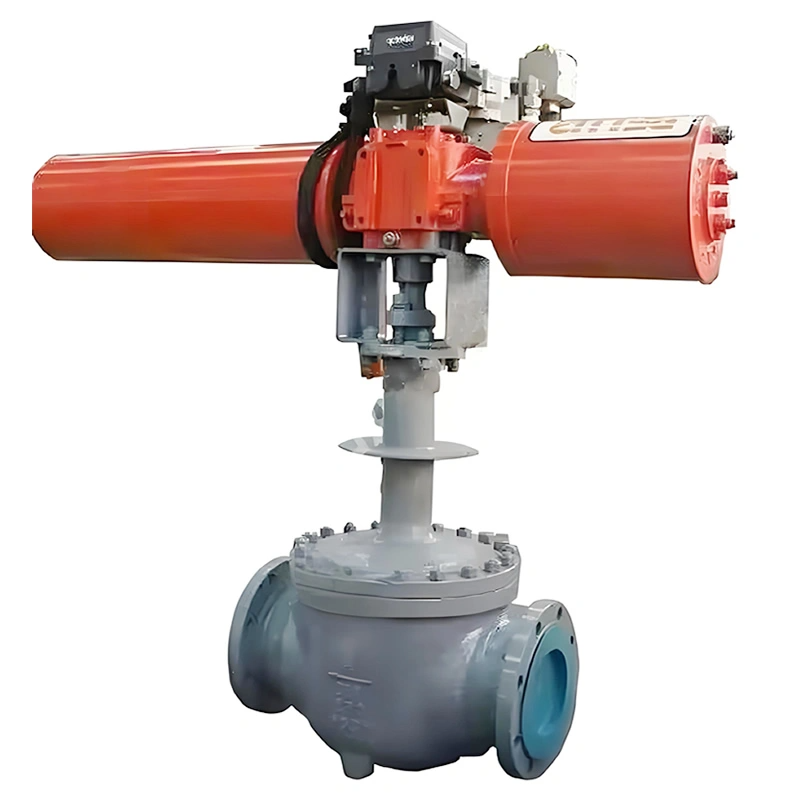
TIANYU DN500 900LB Pneumatic Cryogenic Top Entry Ball Valve: API 6D-Compliant Solution for Extreme Low-Temperature Industrial Flow Control
I. Product Overview
II. Key Attribute Specifications
A. Dimensional and Pressure Parameters
- Nominal Diameter: DN500 (20-inch), catering to large-flow pipeline requirements in industrial cryogenic systems. In LNG transfer applications, a DN500 valve can handle flow rates exceeding 1000 m³/h, ensuring efficient media distribution.
- Pressure Rating: 900LB (equivalent to Class 900, approximately 15.5MPa working pressure), compliant with high-pressure cryogenic storage and transportation systems. This rating ensures the valve can withstand the rigorous pressure demands of LNG terminals and large-scale air separation units.
- Temperature Range: Engineered to operate continuously between -196℃ (boiling point of liquid nitrogen) and 100℃. Special thermal insulation layers are integrated to minimize cold energy loss and prevent external moisture condensation on the valve surface, maintaining operational stability in extreme temperature differentials.
B. Material Composition
- Valve Body and Ball:
- For standard cryogenic applications, low-temperature carbon steel (ASTM A352 LCB) is used, offering exceptional toughness at sub-zero temperatures. LCB steel undergoes quenching and tempering to achieve a Charpy impact energy of ≥27J at -46℃, preventing cold brittleness.
- In corrosive cryogenic environments (e.g., LNG with high sulfur content), stainless steel (ASTM A351 CF8M/316L) is employed. Its molybdenum content enhances resistance to pitting and crevice corrosion, ensuring longevity in aggressive media.
- Sealing Components:
- Primary seals utilize polytetrafluoroethylene (PTFE) with spring pre-loading. PTFE retains elasticity at low temperatures and exhibits low friction, ensuring a reliable seal despite thermal contraction.
- For high-pressure cryogenic scenarios, metal-to-metal seals (e.g., Inconel 625 coating) are available, withstanding high pressure differentials and offering superior wear resistance.
C. Structural and Operational Features
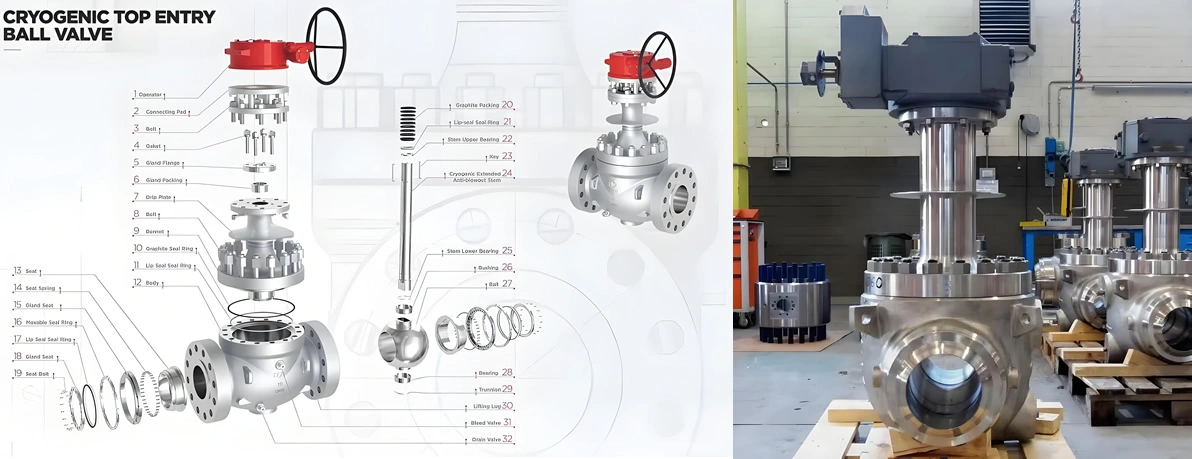
- Top-Entry Design: The valve body features a top-mounted access flange, allowing internal components (ball, stem, seals) to be removed and replaced without disconnecting pipeline flanges. This design reduces maintenance downtime by over 50% compared to side-entry valves, critical for minimizing production losses in continuous-process industries.
- Stem Sealing: A multi-layer sealing structure combines graphite packing and O-rings, preventing cryogenic media leakage and external air ingress. This design maintains the low-temperature environment inside the valve and ensures operational safety.
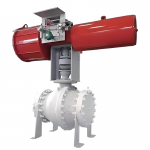
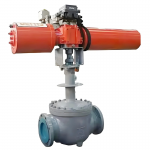
- Actuation: Equipped with a pneumatic actuator (double-acting or spring-return), enabling rapid 90° rotation for quick flow adjustment. For safety-critical applications (e.g., LNG emergency shutdown), spring-return actuators provide fail-safe closure upon air supply loss.
- The Cryogenic Top-Entry Ball Valve, as an important on/off component in the cryogenic pipeline system, is an important part of the petrochemical industry, air separation, and natural gas industry. The structure of Top-Entry Ball Valve can realize online maintenance, and is suitable for low-temperature liquid or gas media, such as liquefied natural gas (LNG), liquefied petroleum gas (LPG), liquid hydrogen, liquid oxygen, ethylene and other conditions. Compared with the Side-Entry ball valve under the same conditions, Top-Entry Ball Valve is more convenient to maintain with a wider scope of application, and is more common.
Size:NPS1/2″~56″
Temperature: -196°C~550°C
Pressure:Class 150~Class 2,500
Materials:Carbon Steel, Stainless Steel, Duplex, Inconel, Monel, Bronze, Titanium Alloy
Standard:AP16DBS 5351ASME B1634SO17292
Face to Face: ASME B16.10API6D
End Connection:ASME B16.5ASME B1647,ASME B1625ASME B16.11
Test Standard: ISO 5208,API6DAPI598
Operators:Manual, Worm Gear, Electric Actuator, Pneumatic Actuator
Product Overview
III. Feature Description
A. Top-Entry Design for Efficient Maintenance
B. Cryogenic-Resistant Sealing Technology
- Primary Seal: PTFE with spring pre-load compensates for thermal contraction, maintaining continuous contact between the seal and ball. In -196℃ testing, this seal achieves a leakage rate of <1×10⁻⁶ cm³/s, far below API 6D requirements.
- Secondary Metal Backup Seal: Activates in extreme scenarios (e.g., fire or seal degradation), preventing catastrophic media release. This redundancy ensures safety in high-risk environments such as LNG processing plants.
C. API 6D Compliance and Safety Assurance
- Pressure Testing: Hydrostatic testing at 1.5× rated pressure (23.25MPa for 900LB) and pneumatic testing at 1.1× rated pressure verify structural integrity.
- Cryogenic Performance Testing: The valve is cooled to -196℃ using liquid nitrogen, subjected to 100+ open/close cycles to validate operational stability.
- Fire-Safe Design (Optional): API 607-certified variants use metal backup seals and graphite packing to maintain temporary sealing during fire exposure, reducing explosion risks in flammable cryogenic applications.
D. Material Toughness at Low Temperatures
- LCB Steel: Quenching and tempering refine the grain structure, enhancing impact toughness. At -46℃, Charpy impact energy exceeds 40J (vs. 27J standard), preventing brittle failure.
- 316L Stainless Steel: Molybdenum content (2-3%) resists pitting in chloride-rich environments (e.g., wet LNG), while maintaining toughness at -196℃.
IV. Manufacturing Processes
A. Low-Temperature Material Processing
- Heat Treatment of LCB Steel: Valve bodies and balls undergo quenching (890-920℃, water-cooled) and tempering (600-650℃, air-cooled) to eliminate internal stresses and optimize microstructure for low-temperature toughness.
- Cold Working of Stainless Steel: 316L components undergo cold extrusion to enhance surface hardness and dimensional accuracy, followed by solution annealing (1050-1100℃) to restore corrosion resistance.
B. Precision Machining of Top-Entry Structure
- Valve Body Machining: 5-axis CNC machines shape the top-entry flange and internal flow channels, with flatness tolerance <0.05mm to ensure bonnet sealing.
- Ball and Stem Assembly: The ball and stem are connected via spline or keyway, with coaxiality tolerance ≤0.02mm to ensure smooth rotation and uniform seat contact.
- Seal Surface Lapping: Ball and seat sealing surfaces are lapped to Ra ≤0.8μm, ensuring tight sealing under high-pressure, low-temperature conditions.
C. Cryogenic Testing and Validation
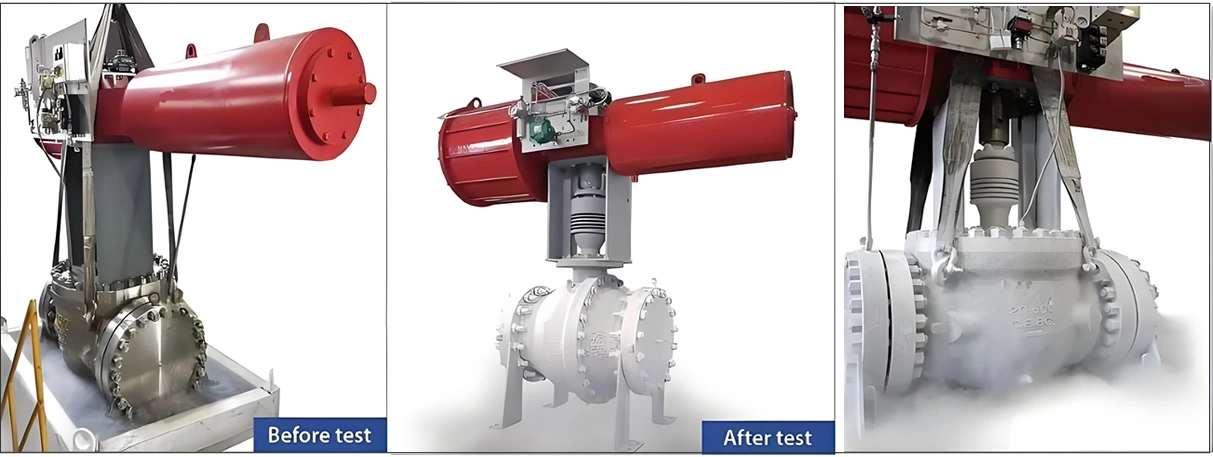
- Deep-Cooling Treatment: Assembled valves are immersed in liquid nitrogen (-196℃) for 4 hours to simulate extreme conditions, detecting material defects or structural deformations.
- Leakage Testing: Helium mass spectrometry measures leakage rates <5×10⁻¹⁰ Pa·m³/s, meeting strict cryogenic sealing demands.
- Cycle Testing: 1000+ open/close cycles at -196℃ verify seal durability and actuator reliability.
Valve Details
V. Product Advantages
A. Uninterrupted Operation in Cryogenic Environments
B. Efficient Maintenance with Top-Entry Design
C. API Certification for Global Compliance
D. Enhanced Safety with Fire-Safe Options
Application
VI. Product Applications
A. LNG Industry
- LNG Receiving Terminals: Controls LNG unloading and distribution on storage tank outlets and unloading arms. The top-entry design ensures rapid maintenance, while cryogenic sealing prevents LNG leakage.
- LNG Transportation Pipelines: Regulates flow in medium- to high-pressure LNG pipelines, withstanding pressure fluctuations and ensuring safe media transport.
B. Air Separation Equipment
- Liquid Oxygen/Nitrogen Systems: Manages flow in air separation units, with LCB steel and reliable sealing ensuring product purity and system stability.
- Cold Box Pipelines: Operates in ultra-low-temperature cold boxes, withstanding frequent flow adjustments and maintaining separation process efficiency.
C. Low-Temperature Chemical Engineering
- Refrigerant Handling: Controls cryogenic refrigerants (ethylene, propylene) in chemical plants, with 316L stainless steel resisting corrosion and ensuring refrigeration system efficiency.
- Low-Temperature Reaction Processes: Regulates material feeding in -100℃ hydrogenation reactors, with precise flow control maintaining reaction stability.
D. Energy and Storage
- Cryogenic Energy Storage: Manages liquid air charging/discharging in energy storage systems, with top-entry design and cryogenic performance supporting long-term operation.
- Aerospace Propellant Systems: Controls liquid hydrogen/oxygen flow in ground test facilities, with strict leakage control ensuring test safety.
RELATED
-
API 602 ASME B16.34 GB/T 12235 CE DN65 PN25 WCB Flanged Cast Carbon Steel Manual Handwheel Operated, with F6a Stem & LNT+13Cr Globe Valve
I. Product Description & Key Specifications A. Core Compliance & Identification The TIANYU Cast Carbon Steel Globe Valve is a precision-engine…
GLOBE VALVE 05/15/2026 -
API 602 ASME B16.34 CE 4″ 300LB Carbon Steel WCB Flanged Angle Type Manual Bellows Seal Globe Valve
I. Product Description & Key Specifications A. Core Identification & Compliance This TIANYU Bellows Seal Globe Valve is engineered to meet the…
Bellow Seal Globe Valve 04/20/2026 -
API 609 ASME B16.34 CE DN100 150LB WCB Body Cr13 Seat Wafer Type Metal Hard Seal Single Plate Check Valve
API 609 ASME B16.34 CE DN100 150LB WCB Body Cr13 Seat Wafer Type Metal Hard Seal Single Plate Check Valve Product Overview In modern industrial fluid …
CHECK VALVE 04/16/2026 -
API 6D ASME B16.34 API 607 CE 4” 150LB A105 Carbon Steel Body PTFE Soft Seated RF Flanged Floating Ball Valve
I. Product Overview & Core Specifications The TIANYU 4” 150LB floating ball valve stands as a precision-engineered, cost-effective fluid control s…
BALL VALVE 04/16/2026 -
API 6D ASME B16.34 API 607 CE 3” 1500LB F22 Alloy Steel Body 304 Stainless Steel Seat Hard Seated RF Flanged Gear Operated Double Block and Bleed (DBB) Trunnion Mounted Ball Valve
API 6D ASME B16.34 API 607 CE NACE MR0175 Certified 3” 1500LB F22 Alloy Steel Body 304 Stainless Steel Seat Hard Seated RF Flanged Gear Operated Doubl…
BALL VALVE 04/05/2026 -
ANSI 150LB Stainless Steel 304 316 JIS 10K Pn10-16 WCB Hard Sealing Worm Wheel Three Eccentric Wafer Butterfly Valve Industrial Water & Eccentric Wafer Type
High – Performance ANSI 150LB Stainless Steel 304/316 Valve by TIANYU: A Comprehensive Guide I. Title Incorporating Key Attributes “ANSI 1…
BUTTERFLY VALVE 04/02/2026


