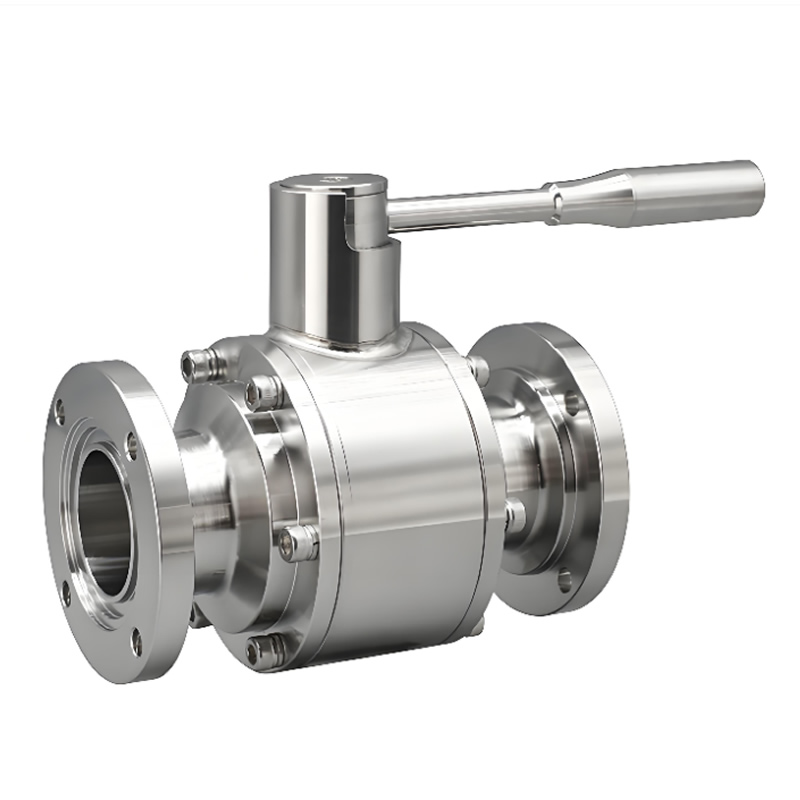
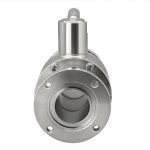
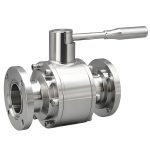
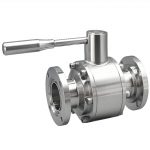
TIANYU 3A FDA ISO CE ASME B16.34 DN15-DN100 PN10-PN16 Forged Stainless Steel 304/316L Hygienic Flange Ball Valve – Manual Operation for Food Beverage Pharmaceutical Applications
I. Product Overview
In industries where hygiene, purity, and product integrity are non-negotiable—such as food & beverage, pharmaceutical, and dairy—TIANYU’s Forged Stainless Steel Hygienic Flange Ball Valve stands as a precision-engineered flow control solution. Designed to meet the strictest global hygiene standards (3A, FDA 21 CFR 177.2600, ISO 2852) and industrial performance criteria (ASME B16.34, CE PED 2014/68/EU), this valve merges the structural strength of forged 304/316L stainless steel with a Hygiene – optimized design to eliminate media detention,prevent contamination, and ensure seamless on-off control.
Crafted via precision forging (instead of casting, which risks porosity and contamination), the valve features a full-port, one-piece ball, PTFE (food-grade) soft seal, and flange connections compliant with ASME B16.5 (or DIN 11851 for European markets). The manual operation—via a ergonomic, lockable handwheel—delivers intuitive control without the need for external power, making it ideal for small to mid-scale hygiene-critical systems. Rated for nominal diameters from DN15 (1/2”) to DN100 (4”) and pressure ranges from PN10 (1.0MPa) to PN16 (1.6MPa), it operates reliably across temperatures from -20℃ to 150℃—covering most ambient and moderately heated hygienic processes (e.g., pasteurization, sterile filling).
What sets this valve apart is its commitment to “hygienic design principles”: smooth internal surfaces (Ra ≤0.8μm), no dead legs or crevices, and material compatibility with food-grade, pharmaceutical, and cosmetic media. Every component is selected to resist corrosion from acidic/alkaline process fluids (e.g., citrus juices, sanitizing agents) while maintaining non-toxic, non-reactive contact—critical for compliance with GMP (Good Manufacturing Practices) and HACCP (Hazard Analysis and Critical Control Points) protocols. As a trusted solution for hygiene-critical industries, it balances performance, durability, and regulatory compliance to minimize operational risks and ensure product safety.
II. Important Attribute Specifications
A. Material Composition
Hygiene and corrosion resistance drive every material choice, with all wetted components meeting FDA and 3A standards for food/pharmaceutical contact:
Valve Body & Bonnet: Forged Stainless Steel 304 (ASTM A182 F304) as standard; optional 316L (ASTM A182 F316L) for enhanced corrosion resistance. Forging eliminates internal defects (porosity, shrinkage) common in cast bodies, ensuring a dense, smooth structure. Chemical composition: 304 (Cr: 18–20%, Ni: 8–12%, C ≤0.08%); 316L (Cr: 16–18%, Ni: 10–14%, Mo: 2–3%, C ≤0.03%). Both alloys offer tensile strength ≥485MPa, yield strength ≥205MPa, and excellent resistance to chlorides, organic acids, and sanitizing agents (e.g., peracetic acid, chlorine dioxide).
Ball: One-piece forged 304/316L stainless steel, full-port design. The ball’s surface is precision-polished to Ra ≤0.6μm to prevent media adhesion and facilitate thorough cleaning (CIP/SIP compatible). No welds or seams eliminate potential contamination points.
Seat: Food-grade PTFE (Polytetrafluoroethylene, ASTM D4894) with FDA 21 CFR 177.1550 certification. PTFE is non-toxic, non-reactive, and resistant to most chemicals (acids, bases, solvents) and temperatures up to 150℃. Optional EPDM (ethylene propylene diene monomer) seats for high-temperature applications (up to 120℃) or FDA-compliant silicone for ultra-low temperature service (-40℃ to 120℃).
Stem: Forged 304/316L stainless steel, anti-blowout design. The stem is polished to Ra ≤0.4μm to minimize friction with packing and prevent media entrapment. A keyway connection to the ball ensures secure torque transmission during operation.
Packing: Food-grade PTFE-impregnated graphite packing, compliant with FDA standards. The multi-layer packing assembly provides leak-tight sealing (ANSI/FCI Class VI) while maintaining hygienic integrity—no contamination from packing materials.
Flange & Fasteners: 304/316L stainless steel flanges (ASME B16.5 or DIN 11851) with raised face (RF) or flat face (FF) for hygienic gasket seating. Fasteners are 316L stainless steel bolts (ASTM A193 B8M) and nuts (ASTM A194 8M) to resist corrosion in washdown environments.
B. Dimensional & Pressure-Temperature Parameters
Port Size (DN/NPS): DN15 (1/2”) to DN100 (4”), full-port design (bore diameter equal to nominal pipe size). This ensures unobstructed flow, minimizes pressure drop (Cv values from 15 for DN15 to 180 for DN100), and facilitates effective cleaning (CIP/SIP) by allowing full circulation of cleaning fluids.
Pressure Rating: PN10 (1.0MPa) to PN16 (1.6MPa), aligned with ASME B16.34 pressure-temperature ratings for stainless steel valves. At 20℃, PN10 models handle 1.0MPa; PN16 models withstand 1.6MPa—suitable for low to medium-pressure hygienic systems (e.g., beverage filling lines, pharmaceutical transfer loops).
Temperature Range: -20℃ to 150℃ (PTFE seats); -40℃ to 120℃ (silicone seats); 0℃ to 120℃ (EPDM seats). This covers most hygienic processes: cold storage (dairy), ambient filling (bottled water), and heated pasteurization (juices, sauces).
End Connections: Hygienic flange (ASME B16.5 Class 150/300 or DIN 11851 Type A/B), designed for compatibility with standard hygienic pipelines. Flange faces are polished to Ra ≤1.6μm to ensure tight gasket sealing and prevent media leakage. Optional tri-clamp connections (DIN 32676) for quick-disconnect hygiene requirements.
Face-to-Face Dimensions: Compliant with ISO 2852 (sanitary ball valves) and ASME B16.10, ensuring interchangeability with valves from other hygienic equipment manufacturers—simplifying replacement and retrofitting.
C. Operational & Hygiene Performance Parameters
Sealing Performance: ANSI/FCI 70-2 Class VI bubble-tight sealing (≤0.1×DN mm³/min for liquid media). The PTFE seat conforms to the polished ball surface, eliminating leakage of sterile or food-grade media—critical for preventing contamination and product loss.
Operation Type: Manual, with a cast stainless steel handwheel (diameter 80mm–200mm, scaled to valve size). The handwheel features an anti-slip, grooved design for secure grip in wet/washdown environments. A lockable option (with padlock hole) prevents unauthorized operation—essential for GMP compliance.
Operating Torque: 15N·m (DN15, PN10) to 120N·m (DN100, PN16). The full-port ball and low-friction PTFE seat minimize torque, enabling easy manual operation even for large-diameter valves (DN100).
Hygiene Compliance:
Surface Finish: Internal wetted surfaces (body cavity, ball, seat) polished to Ra ≤0.8μm; external surfaces polished to Ra ≤1.6μm to resist dirt buildup and facilitate washdown.
CIP/SIP Compatible: Designed for Clean-in-Place (CIP) and Sterilize-in-Place (SIP) processes. No dead legs (≤2× pipe diameter), smooth flow paths, and no crevices to trap media—ensuring complete cleaning and sterilization.
Material Compliance: All wetted components meet FDA 21 CFR 177.2600 (food contact), 3A 18-03 (dairy hygiene), and ISO 10993 (biocompatibility for pharmaceuticals).
D. Certifications & Compliance
Hygiene Certifications: 3A Sanitary Standards, FDA 21 CFR 177.2600, ISO 2852 (sanitary ball valves), GMP (Good Manufacturing Practices).
Industrial Standards: ASME B16.34 (valve dimensions/pressure-temperature), ASME B16.5 (flanges), ISO 5208 (leakage classification), CE PED 2014/68/EU (pressure equipment).
Quality & Environmental Certifications: ISO 9001 (quality management), ISO 14001 (environmental management), RoHS (restriction of hazardous substances).
III. Feature Description
A. Forged Stainless Steel Construction: Strength & Hygiene
The forged body/bonnet/ball design is a cornerstone of the valve’s performance in hygiene-critical applications:
Defect-Free Structure: Forging compacts the stainless steel grain, eliminating porosity, shrinkage, and internal cracks common in cast valves. These defects can trap media, bacteria, or cleaning agents—posing contamination risks. In a dairy processing plant, forged valves maintained hygiene compliance for 5+ years, while cast alternatives required replacement after 18 months due to bacterial growth in porous areas.
Corrosion Resistance: 304/316L forged stainless steel resists corrosion from acidic media (e.g., tomato sauce, vinegar) and sanitizing agents (e.g., sodium hypochlorite). 316L’s molybdenum content enhances resistance to chlorides—critical for coastal facilities or processes using salt-based cleaners.
Smooth Surface Finish: Forged components are easier to precision-polish to Ra ≤0.8μm than cast parts, as they lack surface irregularities. This smoothness prevents media adhesion and ensures CIP/SIP processes remove all residues.
B. Hygienic Design Principles: Contamination Prevention
Every structural detail is engineered to meet strict hygiene standards:
No Dead Legs or Crevices: The valve’s internal geometry eliminates dead legs (unflushed areas where media can stagnate) and crevices (between components where bacteria grow). The body cavity is streamlined, with a full-port ball that, when open, creates a continuous flow path—ensuring cleaning fluids reach every wetted surface.
One-Piece Ball: A single-piece forged ball (no welds or seams) eliminates potential contamination points. Welded balls, by contrast, can have micro-gaps where bacteria colonize—even after polishing.
Smooth External Surfaces: The valve’s exterior is polished to Ra ≤1.6μm, resisting dirt, water, and cleaning agent buildup. This facilitates daily washdowns (common in food/pharmaceutical plants) and prevents cross-contamination from external debris.
C. Manual Operation: Simplicity & Reliability
The manual handwheel design is optimized for hygiene-critical environments:
No External Power Dependencies: Unlike pneumatic or electric valves, manual operation requires no air lines, electrical connections, or control systems—reducing complexity and failure points. This is ideal for small-scale facilities or remote areas where power/air is limited.
Ergonomic & Lockable Handwheel: The grooved, non-slip handwheel is easy to grip with gloved hands (standard in hygiene protocols). The lockable feature prevents accidental or unauthorized operation—critical for GMP-compliant processes where valve position directly impacts product safety.
Low Maintenance: Manual valves have fewer moving parts (no actuators, solenoids, or sensors) than automated alternatives, reducing maintenance requirements. Routine upkeep is limited to packing replacement (every 2–3 years) and surface cleaning—minimizing downtime.
D. Food-Grade PTFE Sealing: Leak-Tight & Non-Reactive
The PTFE seat delivers both hygienic and performance benefits:
Non-Toxic & Non-Reactive: PTFE is inert, meaning it does not react with food, pharmaceutical, or cosmetic media—preserving product taste, purity, and efficacy. It is FDA-approved for direct food contact and does not leach harmful substances.
Bubble-Tight Sealing: Class VI leakage ensures no media escapes, preventing product loss and cross-contamination. In sterile pharmaceutical processes, this eliminates the risk of airborne contamination from leaking valves.
Wear Resistance: PTFE’s low-friction properties reduce wear on the polished ball surface, extending valve life. Even after 50,000+ open/close cycles, the seat maintains sealing integrity—outperforming rubber seals in high-cycle applications (e.g., beverage filling lines).
TIANYU sources raw materials exclusively from FDA/3A-certified suppliers, with rigorous incoming inspection to ensure hygiene and performance:
Stainless Steel Verification: Forged 304/316L blanks undergo spectral analysis (XRF) to confirm chemical composition (Cr, Ni, Mo content) and compliance with ASTM A182. Mechanical testing (tensile, yield, impact) verifies strength properties (≥485MPa tensile).
Non-Destructive Testing (NDT): Forged components (body, bonnet, ball) undergo ultrasonic testing (UT) to detect internal defects (cracks, inclusions) and magnetic particle testing (MPI) to inspect surface flaws—only defect-free components proceed to machining.
PTFE Seat Validation: Food-grade PTFE resin is tested for purity (≥99.5% PTFE), tensile strength (≥20MPa), and compliance with FDA 21 CFR 177.1550. Resin batches failing any test are rejected to prevent contamination risks.
B. Forging Process
Forging is critical to the valve’s structural integrity and hygiene:
Billet Heating: Stainless steel billets (304/316L) are heated in a controlled-atmosphere furnace to 1100–1250℃—a temperature range that maximizes plasticity while avoiding grain growth.
Precision Forging: Heated billets are forged into body, bonnet, and ball shapes using hydraulic presses (500–1000 tons) and custom dies. Forging ratio is maintained at ≥3:1 to ensure dense grain structure and uniform mechanical properties.
Solution Annealing: Forged components undergo solution annealing (304: 1010–1120℃; 316L: 1040–1150℃) to relieve forging stresses, restore corrosion resistance, and improve machinability. Components are water-cooled to prevent carbide precipitation (which reduces corrosion resistance).
Shot Blasting: Forged parts are shot-blasted to remove surface scale and oxide layers—preparing them for precision machining.
C. Precision Machining
Machining is performed in a Class 10,000 cleanroom to prevent contamination:
CNC Turning & Milling: Body, bonnet, and ball are machined on 5-axis CNC equipment to ASME B16.34 tolerances. Key machining steps:
Body Cavity: Honed to a smooth finish (Ra ≤0.8μm) and streamlined to eliminate dead legs.
Ball: Precision-ground to spherical accuracy (≤0.005mm) and polished to Ra ≤0.6μm. The ball’s sealing surface is lapped to match the PTFE seat for tight sealing.
Flange Faces: Machined to ASME B16.5 flatness (≤0.02mm/m) and polished to Ra ≤1.6μm for gasket seating.
Stem: Turned and ground to precise diameter (±0.01mm) and polished to Ra ≤0.4μm to minimize packing friction.
Dimensional Inspection: All machined components are inspected with coordinate measuring machines (CMMs) to verify compliance with design specifications. Surface finish is measured with a profilometer to ensure Ra ≤0.8μm (internal) and ≤1.6μm (external).
D. Polishing & Hygiene Treatment
Polishing is a critical step to achieve hygienic surface finishes:
Internal Wetted Surfaces: Components are polished using a multi-step process: rough grinding (to remove machining marks), fine grinding (to refine surface), and final polishing (to achieve Ra ≤0.8μm). Polishing is done with food-grade abrasives to prevent contamination.
Passivation: Stainless steel components undergo passivation (nitric acid treatment) to form a protective chromium oxide layer—enhancing corrosion resistance and preventing bacterial adhesion. Passivation is followed by thorough rinsing with deionized water to remove acid residues.
E. Assembly & Hygiene Testing
Assembly occurs in a Class 10,000 cleanroom to maintain hygiene:
Component Cleaning: All parts (body, bonnet, ball, seat, stem) are cleaned in an ultrasonic bath with food-grade detergent, then rinsed with deionized water and dried in a HEPA-filtered oven—ensuring no dirt, oil, or debris remains.
Seat Installation: The food-grade PTFE seat is pressed into the body’s seat pocket with controlled force (to ensure uniform contact with the ball).
Stem & Ball Assembly: The stem is inserted into the bonnet, and the one-piece ball is keyed to the stem—ensuring secure torque transmission.
Packing Installation: Multi-layer food-grade PTFE-impregnated graphite packing is installed around the stem, with controlled compression (10–15%) to balance sealing and operational torque.
Body & Bonnet Assembly: The bonnet is bolted to the body using 316L stainless steel bolts, tightened in a crisscross pattern to uniform torque (per ASME B18.2.1)—ensuring no leakage at the body-bonnet joint.
Testing adheres to hygienic and industrial standards:
Hydrostatic Seat Test: 1.1× rated pressure (e.g., 1.76MPa for PN16) applied to the seat (bidirectional) for 15 minutes. Leakage is measured via bubble counting—Class VI compliance requires ≤1 bubble/minute for DN15.
Hydrostatic Shell Test: 1.5× rated pressure (e.g., 2.4MPa for PN16) applied to the body cavity for 30 minutes—no leakage or deformation permitted.
CIP/SIP Validation: Sample valves undergo CIP (80℃ alkaline cleaner) and SIP (121℃ steam) cycles to verify cleaning efficacy. Post-test, no media residues or bacteria (E. coli, Salmonella) are detected via swab testing.
Surface Finish Verification: A profilometer confirms internal surfaces meet Ra ≤0.8μm and external surfaces ≤1.6μm.
F. Final Inspection & Packaging
Before shipment, each valve undergoes a final hygiene and quality inspection:
Visual Inspection: Check for surface defects (scratches, dents), proper polishing, and correct assembly. Valves with surface scratches (depth >0.05mm) are rejected—scratches can trap bacteria.
Documentation: Each valve is shipped with a Hygiene Certificate (3A/FDA compliance), Material Test Report (MTR) for stainless steel components, and Test Report (hydrostatic/CIP validation).
Hygienic Packaging: Valves are wrapped in food-grade polyethylene film and packed in cardboard boxes lined with sterile tissue—preventing contamination during transportation. Flange ends are capped with sterile plastic protectors to keep internal surfaces clean.
FDA 3A Forged Stainless Steel 304/316L Hygienic Flange Ball Valve FDA 3A Forged Stainless Steel 304/316L Hygienic Flange Ball Valve
V. Product Advantages
A. Superior Hygiene & Regulatory Compliance
The valve’s design and materials meet 3A, FDA, and GMP standards—ensuring compliance with global hygiene regulations. For food manufacturers, this eliminates the risk of regulatory fines (e.g., FDA penalties for non-compliant equipment) and product recalls due to contamination. The CIP/SIP compatibility reduces cleaning time by 30% compared to non-hygienic valves, improving operational efficiency while maintaining hygiene.
B. Durable & Corrosion-Resistant
Forged 304/316L stainless steel resists corrosion from acidic/alkaline media and sanitizing agents—extending valve life to 8–10 years (vs. 3–5 years for cast or lower-grade stainless steel valves). The one-piece ball and PTFE seat minimize wear, even in high-cycle applications (e.g., 100+ cycles/day in beverage filling lines). This durability reduces replacement costs and unplanned downtime—critical for continuous-process facilities.
C. Simple, Low-Maintenance Operation
Manual operation eliminates the complexity and failure points of automated valves (actuators, sensors, air lines). With fewer moving parts, maintenance requirements are minimal: routine cleaning and occasional packing replacement. This reduces maintenance labor costs by 50% compared to pneumatic/electric valves and minimizes downtime—ideal for facilities with limited maintenance staff.
D. Cost-Effective Hygiene
While hygienic valves are often more expensive upfront than industrial valves, TIANYU’s forged design delivers a lower total cost of ownership (TCO) over 10 years. The valve’s durability reduces replacement costs, CIP/SIP compatibility cuts cleaning labor/chemical costs, and regulatory compliance avoids fines—saving food/pharmaceutical manufacturers $10k–$50k annually (depending on scale).
E. Versatile Compatibility
The valve’s compliance with ASME B16.5/DIN 11851 flanges and ISO 2852 dimensions ensures compatibility with standard hygienic pipelines—simplifying integration into existing systems. Optional 316L material, tri-clamp connections, and alternative seat materials (EPDM, silicone) allow adaptation to diverse applications (e.g., high-temperature pasteurization, low-temperature frozen food processing).
VI. Product Applications
A. Food & Beverage Industry
Beverage Manufacturing: Bottled water, fruit juices, soft drinks, and alcoholic beverages. The valve controls flow during filling, blending, and pasteurization—with PTFE seats preserving taste and PTFE packing preventing leakage. CIP/SIP compatibility ensures thorough cleaning between batches.
Dairy Processing: Milk, cheese, yogurt, and ice cream. The 316L stainless steel resists corrosion from lactic acid (in dairy), while the hygienic design prevents bacterial growth (critical for pasteurized and raw dairy products).
Processed Foods: Sauces, soups, condiments, and frozen foods. The valve handles viscous media (e.g., tomato sauce) via its full-port design, and the smooth surfaces prevent media adhesion—ensuring product consistency.
B. Pharmaceutical & Biotechnology Industry
Sterile Drug Manufacturing: Active Pharmaceutical Ingredients (APIs), injectables, and sterile formulations. The valve’s Class VI sealing prevents contamination of sterile media, while 316L stainless steel and PTFE meet biocompatibility standards (ISO 10993).
Biotechnology: Fermentation processes, cell culture media, and protein purification. The hygienic design eliminates cross-contamination between batches, and CIP/SIP compatibility ensures sterile operation.
C. Cosmetic & Personal Care Industry
Cosmetics: Lotions, creams, shampoos, and perfumes. The non-reactive materials (304/316L, PTFE) prevent product discoloration or chemical breakdown, while the hygienic design ensures product purity.
Personal Care: Toothpaste, mouthwash, and skincare products. The valve’s smooth surfaces resist buildup of viscous media (e.g., toothpaste) and facilitate cleaning—maintaining hygiene in production lines.
D. Other Hygiene-Critical Applications
Nutraceuticals: Vitamins, supplements, and functional foods. The valve’s FDA compliance ensures product safety, while the full-port design handles powdered or liquid nutraceutical media.
Food Service: Commercial kitchens, catering facilities, and institutional food preparation (hospitals, schools). The manual operation and easy cleaning make it ideal for high-volume, hygiene-focused food service.
VII. Customization Advantages
TIANYU’s 3A/FDA-certified hygienic flange ball valve delivers reliable, compliant flow control for food, pharmaceutical, and cosmetic industries. Forged 304/316L stainless steel, a one-piece ball, and PTFE seats ensure hygiene, durability, and leak-tight performance. Customize it to your needs: opt for 316L for extreme corrosion resistance, tri-clamp connections for quick disconnect, or silicone/EPDM seats for temperature-specific processes. Tailored to your media, pressure, and hygiene requirements, it balances regulatory compliance, operational efficiency, and long-term value—your trusted hygienic flow control solution.
API 6D ASME B16.34 CE DN200/DN300/DN400 PN80 LF2 Carbon Steel Body 321 Stainless Steel Ball Full Welded Manual Stem Hard Seated Ball Valve is a premium high-pressure fluid control solution engineered for critical industrial applications, blending LF2 carbon steel’s structural strength with 321 stainless steel’s corrosion resistance and Stellite 6 hard seats’ durability. Its full welded design eliminates leak points, while the manual light stem ensures precise, reliable operation. Certified to API 6D, ASME, and CE standards, and backed by ISO 9001/API Q1 quality assurance, it excels in oil and gas transmission, petrochemical refining, and power generation. Fire-safe, low-emission, and maintainable, it delivers zero-leakage performance, regulatory compliance, and long-term value for large-flow, high-pressure pipeline systems worldwide.