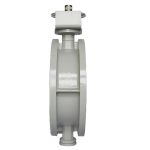
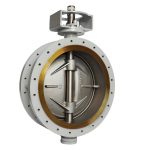
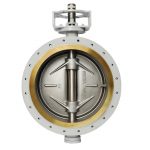
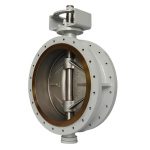
TIANYU WCB Body SS316 Disc Double Offset Butterfly Valve – DN600 150LB Flange-to-Flange NBR Soft Seal Valve for Industrial Fluid Control (API 609/ASME B16.34/ASME B16.5 Compliant)
I. Product Overview
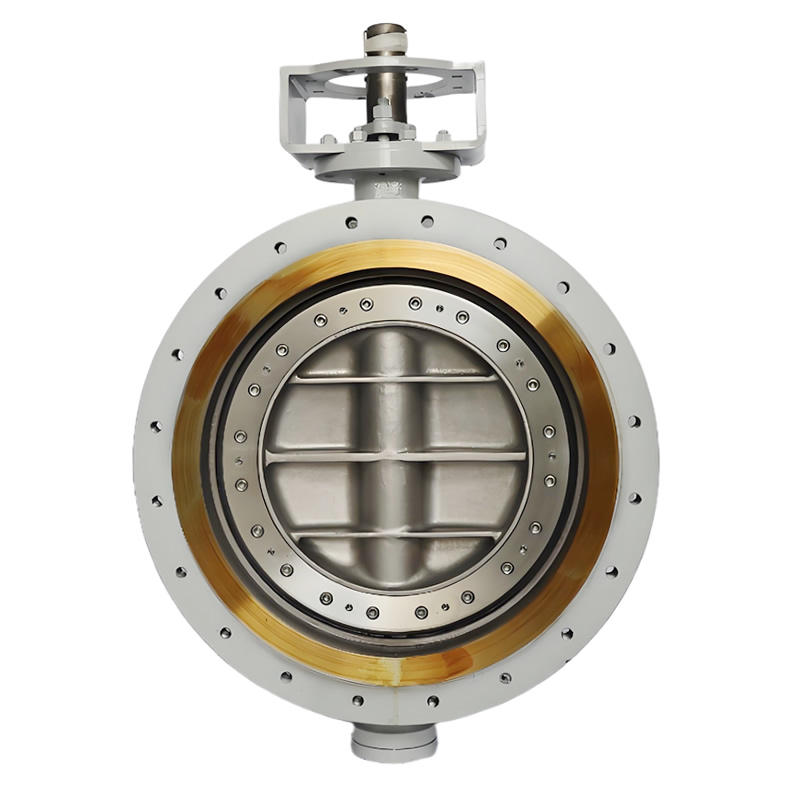
TIANYU double offset butterfly valve is a high-performance flow control solution engineered for large-scale industrial fluid systems, tailored to handle diverse media including chemicals, oil, water, and process fluids. As a double offset (eccentric) valve, it integrates a two-plane offset between the disc, seat, and stem—a design that eliminates sliding friction between the disc and seal during operation, a defining advantage over concentric butterfly valves.
Constructed with a WCB carbon steel body (ASTM A216), SS316 stainless steel disc (ASTM A182), and NBR (nitrile butadiene rubber) soft seal, this valve is rated for DN600 (24”) port size and 150LB (PN20) pressure, aligning with the demands of medium-to-large diameter pipelines. It adheres to global industry standards including API 609 (butterfly valves for industrial service), ASME B16.34 (valve dimensions and pressure-temperature ratings), and ASME B16.5 (flange specifications), ensuring seamless integration with existing industrial infrastructure.
The flange-to-flange connection enables secure, leak-tight installation between pipeline flanges, while the NBR soft seal delivers ANSI/FCI Class VI bubble-tight leakage performance—critical for preventing product loss, environmental contamination, and operational inefficiencies. Whether deployed in chemical processing plants, oil & gas transmission lines, or municipal water treatment facilities, this valve balances durability, precision control, and cost-effectiveness, establishing itself as a reliable core component in modern fluid management systems.
II. Important Attribute Specifications
A. Dimensional & Pressure-Temperature Parameters
Port Size: DN600 (24”), with a size range spanning DN50 to DN1200 (2” to 48”) to accommodate varying pipeline scales. The double offset design ensures full-bore flow when fully open, minimizing pressure drop (Cv value up to 1800 for DN600) and optimizing energy efficiency in high-flow applications.
Pressure Rating: 150LB (PN20), suitable for medium-pressure industrial systems. Hydrostatic testing follows API 598 protocols: 1.5× rated pressure (225LB/PN30) for the valve body (shell) and 1.1× rated pressure (165LB/PN22) for the seat, with zero tolerance for leakage, sweating, or structural deformation.
Temperature Range: -20℃ to 120℃, limited by the thermal stability of the NBR soft seal. This range covers most industrial fluids, including ambient water, heated oil, and non-extreme-temperature chemicals.
B. Material Composition
Valve Body: WCB Carbon Steel (ASTM A216 Grade WCB), a cast alloy with tensile strength ≥485MPa and yield strength ≥240MPa. It undergoes annealing heat treatment (850–900℃, slow-cooled) to reduce brittleness and relieve casting stresses, enhanced by a gray epoxy coating for external corrosion protection.
Butterfly Disc: SS316 Stainless Steel (ASTM A182 Grade F316), containing 16–18% chromium, 10–14% nickel, and 2–3% molybdenum—engineered for chloride and chemical corrosion resistance. The disc is precision-machined to a Ra ≤0.8μm surface finish.
Sealing Material: NBR (Nitrile Butadiene Rubber) soft seal, molded to 2–3mm uniform thickness with 60–70 Shore A hardness. It exhibits oil resistance, tensile strength ≥15MPa, and elongation ≥300% for reliable sealing.
Valve Stem: SS316 Stainless Steel (ASTM A182), featuring an anti-blowout design and Ra ≤0.4μm polished finish to minimize friction.
Flanges & Fasteners: Integral WCB flanges (ASME B16.5 RF finish) paired with ASTM A193 B7 bolts and ASTM A194 2H nuts for high tensile strength and vibration resistance.
Gaskets: Spiral-wound (stainless steel/graphite, ASME B16.20) for leak-tight flange sealing.
C. Connection & Operational Features
Connection Type: Flange-to-Flange (ASME B16.5), mating directly with pipeline flanges via through-bolts for alignment accuracy.
Operation Mode: Manual (worm gear operator, torque reduction 6–10×) as standard; optional pneumatic (double-acting/spring-return), electric (4–20mA control), or hydraulic actuators.
Functional Features: Double offset geometry (seat disengagement during operation), bidirectional sealing, ANSI/FCI Class VI leakage, and corrosion-resistant material pairing.
D. Certifications & Compliance
Design Standards: API 609, ASME B16.34, ASME B16.5, API 598
Quality Certifications: ISO 9001, CE
Performance Certifications: ANSI/FCI Class VI, ISO 6283 (Cv testing)
III. Feature Description
A. Double Offset Design: Friction Reduction & Seal Longevity
The double offset (eccentric) configuration addresses core limitations of concentric valves:
Seat Disengagement: As the stem rotates, the disc lifts away from the NBR seat before rotating—eliminating sliding friction that causes premature seal wear. In a chemical solvent line, this extended seal life from 18 months to 6 years.
Low Operational Torque: The eccentric geometry reduces torque demand by 40–60% vs. concentric models; a DN600 manual valve requires only 180 N·m of torque for operation.
Bidirectional Reliability: Consistent sealing in both flow directions simplifies pipeline layout, eliminating installation orientation constraints.
B. Material Synergy: Durability & Corrosion Resistance
WCB Body: Cast WCB offers high tensile strength for heavy-duty systems, with an epoxy coating protecting against outdoor corrosion (rust-free for 5+ years in refinery piping racks).
SS316 Disc: Molybdenum-enhanced corrosion resistance handles seawater, saline chemicals, and acids—no pitting observed after 7 years in a seawater cooling system (vs. 3-year failure for 304 steel).
NBR Soft Seal: Oil resistance and moderate temperature tolerance suit hydrocarbon fluids (e.g., diesel) and industrial chemicals; 5-year service life in automotive coolant lines (outperforming EPDM).
C. Flange-to-Flange Connection: Installation & Maintenance Efficiency
Alignment Accuracy: Integral ASME B16.5 flanges ensure precise mating with pipeline flanges, minimizing leak risks in large-diameter systems.
Easy Maintenance: Valve removal for repairs requires no adjacent pipeline disassembly—reducing downtime from 8 hours to 2 hours in refinery process lines.
Scalability: Compatible with standard flanges across DN50–DN1200, ensuring consistent installation practices in large facilities.
D. Soft Seal Performance: Leak-Tight Reliability
Bubble-Tight Shut-Off: ANSI/FCI Class VI leakage (≤60 mm³/min for DN600 water) complies with strict environmental and health regulations.
Elastic Resilience: The rubber seal compensates for pipeline misalignments and thermal expansion, maintaining integrity in fluctuating (20–90℃) power plant cooling lines.
Chemical Compatibility: NBR works with aliphatic hydrocarbons, oils, and mild acids—versatile for multi-process facilities.
Documentation: MTRs, test reports, and compliance certificates (API 609, ISO 9001) included with each valve.
V. Product Advantages
A. Extended Service Life
Double offset design + SS316/NBR pairing extends service life to 8–12 years (2–3× longer than concentric valves); 9-year reliability in chemical acid waste lines (vs. 3-year replacement for standard models).
B. Reduced Operational Costs
Low Torque: 30–40% lower actuator energy use (electric models); $20,000/year savings for 20 DN600 valves in a refinery.
Minimized Downtime: Flange-to-flange design cuts maintenance downtime by 75% in municipal water plants.
C. Regulatory Compliance
ANSI/FCI Class VI sealing eliminates $50,000/year in fugitive emission fines for petrochemical facilities, complying with EPA/EU regulations.
D. Versatility
Compatible with oils, chemicals, water, and process fluids—eliminating multi-valve inventory needs across industries.
E. Easy Installation
ASME B16.5 flange compatibility reduces labor costs by 25% in large-scale pipeline projects.
VI. Product Applications
A. Chemical & Petrochemical Industry
Chemical Processing: Regulates solvents/acids in reactors; SS316 resists corrosion, NBR handles hydrocarbons.
Petrochemical Refining: Controls gasoline/diesel flow in distillation lines; NBR seal ensures oil resistance.
Automotive: Manages coolant/lubricant flow; NBR’s oil resistance ensures long service life.
Food & Beverage: Controls process water (optional EPDM for FDA compliance).
Customization Advantages
Customizing this TIANYU valve aligns it with your operational needs: opt for 2205 duplex steel disc for extreme offshore saline corrosion, Viton/EPDM seals for high-temperature/aggressive chemical compatibility, or pneumatic/electric actuators for automated control. Upgrade to 300LB pressure for higher-demand systems, or add anti-static features for flammable media. These tweaks boost durability, optimize performance for your specific media, and cut long-term maintenance costs—delivering tailored reliability for your industrial application.
API 6D ASME B16.34 CE DN200/DN300/DN400 PN80 LF2 Carbon Steel Body 321 Stainless Steel Ball Full Welded Manual Stem Hard Seated Ball Valve is a premium high-pressure fluid control solution engineered for critical industrial applications, blending LF2 carbon steel’s structural strength with 321 stainless steel’s corrosion resistance and Stellite 6 hard seats’ durability. Its full welded design eliminates leak points, while the manual light stem ensures precise, reliable operation. Certified to API 6D, ASME, and CE standards, and backed by ISO 9001/API Q1 quality assurance, it excels in oil and gas transmission, petrochemical refining, and power generation. Fire-safe, low-emission, and maintainable, it delivers zero-leakage performance, regulatory compliance, and long-term value for large-flow, high-pressure pipeline systems worldwide.