
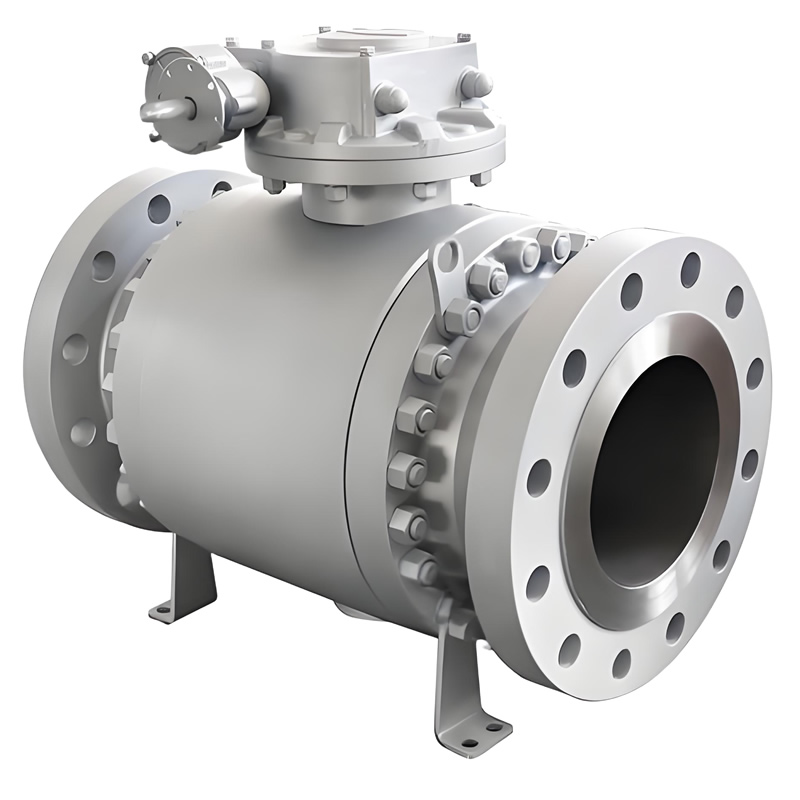
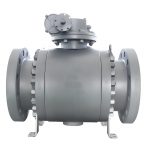
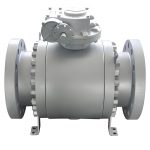
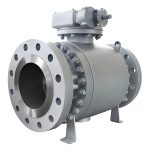
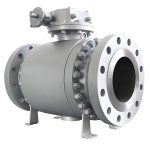
API 6D API 609 ASME B16.34 CE Certified DN15-DN300 150lb-2500lb Forged Steel A105 Full Port 3PC Flange Trunnion Mounted Ball Valve with Fire-Safe & Anti-Static Design
I. Product Overview
II. Important Attribute Specifications and Parameters
A. Material Composition
- Valve Body, Bonnet, and End Flanges: Forged Steel A105 (ASTM A105), a carbon steel forging material widely recognized in the valve industry for its superior mechanical properties. The chemical composition is strictly controlled: Carbon (C) 0.25–0.35%, Manganese (Mn) 0.60–1.05%, Silicon (Si) 0.10–0.35%, Phosphorus (P) ≤0.035%, Sulfur (S) ≤0.035%, with the remainder being iron and trace elements. This composition ensures a tensile strength of ≥485MPa, yield strength of ≥250MPa, and elongation of ≥22%, providing exceptional structural integrity and resistance to deformation under high-pressure conditions. Forging eliminates internal defects such as porosity and shrinkage common in cast materials, further enhancing durability.
- Ball: Forged A105 core with Stellite (ASTM A139) overlay welding on the sealing surface. Stellite, a cobalt-chromium alloy, is selected for its outstanding wear resistance, galling resistance, and corrosion resistance—critical properties for the ball, which bears direct contact with the valve seat during operation. The overlay welding process ensures a uniform layer with a Rockwell hardness of ≥58 HRC, significantly extending the service life of the sealing pair even in abrasive or high-cycle applications.
- Valve Seat: Dual-material design with an A105 steel base and replaceable inserts (PTFE or graphite). PTFE (polytetrafluoroethylene) inserts deliver ANSI/FCI 70-2 Class VI bubble-tight sealing for general service applications, ensuring zero leakage of low-to-medium temperature media. Graphite inserts are utilized for high-temperature service (up to 425℃) and fire-safe scenarios, maintaining sealing integrity even in extreme thermal conditions. Both insert materials are compatible with a wide range of media, including hydrocarbons, acids, and alkalis.
- Valve Stem: 17-4PH Precipitation-Hardened Stainless Steel (ASTM A182 F630), a martensitic stainless steel offering excellent corrosion resistance and high mechanical strength. 经过 solution treatment at 1040℃ and aging treatment at 480℃, the stem achieves a tensile strength of ≥1100MPa and a hardness of 38–42 HRC. The anti-blowout stem design prevents ejection under excessive media pressure, while a precision-polished surface (Ra ≤0.4μm) reduces friction with the packing, ensuring smooth operation and minimizing fugitive emissions.
- Gaskets and Packing: Flange gaskets comply with ASME B16.20, utilizing non-asbestos materials for environmental friendliness and reliable sealing. The stem packing features a multi-layer graphite structure with PTFE inserts, designed to meet ISO 15848-1 fugitive emission standards (Class AH), effectively controlling leakage and ensuring compliance with global environmental regulations.
B. Dimensional and Pressure-Temperature Parameters
- Nominal Diameter (DN/NPS): Ranging from DN15 (1/2”) to DN300 (12”), covering the majority of industrial pipeline requirements. The full-port design ensures the bore diameter matches the pipeline size, minimizing pressure drop and maximizing flow efficiency. The flow coefficient (Cv) varies from 15 (DN15) to 300 (DN300), enabling efficient transfer of viscous or particulate-laden media without clogging.
- Pressure Rating: Available in 150lb (PN20), 300lb (PN50), 600lb (PN100), 900lb (PN160), 1500lb (PN250), and 2500lb (PN420) ratings, aligned with ASME B16.34 pressure-temperature ratings. At 20℃, the maximum working pressure for 150lb models is 1.9MPa, while 2500lb models can withstand up to 42MPa, making the valve suitable for low, medium, and high-pressure systems.
- Temperature Range: Standard operating temperature ranges from -29℃ to 425℃. For low-temperature applications (down to -46℃), optional A350 LF2 material is available, expanding the valve’s versatility across diverse climate and process conditions.
- Flange Connection: Complies with ASME B16.5 (Flanges and Flanged Fittings) and ASME B16.47 (Large Diameter Steel Flanges). Flange sealing surfaces can be processed into Raised Face (RF), Ring Type Joint (RTJ), or Flat Face (FF) as required, ensuring compatibility with existing pipeline systems. The number and size of flange bolts are optimized for uniform clamping force, preventing leakage at the connection.
C. Operational Performance Parameters
- Sealing Performance: Achieves ANSI/FCI 70-2 Class V (standard) and Class VI (with PTFE seats) sealing levels, ensuring bubble-tight closure. Under rated pressure, the leakage rate is ≤0.01% of the nominal flow rate, effectively preventing the loss of expensive, toxic, or flammable media.
- Fire-Safe Performance: Complies with API 607 (Fire Test for Quarter-Turn Valves and Valves Equipped with Multiport Selectors) and API 6FA (Fire Test for Valves) standards. In the event of a fire, the valve’s metal-to-metal backup sealing mechanism activates, maintaining sealing integrity for at least 30 minutes at 750–800℃, preventing the spread of fire and minimizing environmental damage.
- Anti-Static Performance: Equipped with an integrated anti-static device that creates an electrical pathway between the ball, stem, and valve body, guiding static electricity generated during valve operation to the ground. This eliminates the risk of static sparks igniting flammable media, enhancing safety in explosive environments.
- Operating Torque and Cycle Life: The trunnion-mounted design reduces operating torque by distributing the media pressure load to the trunnions rather than the valve seat. For manual operation, the torque ranges from 15N·m (DN15, 150lb) to 350N·m (DN300, 2500lb), enabling easy operation with a worm gear actuator. The valve is rated for over 100,000 switching cycles under normal operating conditions, with a maintenance interval of at least 24 months, reducing downtime and maintenance costs.
D. Actuation Options
- Manual Actuation: Standard with a worm gear actuator and cast iron handwheel featuring anti-slip texture. The worm gear design provides a gear ratio of 30:1 to 100:1, reducing the force required for operation and enabling precise control of the ball position.
- Pneumatic Actuation: Optional double-acting or spring-return pneumatic actuators (compliant with ISO 5211) for fast, reliable operation in automated systems. The actuator is equipped with position feedback and limit switches, enabling real-time monitoring of valve status. It is rated for explosion-proof environments (Ex d IIC T4) and operates at an air supply pressure of 0.4–0.6MPa.
- Electric Actuation: Optional electric actuators (complying with IEC 60534) with AC/DC power supply options (220V AC, 110V AC, 24V DC). Features include remote control, position indication, torque limiting, and fault alarm functions, making it suitable for integration into SCADA (Supervisory Control and Data Acquisition) systems. The electric actuator offers a stroke time of 5–60 seconds, adjustable to meet specific process requirements.
III. Product Features and Structural Advantages
A. Trunnion-Mounted Ball Design
B. Three-Piece (3PC) Body Structure
C. Full-Port Flow Design
D. Integrated Safety Features
- Fire-Safe Design: As per API 607/6FA standards, the valve is equipped with a metal-to-metal backup sealing system. In the event of a fire that damages the polymer seat inserts, the metal seat base and ball come into contact, forming a tight seal that prevents media leakage. The valve body and bonnet are also designed to withstand high temperatures without deformation, ensuring structural integrity during a fire.
- Anti-Static Protection: The anti-static device—consisting of a spring-loaded contact pin—establishes a continuous electrical connection between the ball, stem, and body. This diverts static electricity, which can accumulate during the opening and closing of the valve, to the ground, eliminating the risk of static sparks that could ignite flammable vapors or gases.
- Anti-Blowout Stem: The stem is designed with a enlarged shoulder at the bottom, which engages with the valve bonnet. Under excessive media pressure, the shoulder is pressed against the bonnet, preventing the stem from being blown out of the valve body—a critical safety feature that prevents catastrophic leakage.
- Over-Torque Protection: For automated actuators, an over-torque protection device is integrated to prevent damage to the valve or actuator. If the operating torque exceeds the rated limit (e.g., due to valve jamming or debris accumulation), the device automatically cuts off the power supply (for electric actuators) or releases air pressure (for pneumatic actuators), protecting the valve components from mechanical failure.
E. Superior Sealing Performance


IV. Advanced Manufacturing Processes and Quality Control
A. Raw Material Procurement and Inspection
- Chemical Composition Analysis: Using a direct-reading spectrometer, the chemical composition of the forging blanks is verified to ensure compliance with ASTM standards. Any deviation from the specified composition results in the rejection of the batch.
- Mechanical Property Testing: Tensile, yield, and impact tests are conducted on sample specimens from each batch using a universal testing machine. The impact test is performed at -20℃ to ensure the material maintains toughness in low-temperature environments.
- Non-Destructive Testing (NDT): Ultrasonic Flaw Detection (UT) is used to inspect the internal structure of the forging blanks, detecting defects such as cracks, inclusions, and porosity. Magnetic Particle Inspection (MPI) is performed on the surface of the blanks to identify surface cracks or discontinuities. Only materials passing all NDT inspections are approved for further processing.
B. Forging Process
- Blanking: Raw steel bars are cut to the required length using a high-precision bandsaw, ensuring uniform blank size.
- Heating: The blanks are heated in a natural gas-fired controlled atmosphere furnace to 1200–1250℃, a temperature range that maximizes material plasticity while avoiding grain growth.
- Forging: The heated blanks are forged into the approximate shape of the valve components using multiple passes. The forging ratio is maintained at ≥3:1, ensuring the internal grain structure is refined and uniform, enhancing mechanical properties.
- Cooling: After forging, the components are cooled in a slow cooling pit to below 500℃, preventing thermal stress and cracks caused by rapid cooling.
C. Heat Treatment Process
- Normalizing: The components are heated to 890–920℃ in a controlled atmosphere furnace, held at this temperature for 1–2 hours (depending on thickness), and then cooled in air. This process refines the grain structure, eliminates internal stress, and ensures uniform mechanical properties. After normalizing, the hardness of the A105 components is controlled between 140–180 HB, balancing strength and machinability.
- Solution Treatment: Heated to 1040℃ for 1 hour, then water-cooled to dissolve precipitates and achieve a uniform austenitic structure.
- Aging Treatment: Heated to 480℃ for 4 hours, then air-cooled to form a martensitic structure with precipitates, enhancing strength and hardness.
D. Precision Machining Process
- Valve Body Machining: The flange end faces, inner cavity, and bolt holes are machined on CNC vertical lathes. The flange end face flatness error is controlled within ≤0.02mm/m, and the sealing surface roughness is Ra 1.6μm, ensuring a tight fit with the gasket. The inner cavity is honed to achieve a smooth surface finish, reducing flow resistance.
- Ball Machining: The ball undergoes multiple machining operations, including turning, grinding, and lapping. The outer surface of the ball is ground to a roundness error of ≤0.005mm, and the sealing surface is lapped to a roughness of Ra 0.025μm, ensuring precise contact with the valve seat.
- Stem Machining: The stem is turned and ground to achieve a smooth surface (Ra ≤0.4μm) and precise dimensional tolerance (±0.01mm), ensuring smooth operation and effective sealing with the packing.
E. Assembly and Testing Processes
- Component Cleaning: All machined components are thoroughly cleaned to remove oil, debris, and metal particles, preventing contamination of the sealing surfaces.
- Seat and Ball Installation: The valve seats are installed in the middle body, and the springs are preloaded to ensure the correct sealing force. The ball is carefully positioned between the seats, and the trunnions are fitted with bearings.
- Stem and Packing Installation: The stem is inserted into the bonnet, and the packing is installed in layers, with each layer compressed to the specified torque to ensure effective sealing.
- Body Assembly: The three body sections are aligned and bolted together, with the bolts tightened in a crisscross pattern to ensure uniform clamping force.
- Pressure Testing: Hydrostatic shell test (1.5 times the rated pressure) and seat test (1.1 times the rated pressure) are performed to check for leakage. The valve is held at the test pressure for a specified duration (≥30 minutes), and no leakage is permitted.
- Operational Testing: The valve is cycled open and closed multiple times to verify smooth operation, correct actuator performance, and proper alignment of the ball and seats.
- Fire-Safe Testing: Sample valves are subjected to fire testing in accordance with API 6FA standards, verifying the integrity of the metal-to-metal sealing system after exposure to high temperatures.
- Anti-Static Testing: The resistance of the anti-static device is measured to ensure it is ≤10Ω, confirming effective static discharge.
F. Quality Management System
V. Product Advantages
A. Exceptional Durability and Longevity
B. Reliable Sealing Performance Across All Operating Conditions
C. Low Operational Costs and Easy Maintenance
D. Compliance with Global Standards and Versatility
E. Enhanced Safety Features
VI. Product Applications
A. Oil & Gas Industry
- Upstream: Used in wellhead equipment, production manifolds, and gathering pipelines for onshore and offshore oil & gas fields. The valve’s high-pressure rating (up to 2500lb) and corrosion resistance make it suitable for handling crude oil, natural gas, and produced water containing sand and other particulates.
- Midstream: Utilized in pipeline transmission systems for natural gas and crude oil, where the full-port design minimizes pressure drop and ensures efficient flow. The fire-safe and anti-static features are critical for pipeline safety, particularly in remote or hazardous areas.
- Downstream: Applied in oil refineries for processes such as distillation, cracking, and hydroprocessing. The valve’s ability to withstand high temperatures (up to 425℃) and corrosive media (such as acids and solvents) makes it suitable for these demanding applications.
B. Petrochemical Industry
C. Power Generation Industry
- Thermal Power Plants: Used in boiler feedwater systems, steam pipelines, and turbine bypass systems. The valve’s high-temperature and high-pressure resistance (up to 425℃, 2500lb) makes it suitable for handling high-pressure steam.
- Nuclear Power Plants: Applied in auxiliary systems for handling cooling water, lubricating oil, and other media. The valve’s strict quality control and reliability ensure safe operation in nuclear power environments.
D. Chemical Processing Industry
E. Other Industries
- Water Treatment: Used in high-pressure water injection systems and wastewater treatment plants, where the valve’s corrosion resistance and reliability ensure long-term operation.
- Mining Industry: Applied in slurry pipelines and mineral processing systems, where the full-port design prevents clogging and the wear-resistant Stellite overlay extends service life.
- Marine Industry: Utilized in shipboard fuel systems, ballast water systems, and steam pipelines, where the valve’s compact design and corrosion resistance (to saltwater) make it suitable for marine environments.
VII. Summary of Product Advantages
RELATED
-
API 6D ASME B16.34 CE DN400 PN80 LF2 Carbon Steel Body 321 Stainless Steel Ball Full Welded Manual Light Stem Hard Seated Ball Valve
I. Product Overview & Core Specifications The TIANYU full welded ball valve stands as a high-performance fluid control component engineered for cr…
BALL VALVE 03/24/2026 -
API 6D ASME B16.34 CE 2” 600LB A105 Carbon Steel Body DEVLON Soft Seated RF Flanged Connection Manual Handle DBB Double Block and Bleed Ball Valve
I. Product Overview & Core Specifications The TIANYU DBB double block and bleed ball valve is a precision-engineered fluid control solution purpos…
BALL VALVE 03/18/2026 -
API 6D ASME B16.34 CE DN200/DN300/DN400 PN80 LF2 Carbon Steel Body 321 Stainless Steel Ball Full Welded Manual Stem Hard Seated Ball Valve
API 6D ASME B16.34 CE DN200/DN300/DN400 PN80 LF2 Carbon Steel Body 321 Stainless Steel Ball Full Welded Manual Stem Hard Seated Ball Valve is a premium high-pressure fluid control solution engineered for critical industrial applications, blending LF2 carbon steel’s structural strength with 321 stainless steel’s corrosion resistance and Stellite 6 hard seats’ durability. Its full welded design eliminates leak points, while the manual light stem ensures precise, reliable operation. Certified to API 6D, ASME, and CE standards, and backed by ISO 9001/API Q1 quality assurance, it excels in oil and gas transmission, petrochemical refining, and power generation. Fire-safe, low-emission, and maintainable, it delivers zero-leakage performance, regulatory compliance, and long-term value for large-flow, high-pressure pipeline systems worldwide.
BALL VALVE 03/17/2026 -
API 600 EN 12516 CE DN80 PN10 WCB Carbon Steel Body EPDM Soft Seated Flanged Connection Pneumatic Actuated Diaphragm Valve
I. Product Overview & Core Specifications The TIANYU pneumatic actuated diaphragm valve stands as a robust, precision-engineered fluid control sol…
Diaphragm Valve 03/17/2026 -
API 600 EN 12516 CE DN40 PN10 WCB Carbon Steel Body EPDM Soft Seated Flanged Connection Pneumatic Actuated Diaphragm Valve
I. Product Overview & Core Specifications The TIANYU pneumatic actuated diaphragm valve represents a precision-engineered fluid control solution t…
Diaphragm Valve 03/17/2026 -
API 6D ANSI CLASS300 CE NACE MR0175 DN300 CF8/CF8M Stainless Steel 2PC Flanged Trunnion Mounted Ball Valve
API 6D ANSI CLASS300 CE NACE MR0175 DN300 CF8/CF8M Stainless Steel 2PC Flanged Trunnion Mounted Ball Valve by TIANYU I. Product Overview & Core Sp…
BALL VALVE 03/05/2026