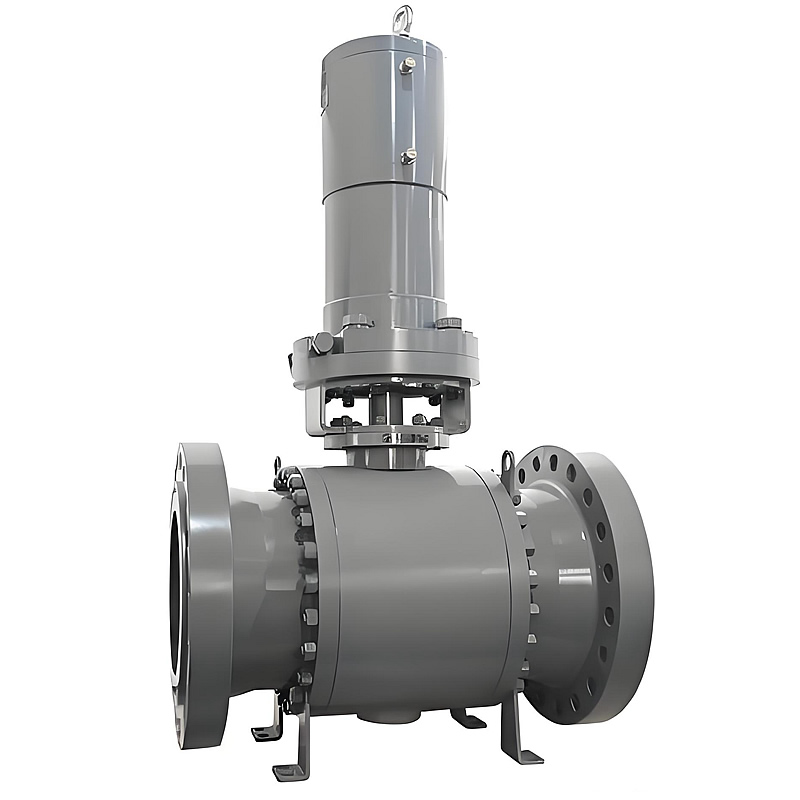
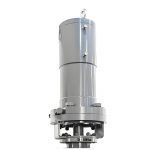
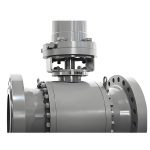
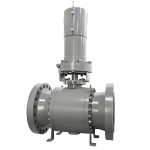
API 6D API 608 ASME B16.34 CE DN300 600LB Carbon/Stainless Steel F316/WCB 3PC Fire-Safe Flanged Pneumatic Trunnion Mounted Ball Valve for Oil & Gas Petrochemical Industrial Systems
I. Product Overview
TIANYU 3PC (three-piece) fire-safe flanged trunnion mounted ball valve is a premium fluid control solution engineered to meet the rigorous demands of oil & gas, petrochemical, chemical, and industrial sectors—where high pressure, flammable media, and uncompromising safety compliance are non-negotiable. Designed in strict adherence to global industry standards including API 6D (pipeline valves), API 608 (trunnion-mounted ball valves), and ASME B16.34 (valve dimensions & pressure-temperature ratings), this valve integrates three core structural advantages: a trunnion-mounted (fixed-ball) design for high-pressure stability, a three-piece body for in-line maintenance, and a fire-safe sealing system compliant with API 607 (fire-test requirements for valves).
Constructed from dual material options—carbon steel (A105N, WCB) for cost-effective durability in non-corrosive media and stainless steel (F316, CF8M) for corrosion resistance in harsh fluids (acids, salts, hydrocarbons)—the valve spans a pressure range of 150LB to 1500LB (PN20 to PN250) and size range of DN100 to DN600 (4” to 24”). It supports multiple actuation modes (pneumatic, electric, manual/worm gear) to adapt to automated process control or manual operation scenarios, while flange connections (FF/RF/RTJ) ensure seamless integration with standard industrial pipelines.
Certified to CE, ISO 9001, and API 6D, this fire-safe valve delivers bubble-tight shut-off (ANSI/FCI Class VI for soft seals) and maintains integrity during extreme conditions—from cryogenic temperatures (-196℃ for metal seals) to high-temperature industrial processes (425℃ for metal seats). Whether deployed in offshore oil wellheads, cross-country gas pipelines, petrochemical reactors, or power plant fluid systems, it balances operational precision, safety resilience, and long-term cost-effectiveness—establishing itself as a critical component in mission-critical industrial networks.
II. Important Attribute Specifications
A. Dimensional & Pressure-Temperature Parameters
Port Size: DN100 to DN600 (4” to 24”), with full-port and reduced-port options. Full-port design ensures minimal pressure drop (Cv values up to 2000 for DN600 models) and enables pipeline pigging/cleaning, critical for oil & gas transmission. Reduced-port is available for space-constrained or low-flow applications.
Pressure Rating: 150LB to 1500LB (PN20 to PN250), aligned with ASME B16.34 pressure-temperature ratings. Hydrostatic testing follows API 598: 1.5× rated pressure for the valve shell (body/bonnet) and 1.1× rated pressure for seats, with zero tolerance for leakage, sweating, or structural deformation.
150LB (PN20): Suitable for municipal water, low-pressure gas distribution.
300LB–600LB (PN40–PN100): Ideal for oil & gas midstream, petrochemical process lines.
900LB–1500LB (PN150–PN250): Engineered for high-pressure upstream oil wellheads, industrial reactors.
Temperature Range:
Soft-seal (PTFE/PPL): -27℃ to 220℃, compatible with most industrial fluids, water, and hydrocarbons.
Metal-seal (fire-safe backup): -196℃ to 425℃, for cryogenic LNG service, high-temperature steam, or abrasive media.
Fire-safe operation: Maintains sealing integrity up to 750℃ during API 607 30-minute fire testing.
B. Material Composition
Valve Body (3PC):
Carbon Steel: A105N forged carbon steel (ASTM A105) for 150LB–1500LB high-pressure service; WCB cast carbon steel (ASTM A216) for medium-pressure applications. Both undergo heat treatment (normalizing for A105N, annealing for WCB) to relieve internal stresses.
Stainless Steel: F316 (ASTM A182) or CF8M (ASTM A351) austenitic stainless steel, containing 16–18% chromium, 10–14% nickel, and 2–3% molybdenum for superior corrosion resistance against chlorides, acids, and sulfur-containing media.
Ball & Trunnions:
Solid ball: F316/CF8M (stainless steel models) or A105N/WCB (carbon steel models), precision-ground to a spherical tolerance of ≤0.01mm for bubble-tight sealing.
Trunnions: Integral to the ball, machined from the same material as the ball, surface-hardened (HRC 30–35) to reduce bearing wear and enhance load-bearing capacity.
Fire-Safe Sealing System:
Primary seal: Reinforced PTFE (polytetrafluoroethylene) or PPL (polyphenylene sulfide) for ANSI/FCI Class VI leakage; PTFE+carbon fiber or PTFE+glass fiber for enhanced wear resistance.
Secondary fire-safe backup: Expanded graphite + metal-to-metal contact (316 stainless steel seat ring) to maintain sealing during fire events (API 607 compliant).
Valve Stem: 316 stainless steel (ASTM A182) for corrosion resistance, with an anti-blowout design to prevent ejection under pressure. Polished to Ra ≤0.4μm to minimize packing friction and fugitive emissions (ISO 15848-1 Class BH).
Flanges & Fasteners:
Flanges: Integral to the body, machined to ASME B16.5 (FF/RF/RTJ faces) for carbon steel/stainless steel models.
Gaskets: Spiral-wound gaskets (316 stainless steel/graphite, ASME B16.20) for leak-tight flange connections under pressure/temperature fluctuations.
C. Connection & Operational Features
Connection Type: Flanged (ASME B16.5/ASME B16.47), compatible with standard pipeline flanges to simplify installation, retrofitting, and replacement. RTJ (Ring Type Joint) flanges are optional for high-pressure 900LB–1500LB applications.
Actuation Modes:
Manual: Lever operator (for DN100–DN200 150LB–300LB) or worm gear operator (for DN250+ or 600LB+), reducing torque by 5–10× to enable single-person operation.
Pneumatic: Double-acting (compressed air for open/close) or spring-return (auto-fail-safe position on air loss) actuators, 4–8 bar air supply, cycle time 3–5 seconds for DN300 models. Equipped with 4–20mA positioner (optional) for remote control.
Electric: Quarter-turn electric actuators (IP67 enclosure) with Modbus TCP/IP connectivity, 4–20mA control signal, suitable for remote or automated systems (e.g., SCADA integration).
Functional Attributes:
Trunnion-mounted (fixed-ball) design: Distributes fluid pressure forces to bearings, eliminating seat deformation in high-pressure service.
3PC body: Bolted split-body configuration for in-line disassembly and maintenance.
Bidirectional sealing: Reliable shut-off in both flow directions, simplifying pipeline design.
Fire-safe: API 607 compliant, with secondary metal seal to prevent media escape during fire.
Anti-static device: Conductive spring between ball and body to dissipate static charges (resistance ≤10Ω), critical for flammable media.
D. Certifications & Compliance
Design & Performance Standards: API 6D, API 608, API 607 (fire-safe), ASME B16.34, ASME B16.5, ASME B16.10, ISO 5208, BS 5351.
Quality & Safety Certifications: ISO 9001 (quality management), CE (PED 2014/68/EU), API 6D monogram (optional), ATEX/IECEx (optional for explosive atmospheres), NACE MR0175 (optional for sour gas service).
Environmental Compliance: ISO 15848-1 (fugitive emissions), REACH (EU chemical regulations), RoHS.
API 6D API 608 ASME CE DN300 600LB Carbon/Stainless Steel F316/WCB 3PC Fire-Safe Flanged Pneumatic Trunnion Mounted Ball Valve
III. Feature Description
A. 3PC Split-Body Design: In-Line Maintenance & Durability
The three-piece body configuration is a defining advantage for industrial operators, addressing the core pain point of downtime in critical processes:
In-Line Disassembly: Unlike one-piece or two-piece valves, which require complete removal from the pipeline for maintenance, the TIANYU 3PC valve can be disassembled by unbolting its three segments (two end caps + one middle body). This allows technicians to access the ball, seat, and stem without disconnecting adjacent piping—reducing maintenance time by 70% compared to one-piece valves. For example, in a petrochemical refinery’s DN300 600LB process line, replacing worn seats takes 2 hours (vs. 8 hours for a one-piece valve), avoiding $80k+ in lost production.
Uniform Seal Compression: The bolted body segments enable controlled torque application (per ASME B18.2.1), ensuring uniform compression of the seat seals. This eliminates uneven wear and extends seal life by 2–3×, critical for high-cycle applications (e.g., gas pipeline shut-off valves).
Structural Rigidity: The split-body design enhances rigidity for large-diameter, high-pressure valves (DN600 1500LB), preventing body deformation under extreme pressure loads.
B. Trunnion-Mounted (Fixed-Ball) Structure: High-Pressure Stability
The trunnion-mounted design solves a key limitation of floating-ball valves: in high-pressure systems, floating balls transfer pressure forces to the seats, increasing operational torque and accelerating seat wear. TIANYU’s fixed-ball design delivers:
Pressure Force Distribution: The ball is supported by upper and lower trunnions, which transfer fluid pressure forces to robust PTFE-impregnated bronze bearings. This eliminates seat deformation, even in 1500LB (PN250) service, maintaining consistent sealing over 10,000+ cycles.
Low Operational Torque: Trunnion support reduces friction between the ball and seats by 40–50% compared to floating-ball valves. A DN600 600LB worm gear model requires only 200 N·m of torque—enabling manual operation without specialized tools.
Bidirectional Reliability: The fixed-ball design ensures symmetric sealing in both flow directions, eliminating installation direction constraints. This simplifies pipeline layout for oil & gas midstream transmission, where flow direction may reverse during maintenance.
C. API 607 Fire-Safe Sealing: Critical Safety Resilience
For industries handling flammable media (oil, gas, chemicals), fire safety is mandatory. The valve’s fire-safe system is engineered to API 607 7th Edition standards:
Dual-Seal Design: During normal operation, the reinforced PTFE/PPL primary seal delivers ANSI/FCI Class VI bubble-tight leakage. In a fire event (750℃ exposure), the PTFE melts, and the expanded graphite secondary seal swells to fill gaps, while the 316 stainless steel seat ring forms a metal-to-metal backup seal.
Post-Fire Performance: After 30 minutes of API 607 fire testing, the valve maintains leakage below 0.1×DN mm³/min—preventing flammable media escape and secondary explosions. This compliance is mandatory for offshore platforms, refineries, and chemical plants operating under OSHA or ATEX regulations.
Anti-Static Protection: A conductive spring connects the ball, stem, and body to dissipate static charges (common in gas flow), eliminating spark risks that could ignite flammable vapors.
D. Dual Material Options: Versatility Across Media
The valve’s carbon steel and stainless steel variants are tailored to diverse application needs:
Carbon Steel (A105N/WCB): Cost-effective for non-corrosive media (water, crude oil, natural gas) in 150LB–1500LB service. A105N forged carbon steel offers superior tensile strength (485–655MPa) for high-pressure upstream oil wellheads, while WCB cast carbon steel is ideal for midstream pipeline valves.
Stainless Steel (F316/CF8M): Corrosion-resistant for harsh media (seawater, acids, chlorides) in coastal/offshore or chemical processing applications. F316’s molybdenum content resists pitting corrosion, making it suitable for seawater cooling systems or sour gas service (with NACE MR0175 compliance).
Material Compatibility: Both variants work with a range of seal materials (PTFE, PPL, PTFE+carbon fiber) to match media characteristics—e.g., PPL for high-temperature hydrocarbons, PTFE+glass fiber for abrasive fluids.
E. Multi-Actuation Flexibility: Adaptation to Operational Needs
The valve supports manual, pneumatic, and electric actuation to align with diverse process control requirements:
Manual/Worm Gear: Ideal for low-cycle, remote applications (e.g., pipeline isolation valves) where power is unavailable. The worm gear operator’s self-locking design prevents accidental valve movement due to vibration.
Pneumatic (Double-Acting/Spring-Return): Fast-acting (3–5 seconds) for automated process lines (e.g., petrochemical reactor feed valves). Spring-return models provide fail-safe operation (auto-close/auto-open) on air supply loss—critical for emergency shutdown systems (ESD).
Electric: Remote-controllable for large-scale facilities (e.g., refineries, power plants) with SCADA/DCS integration. The IP67-rated actuator withstands harsh industrial environments (dust, moisture), while the 4–20mA positioner enables precise position monitoring.
F. Flange Connection Reliability: Seamless Integration
Leak-Tight Sealing: Bolted flanges distribute clamping force evenly across spiral-wound gaskets, ensuring integrity under pressure/temperature fluctuations. RTJ flanges (optional for 900LB+) use metal ring gaskets for ultra-high-pressure service, eliminating fugitive emissions.
Standard Compatibility: Compliance with ASME B16.5 ensures compatibility with existing pipeline flanges, reducing retrofitting costs. For example, a DN300 300LB valve can replace an aging valve without modifying pipeline flanges.
Easy Installation: Flange alignment is simplified via precision-machined bolt holes, reducing installation time by 30% compared to welded valves. This is critical for offshore platforms or tight-space industrial facilities.
IV. Manufacturing Process
A. Raw Material Inspection & Preparation
Quality control begins with rigorous validation of raw materials to ensure compliance with ASTM/API standards:
Carbon Steel Verification: A105N billets and WCB castings undergo spectral analysis (XRF) to confirm chemical composition (C: 0.25–0.35% for A105N) and ultrasonic testing (UT) to detect internal defects (porosity, cracks). Mechanical testing (tensile strength, impact resistance) ensures compliance with ASTM A105/A216, documented in Material Test Reports (MTRs).
Stainless Steel Validation: F316/CF8M bar stock is tested for chromium, nickel, and molybdenum content (16–18% Cr, 2–3% Mo for F316) via XRF spectroscopy. Salt spray testing (ASTM B117) confirms corrosion resistance (≥1000 hours without pitting).
Seal Material Testing: Reinforced PTFE is tested for hardness (Shore D 55–65) and thermal stability (220℃ for 1000 hours); expanded graphite is evaluated for expansion rate (≥200% at 750℃) to ensure API 607 compliance.
Fastener Validation: ASTM A193 B7/B8M bolts undergo tensile strength testing (≥827MPa for B7) and thread verification (ASME B1.1) to ensure load capacity.
B. Valve Body & Ball Fabrication
3PC Body Machining:
Carbon steel/stainless steel bar stock is cut into three segments (end caps, middle body) via CNC sawing.
5-axis CNC machining centers precision-machine flange faces to ASME B16.5 flatness (≤0.05mm/m) and surface finish (Ra ≤3.2μm). Trunnion bearing bores are honed to ±0.02mm tolerance to ensure ball alignment.
Body segments undergo shot blasting (SA 2.5) to remove scale and surface impurities, then coated with epoxy paint (carbon steel models) or passivated (stainless steel models) for corrosion protection.
Ball & Trunnion Processing:
Solid F316/A105N ball blanks are turned via CNC lathes, then ground with spherical grinders to achieve a surface finish of Ra ≤0.2μm—critical for bubble-tight sealing.
Trunnions are machined integrally with the ball, then heat-treated (carburizing for carbon steel, solution annealing for stainless steel) and polished to reduce bearing friction.
Seat Ring Manufacturing:
316 stainless steel seat rings are machined, then fitted with reinforced PTFE/PPL and expanded graphite layers via compression molding. The seat ring’s outer diameter is precision-machined to ensure interference fit with the body’s seat pocket.
C. Assembly & Actuator Integration
Assembly is performed in a Class 10,000 cleanroom to prevent contamination of sealing surfaces:
Trunnion & Ball Installation: The ball (with integral trunnions) is inserted into the middle body, and PTFE-impregnated bronze bearings are pressed into the trunnion bores. Bearings are lubricated with high-temperature grease (resistant to 200℃) for long-term smooth operation.
Seal & Body Assembly: Seat rings are installed in the end caps, then the three body segments are bolted together with torque-controlled wrenches (per ASME B18.2.1) to ensure uniform seal compression.
Stem & Packing Installation: The 316 stainless steel stem is inserted into the body, and graphite-impregnated PTFE packing is installed in layers (5–7 layers) with controlled compression (10–15%) to balance sealing and torque.
Actuator Mounting: Manual/worm gear actuators are attached via ISO 5211 flanges, with laser alignment to ensure stem-trunnion coaxiality (runout ≤0.05mm). Pneumatic/electric actuators are calibrated to 4–20mA signals, with limit switches set to trigger at fully open/closed positions.
D. Quality Testing & Certification
Every valve undergoes multi-stage testing to meet API/ASME standards and industrial safety requirements:
Hydrostatic Testing (API 598):
Shell test: 1.5× rated pressure (e.g., 22.5MPa for 600LB) for 30 minutes, with no leakage, sweating, or deformation.
Seat test: 1.1× rated pressure (e.g., 16.5MPa for 600LB) for 15 minutes, with leakage measured via bubble counting (≤1 bubble/minute for Class VI).
Fire Testing (API 607): Random samples undergo 30-minute exposure to 750℃ propane flames, followed by a seat test to confirm post-fire leakage compliance.
Operational Testing: 100 open-close cycles to verify torque consistency, actuation speed (3–5 seconds for pneumatic models), and position accuracy.
Non-Destructive Testing (NDT):
Liquid penetrant testing (PT) for flange welds and body segments to detect surface cracks.
Magnetic particle testing (MPI) for trunnions and stem to ensure structural integrity.
Ultrasonic testing (UT) for forged components (A105N) to detect internal defects.
Fugitive Emissions Testing (ISO 15848-1): The stem and body-bonnet joint are tested for methane emissions, meeting Class BH standards (≤100 ppmv).
Post-test, each valve receives a unique serial number, and documentation (MTRs, test reports, certifications) is packaged with the unit for traceability.
V. Product Advantages
A. Reduced Total Cost of Ownership (TCO)
Maintenance Efficiency: The 3PC design cuts maintenance downtime by 70% and reduces labor costs by 40% compared to one-piece valves. For a refinery with 50 DN300 600LB valves, this translates to annual savings of $300k+ in lost production and labor.
Extended Service Life: Trunnion-mounted design and corrosion-resistant materials extend service life to 8–12 years (vs. 3–5 years for standard floating-ball valves). This reduces replacement costs and minimizes environmental impact from valve disposal.
Low Energy Consumption: Pneumatic actuators require 4–8 bar air supply, consuming 30% less energy than hydraulic alternatives. Electric actuators with Modbus integration enable energy-efficient remote control, reducing on-site power usage.
B. High-Pressure & Extreme Condition Resilience
Pressure Stability: The trunnion-mounted design maintains sealing integrity in 1500LB (PN250) service, outperforming floating-ball valves that risk seat damage under ultra-high pressure.
Temperature Versatility: Metal-seal variants operate from -196℃ (LNG service) to 425℃ (high-temperature steam), covering cryogenic, ambient, and high-heat applications.
Corrosion Resistance: F316/CF8M stainless steel models resist chloride-induced pitting, sulfur corrosion (NACE MR0175 compliant), and acid attack—ideal for offshore, chemical, and sour gas applications.
C. Safety & Regulatory Compliance
Fire-Safe Reliability: API 607 compliance mitigates fire-related risks, avoiding fines of $50k+ for non-compliance with OSHA/ATEX regulations.
Bubble-Tight Sealing: ANSI/FCI Class VI leakage prevents fugitive emissions of flammable or toxic media, aligning with EPA Methane Rules and EU Industrial Emissions Directive.
Anti-Static & Anti-Blowout Features: Eliminate spark risks and stem ejection, enhancing workplace safety in explosive atmospheres.
D. Versatility Across Industrial Sectors
The valve’s dual materials, multi-actuation, and broad pressure/size range make it adaptable to diverse applications—eliminating the need for multiple valve types across facilities. This reduces inventory costs by 40% for multi-process plants.
E. Global Standard Compatibility
Compliance with API 6D, ASME B16.34, and CE ensures seamless integration with global industrial infrastructure. Whether deployed in North American oil pipelines (ASME standards), European chemical plants (CE/PED), or Asian power plants (JIS/BS standards), the valve meets regional regulatory requirements.
VI. Product Applications
A. Oil & Gas Industry
Upstream Production:
Wellhead Control: DN100–DN200 1500LB A105N valves regulate crude oil/gas flow from wellheads, with trunnion design handling high-pressure reservoir fluids (up to 25MPa) and anti-static features preventing spark-induced explosions.
Hydraulic Fracturing: DN150–DN250 600LB F316 valves control fracturing fluid flow, with corrosion resistance against saline fracturing fluids.
Midstream Transmission:
Cross-Country Pipelines: DN300–DN600 300LB WCB valves regulate natural gas/oil flow, with full-port design enabling pigging and flange connections simplifying maintenance.
LNG Terminals: DN200–DN400 600LB CF8M valves handle LNG vaporization, with metal-seal design operating at -196℃.
Downstream Refining:
Distillation Units: DN100–DN300 600LB F316 valves control gasoline/diesel flow, with fire-safe design protecting against refinery fire hazards.
Hydrocracking Reactors: DN150–DN250 900LB A105N valves regulate feedstock flow, with high-pressure stability and low torque enabling automated control.
B. Petrochemical & Chemical Industry
Petrochemical Reactors: DN100–DN200 600LB F316 valves control ethylene, propylene, and other chemical intermediates, with PPL seals resisting high-temperature hydrocarbons (up to 220℃).
Chemical Processing:
Acid Production: DN100–DN150 300LB CF8M valves handle sulfuric/hydrochloric acid flow, with F316 material resisting acid corrosion.
Pharmaceutical API Manufacturing: DN50–DN100 150LB F316 valves control high-purity solvents, with polished surfaces (Ra ≤0.2μm) preventing contamination.
C. Power Generation
Thermal Power Plants: DN200–DN300 300LB WCB valves regulate boiler feedwater and steam condensate flow, with flange connections simplifying installation in boiler auxiliary systems.
Nuclear Power Plants: DN150–DN250 600LB CF8M valves control service water flow, with corrosion resistance against reactor cooling water and fire-safe design complying with nuclear safety standards.
Renewable Energy (Biogas): DN100–DN150 150LB F316 valves regulate biogas flow in anaerobic digesters, with anti-static features preventing methane ignition.
D. Municipal & Industrial Water Systems
Industrial Wastewater Treatment: DN200–DN400 150LB WCB valves control chlorinated wastewater flow, with epoxy coating resisting corrosion from chlorine.
Desalination Plants: DN300–DN500 300LB F316 valves handle seawater reverse osmosis (RO) systems, with F316 material resisting saltwater corrosion.
E. Marine & Offshore Applications
Offshore Oil Platforms: DN150–DN300 900LB F316 valves regulate production fluid flow, with salt spray resistance (ASTM B117 ≥1000 hours) and RTJ flanges ensuring high-pressure sealing.
Shipboard Systems: DN100–DN200 300LB CF8M valves control fuel oil and ballast water flow, with compact worm gear actuators fitting in tight ship engine rooms.
Customization Advantages
Customize this TIANYU valve to your operational needs: opt for 2205 duplex steel for extreme offshore corrosion, Inconel alloy for high-temperature (500℃+) service, or titanium for chemical resistance. Upgrade to 2500LB pressure for ultra-high-duty wellheads, select Viton seals for oil-rich media, or add ATEX/IECEx certification for explosive zones. Integrate smart electric actuators with IoT connectivity for remote monitoring, or choose reduced-port design for space constraints. These tweaks optimize performance, extend service life, and cut long-term costs—delivering a valve tailored to your unique workflow.
API 6D ASME B16.34 CE DN200/DN300/DN400 PN80 LF2 Carbon Steel Body 321 Stainless Steel Ball Full Welded Manual Stem Hard Seated Ball Valve is a premium high-pressure fluid control solution engineered for critical industrial applications, blending LF2 carbon steel’s structural strength with 321 stainless steel’s corrosion resistance and Stellite 6 hard seats’ durability. Its full welded design eliminates leak points, while the manual light stem ensures precise, reliable operation. Certified to API 6D, ASME, and CE standards, and backed by ISO 9001/API Q1 quality assurance, it excels in oil and gas transmission, petrochemical refining, and power generation. Fire-safe, low-emission, and maintainable, it delivers zero-leakage performance, regulatory compliance, and long-term value for large-flow, high-pressure pipeline systems worldwide.