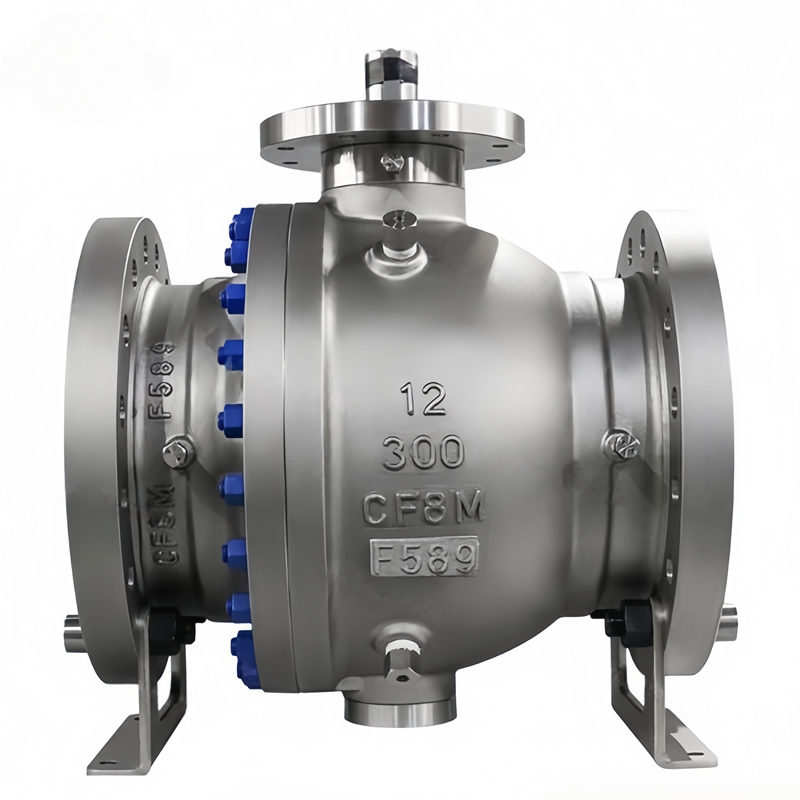
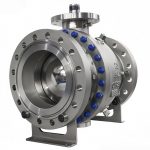
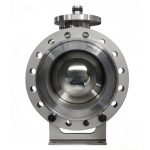
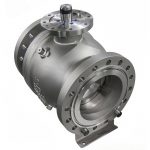
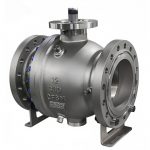
API 6D ANSI CLASS300 CE NACE MR0175 DN300 CF8/CF8M Stainless Steel 2PC Flanged Trunnion Mounted Ball Valve by TIANYU
I. Product Overview & Core Specifications
The TIANYU API 6D trunnion mounted ball valve is a precision-engineered fluid control solution purpose-built for the most demanding oil and gas, petrochemical, and industrial pipeline applications, with a nominal diameter of DN300 and pressure rating of ANSI CLASS300 delivering robust performance for medium-to-large flow rate systems requiring uncompromising isolation and shutoff reliability. As a 2-piece (2PC) flanged configuration, this valve adheres to the strictest global industry standards, integrating sour service compliance with premium corrosion-resistant materials to ensure long-term operational integrity in harsh and corrosive operating environments.
Constructed from CF8 (AISI 304) and CF8M (AISI 316) stainless steel for all pressure-containing components, including the body, bonnet, and ball, the valve offers exceptional resistance to general corrosion, pitting, crevice corrosion, and oxidation—critical properties for contact with crude oil, natural gas, sour gas, produced water, steam, and mild to moderate chemical process fluids. CF8 stainless steel delivers superior corrosion protection in neutral and mild acidic environments, while CF8M incorporates molybdenum to enhance resistance to pitting and crevice corrosion in chloride-rich and sour service conditions, aligning with NACE MR0175/ISO 15156 standards for sour gas handling.
Rated for ANSI CLASS300, the valve operates reliably at a maximum working pressure of 5.17 MPa (750 PSI) and a broad temperature range of -29°C to 204°C as standard, with optional extended temperature ratings available for extreme low or high-temperature applications. The trunnion mounted ball design, a defining feature of this valve, supports the spherical ball on precision-machined upper and lower trunnions, eliminating the risk of ball displacement under high line pressure—a common limitation of floating ball valves. This design distributes hydraulic forces evenly across the trunnion bearings and seat assemblies, ensuring consistent sealing performance regardless of pressure fluctuations and extending the service life of internal components by minimizing friction and wear.
Equipped with flanged end connections compliant with ANSI B16.5, the valve enables seamless, leak-proof integration into standard industrial pipeline systems, with standardized flange dimensions, bolt patterns, and face finishes (RF – Raised Face as standard) ensuring interoperability with existing infrastructure and reducing installation time and costs. The 2-piece body construction features a bolted bonnet-to-body joint with a premium spiral wound gasket (flexible graphite with 316SS inner ring) for a secure, fire-safe seal, facilitating easy disassembly for maintenance, inspection, and replacement of internal components without removing the entire valve from the pipeline— a key advantage for critical process systems where downtime must be minimized.
The valve incorporates a soft-seated or metal-seated design (soft-seated as standard) to meet diverse leakage requirements, with soft seats engineered for bubble-tight shutoff compliant with ANSI/FCI Class VI and metal seats for high-temperature, high-pressure, and abrasive fluid applications compliant with ANSI/FCI Class IV. The stem assembly features an anti-blowout design, a critical safety feature that mechanically retains the stem within the body to prevent ejection under high pressure, and a multi-layer packing system (PTFE with graphite backup rings) to eliminate fugitive emissions, meeting the strict low-emission requirements of ISO 15848-1 and EPA Method 21. Actuation options include manual gear operation (standard for DN300 CLASS300), pneumatic, electric, or hydraulic actuation, all integrated with a visual position indicator and optional limit switches, solenoid valves, and positioners for remote monitoring and control.
API 6D ANSI CLASS300 CE NACE MR0175 DN300 CF8/CF8M Stainless Steel 2PC Flanged Trunnion Mounted Ball Valve
II. Design Features & Functional Advantages
The TIANYU API 6D DN300 CLASS300 trunnion mounted ball valve is engineered with a suite of innovative design features that elevate its performance, safety, and operational efficiency beyond conventional ball valves, addressing the unique challenges of oil and gas transmission, petrochemical processing, and industrial fluid control—including sour service, high pressure, and extended service intervals.
At the core of its design excellence is the trunnion mounted ball configuration, which redefines sealing reliability in high-pressure applications. Unlike floating ball valves, which rely on fluid pressure to seat the ball against the downstream seat, the trunnion mounted design uses pre-loaded seat springs to maintain constant contact between the ball and both upstream and downstream seats, ensuring a positive seal in both open and closed positions, even at low line pressures or during pressure transients. This bi-directional sealing capability eliminates the risk of leakage caused by pressure imbalances, making the valve ideal for bi-directional flow systems and isolation applications where absolute shutoff is non-negotiable. The precision-machined trunnions are fitted with anti-friction bearings, reducing operating torque and enabling smooth, effortless actuation—even for the large DN300 size—while minimizing wear on the trunnion and body bore surfaces.
The valve’s 2-piece bolted body construction strikes the perfect balance between structural integrity and maintainability. The one-piece body and bonnet (2PC design) eliminates the need for a mid-body joint, reducing potential leak points and enhancing the valve’s structural strength for high-pressure CLASS300 service. The bolted bonnet connection allows for easy removal of the bonnet and internal trim (ball, seats, stem) without disconnecting the valve body from the pipeline, enabling rapid maintenance and inspection. The bonnet joint features a fire-safe spiral wound gasket and a live-loaded packing system, ensuring the seal remains intact even under thermal expansion or contraction and meeting fire-safe design requirements of API 607 and API 6FA.
Sour service compliance is a cornerstone of the valve’s design, with all wetted components manufactured from CF8/CF8M stainless steel that meets NACE MR0175/ISO 15156 standards for resistance to sulfide stress cracking (SSC) and hydrogen induced cracking (HIC). The material selection is complemented by a precision machining process that eliminates sharp edges, notches, and surface defects—common initiators of SSC in sour service—and a post-machining passivation treatment to restore the stainless steel’s passive oxide layer, enhancing corrosion resistance and ensuring compliance with NACE’s strict material and manufacturing requirements.
The valve’s sealing system is engineered for versatility and reliability, with standard soft seats made from PEEK (Polyether Ether Ketone) or reinforced PTFE (Polytetrafluoroethylene) for bubble-tight shutoff. PEEK seats offer exceptional thermal stability (up to 260°C), chemical resistance, and wear resistance, making them ideal for most oil and gas and petrochemical applications, while reinforced PTFE seats provide superior low-temperature performance (down to -50°C). For high-temperature, high-pressure, or abrasive fluid applications, metal seats (Stellite 6 overlay on 316SS) are available, delivering a metal-to-metal seal that maintains integrity at temperatures up to 427°C and resists wear from particulate-laden fluids. All seat assemblies are spring-loaded, compensating for thermal expansion, contraction, and wear over time to ensure a consistent seal throughout the valve’s service life.
Safety and environmental protection are integrated into every design detail, starting with the anti-blowout stem. The stem is machined with a circumferential groove that engages with a retaining ring in the body bore, preventing the stem from being ejected from the body even if the primary packing seal fails under high pressure—eliminating a major safety hazard in industrial pipeline systems. The multi-layer stem packing system features PTFE V-rings with graphite backup rings, providing a low-friction seal that eliminates fugitive emissions and meets ISO 15848-1 (TA-Luft) and EPA Method 21 requirements for low-emission valves. The packing gland is live-loaded with Belleville washers, maintaining constant packing compression even as the packing settles or wears, ensuring long-term emission control without the need for frequent re-tightening.
The valve is also engineered with a fire-safe design compliant with API 607 (7th edition) and API 6FA, a critical requirement for oil and gas and petrochemical applications where fire risk is inherent. In the event of a fire, the soft seat material may degrade, but the valve’s metal-to-metal backup seal (between the ball and metal seat retainers, and the bonnet and body joint) activates to maintain a pressure-tight seal, preventing the release of flammable fluids and minimizing fire propagation. The fire-safe design is validated through rigorous third-party testing, ensuring the valve meets the strict performance criteria of API and ANSI fire-safe standards.
For operational convenience, the valve is fitted with a robust manual gear operator as standard for DN300 CLASS300, featuring a heavy-duty gear box with precision-machined gears that reduce operating torque by up to 80%, enabling a single operator to actuate the large valve with minimal effort. The gear operator includes a positive-locking handwheel to prevent accidental operation, a visual position indicator (open/closed) with clear markings, and a grease fitting for easy lubrication of the gear train and trunnion bearings. Optional actuation systems (pneumatic rack and pinion, electric quarter-turn, hydraulic) are fully integrated with the valve’s stem and position indicator, with mounting flanges compliant with ISO 5211 for seamless compatibility with industry-standard actuation equipment. The valve also features optional accessories such as limit switches, solenoid valves, positioners, and pressure gauges, enabling integration with SCADA, DCS, and PLC systems for remote monitoring, control, and automation.
III. Manufacturing Process & Quality Assurance
The production of the TIANYU API 6D DN300 CLASS300 trunnion mounted ball valve adheres to the most rigorous manufacturing processes and quality control protocols in the industry, aligning with API Q1, ISO 9001:2015, and NACE MR0175 standards to ensure every valve meets or exceeds design specifications and global industry requirements. From raw material procurement to final factory testing, every step of the manufacturing process is controlled and documented, with a focus on precision, consistency, and reliability—critical for a valve designed for critical sour service and high-pressure applications.
Raw Material Procurement & Inspection
Raw materials for the valve—CF8 and CF8M stainless steel ingots and billets—are sourced exclusively from approved, ISO 9001-certified suppliers with a proven track record of producing high-quality stainless steel for the oil and gas industry. All raw materials are accompanied by a mill test certificate (MTC) that verifies chemical composition, mechanical properties, and compliance with ASTM A351 (for CF8/CF8M castings) and NACE MR0175. Upon receipt, the raw materials undergo rigorous incoming inspection in TIANYU’s state-of-the-art quality control laboratory, including:
Chemical composition analysis via optical emission spectroscopy (OES) to verify compliance with ASTM and NACE standards;
Mechanical property testing (tensile strength, yield strength, elongation, hardness) via universal testing machine (UTM) and Brinell hardness tester;
Non-destructive testing (NDT) including ultrasonic testing (UT) and magnetic particle testing (MPT) to detect internal and surface defects;
Passivation testing to verify the integrity of the stainless steel’s passive oxide layer.
Any raw material that fails to meet the specified requirements is rejected and returned to the supplier, ensuring only high-quality materials are used in production.
Casting & Forging
The valve body, bonnet, and ball are manufactured using precision investment casting (for CF8/CF8M) for complex geometries and consistent material properties. The investment casting process involves creating a wax pattern of the component, coating the pattern with a refractory ceramic shell, melting the wax to create a cavity, and pouring molten CF8/CF8M stainless steel into the cavity. This process delivers exceptional dimensional accuracy, a smooth surface finish (Ra ≤ 6.3 μm), and consistent material density, eliminating internal defects such as porosity, inclusions, and shrinkage that are common in traditional sand casting. After casting, all components undergo a solution annealing heat treatment (1040°C to 1100°C for CF8/CF8M) followed by rapid quenching in water or air, which refines the microstructure, relieves internal casting stresses, and enhances corrosion resistance and mechanical properties. The trunnions and stem are manufactured using hot forging from CF8M stainless steel billets, a process that increases material density and strength by aligning the metal’s grain structure with the direction of applied forces, ensuring superior fatigue resistance for these critical load-bearing components.
Precision Machining
All cast and forged components undergo precision CNC machining to achieve the tight dimensional tolerances required for API 6D compliance and optimal performance. The machining process is performed using high-precision CNC lathes, milling machines, and vertical machining centers (VMCs) with computer-aided design (CAD) and computer-aided manufacturing (CAM) integration, ensuring repeatability and consistency across all production runs. Key machining steps include:
Machining the body bore and trunnion bearing bores to a precision tolerance of ±0.01 mm for optimal trunnion fit and smooth operation;
Machining the flange faces, bolt holes, and raised face (RF) to ANSI B16.5 standards, with a surface finish of Ra ≤ 3.2 μm for a secure gasket seal;
Machining the ball to a spherical tolerance of ±0.005 mm and a surface finish of Ra ≤ 0.8 μm for optimal sealing with the seat assemblies;
Machining the stem and trunnions to precise tolerances for the anti-blowout design and bearing fit;
Deburring all machined surfaces to eliminate sharp edges and notches, a critical step for NACE MR0175 sour service compliance.
After machining, all components undergo a second round of NDT, including dye penetrant testing (DPT) for surface defects and ultrasonic testing (UT) for internal defects, to ensure no machining-induced defects are present.
Assembly
Valve assembly is performed in a controlled, clean room environment to prevent contamination of internal components, with skilled technicians following detailed, step-by-step assembly work instructions that align with API 6D and ISO 9001 standards. The assembly process is highly structured, with each step verified and documented to ensure quality and traceability:
The body is mounted on a precision assembly fixture to ensure alignment of all internal components;
The lower trunnion bearing is installed in the body bore, with a high-performance anti-friction grease applied to reduce wear;
The ball is lowered into the body, with the lower trunnion seated in the lower bearing;
The pre-loaded seat assemblies (upstream and downstream) are installed into the body seat pockets, with the seat springs compressed to ensure constant contact with the ball;
The upper trunnion bearing is installed, and the stem is inserted through the bonnet packing and connected to the ball’s upper trunnion via a square drive or keyed connection;
The bonnet is bolted to the body using high-strength alloy steel bolts (ASTM A193 B8M) torqued to the specified value using a calibrated torque wrench, ensuring uniform bolt load and a secure seal;
The stem packing system is installed, with the packing gland torqued to the specified value to eliminate fugitive emissions;
The gear operator or actuation system is mounted to the valve, and the stem is connected to the actuator drive shaft;
The visual position indicator is calibrated to align with the ball’s open/closed position, and all moving parts are lubricated with a high-performance, NACE-compliant grease.
During assembly, critical dimensions and clearances are verified using precision measurement tools, including coordinate measuring machines (CMMs), dial indicators, and calipers, to ensure compliance with design specifications.
Factory Testing & Certification
Before leaving the factory, every TIANYU API 6D DN300 CLASS300 trunnion mounted ball valve undergoes a comprehensive series of performance tests in accordance with API 6D, API 598, and ISO 5208 standards, with all test results documented in a factory test certificate (FTC) provided with each valve. The testing program includes:
Shell Test: A hydrostatic pressure test of the body and bonnet at 1.5 times the rated CLASS300 pressure (7.76 MPa) for a minimum of 30 seconds, to verify structural integrity and no visible leakage or deformation;
Seat Test (Hydrostatic): A hydrostatic pressure test of the seat assemblies at 1.1 times the rated pressure for both upstream and downstream flow directions, to verify bubble-tight shutoff (no visible leakage for soft seats, minimal allowable leakage for metal seats) compliant with ANSI/FCI Class VI/IV;
Seat Test (Pneumatic): A pneumatic pressure test at 0.69 MPa (100 PSI) for soft-seated valves, to verify bubble-tight shutoff in low-pressure applications;
Operational Test: A functional test of the valve’s actuation system (gear operator/actuator) to verify smooth opening and closing, accurate position indication, and positive locking;
Fugitive Emission Test: A test of the stem packing system in accordance with ISO 15848-1, to verify emissions are below the specified limit (≤ 100 ppm for Class A);
Fire-Safe Test: A third-party fire test in accordance with API 607 and API 6FA for fire-safe rated valves, to verify the metal-to-metal backup seal maintains integrity after fire exposure;
NACE MR0175 Compliance Test: A series of tests to verify compliance with NACE MR0175, including sulfide stress cracking (SSC) testing and hydrogen induced cracking (HIC) testing for sour service valves.
Only valves that pass all tests are certified and released for shipment, with the FTC including all test results, material certifications, and compliance standards for full traceability.
Quality Management System
TIANYU maintains a certified quality management system (QMS) compliant with ISO 9001:2015 and API Q1, the oil and gas industry’s premier quality standard for manufacturing facilities. The QMS covers all aspects of the manufacturing process, from raw material procurement to final delivery, with a focus on continuous improvement, customer satisfaction, and compliance with global industry standards. The QMS is supported by a team of experienced quality assurance (QA) engineers who conduct regular internal audits, process reviews, and supplier audits to ensure compliance, and a document control system that maintains all manufacturing, testing, and certification records for a minimum of 7 years—meeting the traceability requirements of the oil and gas industry.
IV. Application Scenarios & Industry Relevance
The TIANYU API 6D DN300 CLASS300 CF8/CF8M trunnion mounted ball valve is a versatile, high-performance fluid control solution designed to meet the demands of a wide range of industrial applications, with a particular focus on oil and gas (upstream, midstream, downstream), petrochemical, chemical processing, and power generation—where sour service compliance, high-pressure reliability, and bubble-tight shutoff are critical. Its robust design, premium materials, and compliance with global industry standards make it a trusted choice for critical pipeline systems where operational safety, environmental protection, and minimal downtime are non-negotiable.
Oil & Gas Upstream (Exploration & Production)
In oil and gas upstream applications, including onshore and offshore drilling, wellhead control, and production facilities, the valve is used for isolation and shutoff of production lines, flow lines, and wellhead manifolds. The DN300 size is ideal for medium-to-large flow rate production systems, while the CLASS300 pressure rating handles the high pressures common in wellhead and production applications. NACE MR0175 compliance makes the valve suitable for sour gas production (H2S-containing gas), where sulfide stress cracking is a major risk, and the fire-safe design addresses the fire hazard inherent in drilling and production operations. The trunnion mounted design’s bi-directional sealing and low operating torque make it ideal for remote offshore platforms where manual actuation or limited actuator power is available, and the 2-piece body construction enables easy maintenance without removing the valve from the pipeline—critical for offshore facilities where downtime is costly and access is limited.
Oil & Gas Midstream (Transmission & Storage)
In the midstream oil and gas sector, including natural gas pipelines, crude oil transmission lines, and storage terminals, the valve is used for mainline isolation, block valve stations, and storage tank inlet/outlet control. The DN300 size is a common diameter for medium-to-large transmission pipelines, and the CLASS300 pressure rating is well-suited for pipeline operating pressures. The valve’s bubble-tight shutoff (ANSI/FCI Class VI) prevents product loss and environmental contamination, a key requirement for cross-country pipeline systems, and the fugitive emission control (ISO 15848-1) meets strict environmental regulations for pipeline operations. The trunnion mounted design’s reliable sealing under pressure transients (common in pipeline systems) ensures consistent performance, while the fire-safe design is critical for block valve stations and storage terminals where fire risk is high. The valve’s compatibility with electric and pneumatic actuation enables integration with pipeline SCADA systems for remote monitoring and control, a standard requirement for modern midstream pipeline operations.
Oil & Gas Downstream (Refining & Petrochemical)
In oil and gas downstream applications, including petroleum refineries, petrochemical plants, and chemical processing facilities, the valve is used for isolation and control of process lines, reactor feed lines, and product transfer lines. The CF8/CF8M stainless steel construction resists corrosion from the wide range of chemicals and hydrocarbons processed in refineries and petrochemical plants, while the NACE MR0175 compliance makes it suitable for sour service process streams. The DN300 size is ideal for medium-to-large flow rate process lines, and the CLASS300 pressure rating handles the high pressures common in refinery and petrochemical processing. The valve’s soft-seated bubble-tight shutoff ensures product purity by preventing cross-contamination between process streams, a critical requirement for petrochemical manufacturing, and the fire-safe design addresses the fire risk inherent in refinery operations. The 2-piece body construction enables easy maintenance and inspection, minimizing downtime for critical process systems where production interruptions can result in significant financial losses.
Chemical Processing & Specialty Chemicals
In chemical processing and specialty chemical manufacturing, the valve is used for isolation and control of process lines handling a wide range of corrosive and hazardous chemicals, including acids, bases, solvents, and chlorinated compounds. The CF8/CF8M stainless steel construction offers exceptional corrosion resistance for most chemical process fluids, while the PEEK/PTFE soft seats provide chemical compatibility and bubble-tight shutoff. The trunnion mounted design’s reliable sealing and low operating torque make it ideal for continuous process systems, and the fugitive emission control (ISO 15848-1) meets strict environmental regulations for chemical manufacturing facilities. The valve’s compliance with API 6D and ANSI standards ensures interoperability with standard industrial pipeline systems, and the optional metal seats enable use in high-temperature chemical process applications (up to 427°C).
Power Generation
In power generation facilities, including thermal power plants (coal, natural gas), combined cycle power plants, and biomass power plants, the valve is used for isolation and control of cooling water lines, feedwater systems, steam lines (low-to-medium pressure), and fuel gas lines. The DN300 size is ideal for medium-to-large flow rate cooling water and feedwater systems, and the CLASS300 pressure rating handles the operating pressures of these systems. The CF8/CF8M stainless steel construction resists corrosion from cooling water (including chloride-rich water) and steam, while the bubble-tight shutoff prevents water loss and ensures efficient plant operation. The valve’s fire-safe design is critical for fuel gas lines and power plant boiler areas, and the compatibility with electric actuation enables integration with the plant’s DCS system for remote monitoring and control.
Water Treatment & Desalination
In large-scale water treatment and desalination plants, the valve is used for isolation and control of raw water intake lines, reverse osmosis (RO) system feed lines, and treated water distribution lines. The DN300 size is ideal for medium-to-large flow rate water treatment systems, and the CLASS300 pressure rating handles the high pressures common in RO desalination systems. The CF8/CF8M stainless steel construction resists corrosion from chlorinated water, seawater, and brackish water—common in desalination and water treatment applications—while the bubble-tight shutoff prevents contamination of treated water by raw water. The trunnion mounted design’s reliable sealing and low operating torque make it ideal for continuous water treatment operations, and the fugitive emission control ensures compliance with environmental regulations for water treatment facilities.
V. Compliance & Certification
The TIANYU API 6D DN300 CLASS300 trunnion mounted ball valve is designed, manufactured, and tested in compliance with a comprehensive set of global industry standards and certifications, ensuring it meets the strictest requirements for performance, safety, environmental protection, and sour service compliance. These standards and certifications validate the valve’s quality, reliability, and interoperability with global industrial pipeline systems, providing customers with confidence in its performance for critical applications.
International Design & Performance Standards
API 6D: The primary standard for pipeline valves, specifying design, manufacturing, testing, and marking requirements for ball valves, gate valves, and check valves used in oil and gas pipeline systems—including sour service, fire-safe design, and fugitive emission control.
ANSI B16.5: Specifies dimensional requirements for flanged pipe fittings, including flange dimensions, bolt patterns, face finishes, and pressure ratings—ensuring the valve’s flanged connections are compatible with ANSI/ASME pipeline systems.
ANSI B16.34: Specifies design, manufacturing, and testing requirements for valves for pressure piping applications, including material requirements, pressure-temperature ratings, and fire-safe design.
NACE MR0175/ISO 15156: The global standard for materials used in sour gas service (H2S-containing gas), specifying requirements for resistance to sulfide stress cracking (SSC) and hydrogen induced cracking (HIC).
API 598: Specifies pressure testing and inspection procedures for industrial valves, including shell tests, seat tests, and operational tests—ensuring the valve meets strict leakage and performance criteria.
API 607/API 6FA: The global standards for fire-safe valve design and testing, specifying requirements for valve performance after exposure to fire—critical for oil and gas, petrochemical, and other fire-risk applications.
ISO 15848-1: The global standard for fugitive emissions from industrial valves, specifying test procedures and emission limits for stem and body joint seals—meeting strict environmental regulations for low-emission valves.
ANSI/FCI 70-2: Specifies leakage classification for control valves and isolation valves, with the valve meeting ANSI/FCI Class VI (bubble-tight) for soft-seated designs and Class IV for metal-seated designs.
Quality & Environmental Certifications
ISO 9001:2015: International quality management system certification, validating TIANYU’s commitment to consistent quality, customer satisfaction, and continuous improvement.
API Q1: The oil and gas industry’s premier quality management system certification, specifying additional requirements for manufacturing facilities serving the oil and gas sector—including traceability, document control, and supplier quality management.
ISO 14001:2015: International environmental management system certification, validating TIANYU’s commitment to environmental protection, sustainable manufacturing, and compliance with environmental regulations.
ISO 45001:2018: International occupational health and safety management system certification, validating TIANYU’s commitment to providing a safe and healthy working environment for its employees.
CE PED (2014/68/EU): European Union Pressure Equipment Directive certification, validating the valve’s compliance with EU health, safety, and environmental requirements for pressure equipment—enabling its sale and use in the European Economic Area (EEA).
Product Marking & Traceability
In accordance with API 6D and ANSI standards, every TIANYU valve is permanently marked with all critical information for identification and traceability, including:
Valve manufacturer (TIANYU);
Valve type (trunnion mounted ball valve);
Nominal diameter (DN300);
Pressure rating (ANSI CLASS300);
Material grade (CF8/CF8M);
API 6D certification mark;
NACE MR0175 certification mark (for sour service valves);
Serial number;
Manufacturing date;
Pressure-temperature rating table.
All manufacturing, testing, and certification records are maintained in TIANYU’s document control system for a minimum of 7 years, providing full traceability for every valve— a key requirement for the oil and gas and petrochemical industries.
Executive Summary
The TIANYU API 6D DN300 CLASS300 trunnion mounted ball valve is a premium fluid control solution engineered for critical oil and gas, petrochemical, and industrial applications, blending CF8/CF8M stainless steel corrosion resistance with NACE MR0175 sour service compliance and API 6D pipeline valve standards. Its trunnion mounted design delivers unrivaled bi-directional sealing and low operating torque, while the 2-piece flanged construction ensures easy maintenance and leak-proof integration. Fire-safe, anti-blowout, and low-emission features elevate safety and environmental performance, with bubble-tight Class VI shutoff and ANSI CLASS300 pressure resilience. Certified to global API, ANSI, and CE standards, and backed by rigorous ISO 9001/API Q1 quality assurance, it delivers reliable, long-term performance for upstream, midstream, and downstream fluid control, minimizing downtime and ensuring regulatory compliance for critical pipeline systems.
API 6D ASME B16.34 CE DN200/DN300/DN400 PN80 LF2 Carbon Steel Body 321 Stainless Steel Ball Full Welded Manual Stem Hard Seated Ball Valve is a premium high-pressure fluid control solution engineered for critical industrial applications, blending LF2 carbon steel’s structural strength with 321 stainless steel’s corrosion resistance and Stellite 6 hard seats’ durability. Its full welded design eliminates leak points, while the manual light stem ensures precise, reliable operation. Certified to API 6D, ASME, and CE standards, and backed by ISO 9001/API Q1 quality assurance, it excels in oil and gas transmission, petrochemical refining, and power generation. Fire-safe, low-emission, and maintainable, it delivers zero-leakage performance, regulatory compliance, and long-term value for large-flow, high-pressure pipeline systems worldwide.