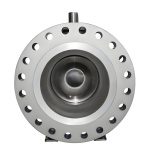
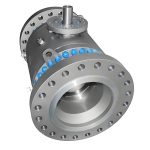
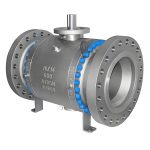
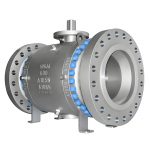
TIANYU A105N Trunnion Mounted Flange Ball Valve – API 6D/608 ASME B16.34 Class 600 High-Pressure Valve for Oil & Gas, Petrochemical & Industrial Systems
I. Product Overview
TIANYU trunnion mounted flange ball valve is a robust, high-pressure flow control solution engineered for demanding industrial applications—specifically optimized for oil & gas transmission, petrochemical processing, and high-pressure industrial fluid systems. As a trunnion-mounted (fixed ball) valve, it features a structurally superior design where the ball is supported by upper and lower trunnions, transferring fluid pressure forces to durable bearings rather than relying on valve seats. This configuration ensures exceptional sealing stability, reduced operational torque, and extended service life in Class 600 (PN100) pressure environments.
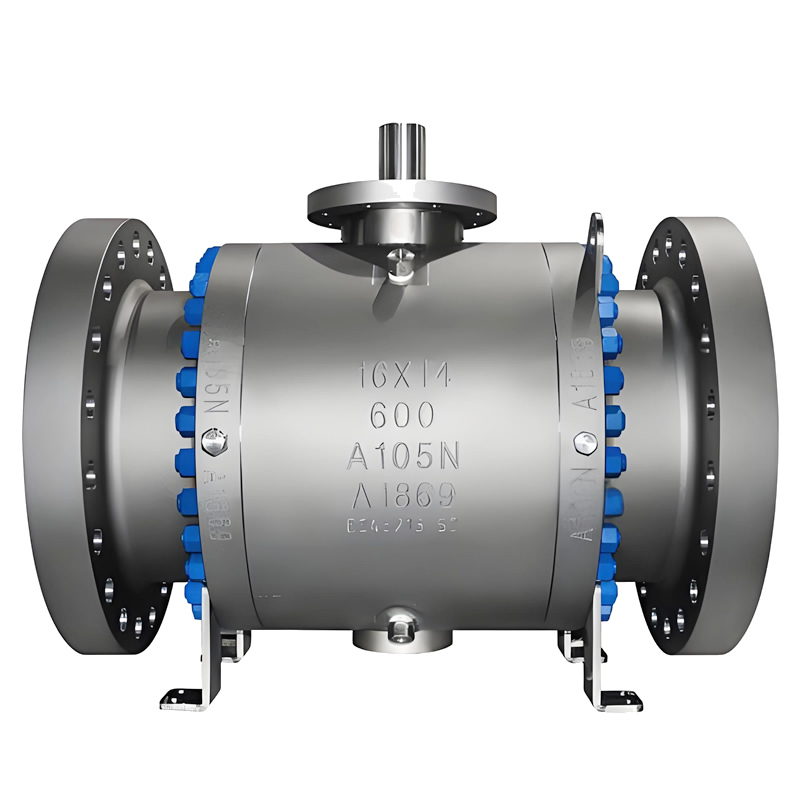
Constructed from A105N forged carbon steel (ASTM A105N), a material renowned for its high tensile strength, impact resistance, and cost-effectiveness in high-pressure services, this valve adheres to global industry standards including API 6D (pipeline valves), API 608 (trunnion-mounted ball valves), and ASME B16.34 (valve dimensions and pressure-temperature ratings). It is designed for a port size of 16×14” (DN400-DN350 equivalent) and Class 600 pressure rating, making it suitable for ultra-high-pressure pipelines handling oil, natural gas, and industrial fluids.
The valve features a flanged connection for secure, leak-tight installation and a metal-to-metal hard seal configuration to withstand harsh media, high temperatures, and abrasive particles common in oil & gas applications. Drive options include manual (lever/worm gear), pneumatic, electric, hydraulic, and electro-hydraulic actuation—catering to manual, semi-automated, and fully integrated process control systems. Whether deployed in cross-country oil pipelines, offshore oil platforms, or petrochemical refineries, this valve delivers uncompromising reliability, safety, and efficiency—establishing itself as a critical component in industries where operational integrity and compliance are non-negotiable.
II. Key Attribute Specifications
A. Dimensional & Pressure-Temperature Parameters
Port Size: 16×14” (equivalent to DN400-DN350), with a size range of 2” to 24” (DN50 to DN600) to accommodate diverse pipeline requirements. The full-port design ensures the valve’s internal bore matches the pipeline diameter, minimizing pressure drop (Cv value up to 1500 for 16×14” size) and enabling pipeline pigging/cleaning—critical for oil & gas transmission lines.
Pressure Rating: Class 600 (PN100), engineered for ultra-high-pressure applications. Hydrostatic testing follows API 598: 1.5× rated pressure (900LB/PN150) for the valve shell (body/bonnet) and 1.1× rated pressure (660LB/PN110) for seats—ensuring no leakage, sweating, or structural deformation under operating conditions.
Temperature Range: -29℃ to 425℃, optimized for A105N carbon steel’s thermal stability and hard-seal compatibility. This range covers heated crude oil, natural gas, and high-temperature industrial media (e.g., process steam), outperforming soft-sealed valves that degrade above 200℃.
B. Material Composition
Each component is selected for high-pressure resilience, wear resistance, and compatibility with oil, gas, and industrial fluids:
Valve Body & Bonnet: A105N Forged Carbon Steel (ASTM A105N), a normalized alloy with tensile strength of 485–655MPa and yield strength ≥240MPa. It undergoes forging and normalizing heat treatment (900–950℃, air-cooled) to relieve internal stresses and enhance machinability.
Ball & Trunnions: Solid A105N carbon steel ball with precision-ground surface finish (Ra ≤0.2μm) for uniform sealing contact. Trunnions (upper/lower) are integral to the ball, made from the same A105N material and surface-hardened (HRC 30–35) to reduce wear. For abrasive media (e.g., natural gas with sand particles), the ball’s sealing surface is hard-faced with Stellite 6 (cobalt-chromium alloy, HRC ≥58) to extend service life by 3–5 times.
Seal Materials:
Hard Seal: Metal-to-metal sealing with Stellite 6 overlay on valve seats, delivering ANSI/FCI Class IV leakage performance—ideal for high-temperature, high-pressure, and abrasive media (e.g., crude oil, natural gas).
Optional Soft Seal: PTFE/RPTFE for low-temperature, non-abrasive media (e.g., purified natural gas), providing ANSI/FCI Class VI bubble-tight sealing (near-zero leakage).
Valve Stem: A105N carbon steel or 17-4PH precipitation-hardened stainless steel, featuring an anti-blowout design to prevent ejection under pressure. Sealed with graphite-impregnated PTFE packing to minimize fugitive emissions (compliant with ISO 15848-1 Class BH).
Flanges & Fasteners: Integral flanges machined to ASME B16.5 standards with Raised Face (RF) or Ring Type Joint (RTJ) finishes. Fasteners are ASTM A193 B7 alloy steel bolts and ASTM A194 2H nuts—offering high tensile strength (≥827MPa) and resistance to vibration-induced loosening.
Gaskets: Spiral-wound gaskets (carbon steel with graphite filler) complying with ASME B16.20, ensuring leak-tight flange sealing under pressure and temperature fluctuations.
C. Connection & Operational Features
Connection Type: Flanged (ANSI B16.5/ASME B16.47) as standard:
RF Flange: Suitable for Class 150-300 applications, providing a secure seal with spiral-wound gaskets—ideal for general industrial and natural gas distribution use.
RTJ Flange: Standard for Class 600 ultra-high-pressure systems (e.g., offshore oil platforms), using metal ring gaskets to withstand extreme pressure and prevent fugitive emissions.
Drive Options:
Manual: Worm gear operation as standard for large-size valves, reducing torque requirements by 5–10 times and enabling single-person operation.
Pneumatic: Double-acting (compressed air for both opening and closing) or spring-return (auto-close/open on air supply loss) actuators. Cycle times for large-size valves range from 20–40 seconds, making spring-return models ideal for emergency shutdowns in oil & gas pipelines.
Electric: Quarter-turn electric actuators with 4–20mA control signals, integrating with SCADA/DCS systems for remote monitoring and automation. IP67-rated enclosures ensure protection against dust and water, suitable for outdoor pipeline installations.
Hydraulic/Electro-Hydraulic: For ultra-high-torque applications (24”+ or Class 600), providing precise control in heavy-industry settings (e.g., large-scale refineries).
Functional Features:
Trunnion Mounted Design: Trunnion support distributes fluid pressure forces to bearings, eliminating seat deformation and reducing operational torque—critical for high-pressure Class 600 applications.
Bidirectional Sealing: Dual seats (upstream/downstream) enable reliable shut-off in both flow directions, simplifying pipeline design and eliminating installation direction constraints.
Anti-Static Device: A conductive spring connecting the ball, stem, and body dissipates static charges (resistance ≤10Ω)—essential for natural gas and oil applications to prevent spark-induced explosions.
Fire-Safe Design: Compliant with API 607, ensuring metal-to-metal sealing if non-metallic components (e.g., packing) degrade in a fire—preventing catastrophic media release.
D. Certifications & Compliance
Design & Manufacturing Standards: API 6D (pipeline valves), API 608 (trunnion-mounted ball valves), ASME B16.34 (valve pressure-temperature ratings), ASME B16.5 (flange dimensions), API 598 (valve testing and inspection).
Quality & Safety Certifications: ISO 9001 (quality management), CE (EU safety compliance), ATEX (optional for explosive gas atmospheres), IECEx (global hazardous area compliance).
Performance Certifications: NACE MR0175 (optional for sour gas service with H₂S), ISO 15848-1 (fugitive emissions), ANSI/FCI Class IV (leakage).
III. Feature Description
A. Trunnion Mounted Design: Stability in Ultra-High Pressure
The trunnion-mounted (fixed ball) configuration is the cornerstone of this valve’s performance, addressing critical limitations of floating ball valves in oil & gas and high-pressure applications:
Pressure Force Distribution: Fluid pressure acts on the ball, but trunnions transfer these forces to robust bearings—preventing the ball from shifting into the valve seats. This eliminates seat deformation, a common issue in floating ball valves that increases operational torque and shortens seal life. In a Class 600 offshore oil pipeline, this design maintains consistent sealing for 8–12 years, compared to 3–5 years for floating ball alternatives.
Low Operational Torque: Trunnion support reduces friction between the ball and seats, lowering torque requirements by 40–50% compared to floating ball valves. A 16×14” worm gear-operated model requires only 150 N·m of torque to operate—enabling manual control without specialized tools, even in high-pressure Class 600 systems.
High-Pressure Resilience: The trunnion structure withstands Class 600 pressures without structural failure. In an offshore oil wellhead (Class 600), the valve handles 15MPa pressure spikes without leakage, outperforming floating ball valves that risk seat damage under such extreme conditions.
B. A105N Carbon Steel Construction: Durability & Cost-Effectiveness
A105N forged carbon steel is the material of choice for ultra-high-pressure valves, balancing performance, durability, and economics:
Ultra-High-Pressure Strength: Forged A105N offers superior tensile and yield strength compared to cast materials, making it suitable for Class 600 high-pressure applications. In hydrostatic testing, the A105N body withstands 1.5× Class 600 pressure (900LB/PN150) without deformation—ensuring safety in over-pressure scenarios (e.g., pump surges, pipeline blockages).
Cost-Effectiveness: A105N is more affordable than stainless steel (e.g., 304/316) while delivering comparable strength in non-corrosive oil & gas media. For large-scale oil pipeline projects with 100+ valves, this translates to 30–40% cost savings without compromising performance.
Thermal Stability: A105N retains its mechanical properties up to 425℃, making it suitable for heated media applications (e.g., crude oil heating systems, process steam lines) where lower-grade materials would soften or deform.
Machinability & Weldability: A105N’s excellent machinability enables precision CNC machining of critical surfaces (flanges, trunnion seats), ensuring dimensional accuracy. Its weldability allows for on-site modifications or repairs—critical for remote pipeline installations where valve replacement is time-consuming and costly.
C. Hard-Seal Performance: Reliability in Harsh Media
The metal-to-metal hard-seal configuration is engineered to withstand the harsh conditions of oil & gas and industrial applications:
High-Temperature Compatibility: Stellite 6 hard-facing retains its hardness (≥58 HRC) up to 425℃, making the valve suitable for high-temperature media (e.g., heated crude oil, natural gas, industrial steam) where soft seals (PTFE) would degrade rapidly. In a refinery’s hot oil line (380℃), the hard-seal valve operated reliably for 10 years, while a soft-sealed valve required quarterly seat replacements.
Abrasive Media Resistance: The hard-sealed surface resists wear from particulate-laden media (e.g., natural gas with sand, crude oil with sediment). In a rural natural gas pipeline with fine dust particles, the valve withstood abrasive wear for 8 years, outperforming soft-sealed valves that failed within 2 years.
Leak-Tight Sealing: The precision-ground metal-to-metal seal achieves ANSI/FCI Class IV leakage performance (≤0.1×DN mm³/min for gas), preventing fugitive emissions of oil and natural gas. This compliance with environmental regulations (e.g., EPA Methane Rules, EU Industrial Emissions Directive) avoids costly fines and reduces safety risks in residential or industrial areas.
D. Flanged Connection: Secure Installation & Maintenance Ease
Flanged connections offer practical advantages for oil & gas pipelines and industrial systems:
Leak-Tight Sealing: Bolted flanges distribute clamping force evenly across the gasket, ensuring a secure seal even under vibration or pressure fluctuations. In a 16×14” oil pipeline, this design prevented fugitive emissions of crude oil, meeting strict safety standards for pipeline operations.
Easy Installation & Retrofit: Flanges align with standard pipeline components, reducing installation time by 30% compared to welded valves. When upgrading an existing natural gas line, the valve can be installed without cutting the pipeline—minimizing downtime for utilities or oil & gas operators.
Simplified Maintenance: Flanged valves can be disassembled for seat replacement or stem packing adjustment without removing the valve from the pipeline. In a refinery, this reduced maintenance time for large-size valves from 8 hours (welded valves) to 2 hours—critical for continuous-process operations where unplanned downtime costs thousands of dollars per hour.
E. Multi-Drive Adaptability: Flexibility for Diverse Operations
The valve’s modular drive design ensures compatibility with manual, semi-automated, and fully integrated systems—adapting to the unique needs of oil & gas, natural gas, and industrial applications:
Manual Operation: Worm gear operators enable easy manual control of large-size valves, ideal for remote pipeline sections or low-frequency use (e.g., emergency isolation in natural gas storage facilities). The ergonomic handwheel and 90-degree rotation reduce operator fatigue.
Pneumatic Actuation: Spring-return pneumatic actuators provide critical fail-safe operation—auto-closing the valve if air supply fails, a non-negotiable feature for oil & gas pipelines where uncontrolled media release poses severe safety and environmental risks. Double-acting pneumatic actuators offer rapid cycle times for high-frequency applications (e.g., refinery process lines).
Electric Actuation: Electric actuators with remote control capabilities integrate seamlessly with SCADA/DCS systems, enabling centralized monitoring and control. For cross-country oil pipelines or large refineries, this eliminates the need for on-site operators, reducing labor costs and safety risks associated with manual intervention.
API 6D/608 ASME Class 600 High-Pressure A105N Trunnion Mounted Flange Ball Valve
IV. Manufacturing Processes
A. Material Inspection & Preparation
Raw material quality is foundational to the valve’s high-pressure and oil & gas compatibility, so all components undergo rigorous testing:
A105N Carbon Steel Verification: Forged A105N billets are tested via spectral analysis to confirm chemical composition (C: 0.25–0.35%) and ultrasonic testing (UT) to detect internal defects (porosity, cracks, inclusions). Mechanical testing (tensile strength, impact resistance, hardness) ensures compliance with ASTM A105 standards, with results documented in Material Test Reports (MTRs) for full traceability.
Heat Treatment: A105N billets undergo normalizing (900–950℃, air-cooled) to relieve forging stresses and improve machinability. This step is critical for preventing fatigue cracking in high-pressure cyclic operations.
Hard-Seal Material Validation: Stellite 6 alloy is tested for hardness (≥58 HRC) via Rockwell testing and chemical composition (Co: 50–60%, Cr: 25–30%) to ensure wear resistance in abrasive oil & gas media.
B. Valve Body & Ball Fabrication
Body Manufacturing: A105N valve bodies are produced via forging to ensure material density and structural integrity—forging eliminates internal porosity, critical for ultra-high-pressure Class 600 service. Forged blanks are cleaned via shot blasting to remove scale and surface impurities.
CNC Machining: Critical surfaces—flange faces, trunnion bearings, and seat pockets—are machined using 5-axis CNC centers. Flange faces are machined to ASME B16.5 flatness (≤0.05mm/m) and surface finish (Ra ≤3.2μm) for proper gasket seating. Trunnion seats are machined to a tolerance of ±0.02mm to ensure proper ball alignment. The valve’s internal flow path is polished to reduce friction and minimize pressure drop.
Ball & Trunnion Fabrication: Solid A105N carbon steel balls are precision-turned and ground using spherical grinders to achieve a surface finish of Ra ≤0.2μm—ensuring uniform contact with the hard seal. Trunnions (upper/lower) are integral to the ball, heat-treated for hardness (HRC 30–35) and machined to match the valve body’s bearing seats. For abrasive media, Stellite 6 is applied to the ball’s sealing surface via plasma transfer arc (PTA) welding, then ground to restore sphericity.
C. Seal & Actuator Integration
Assembly is performed in a controlled, clean environment (Class 10,000) to ensure precision and reliability—critical for oil & gas applications where even minor defects can lead to leaks:
Trunnion & Bearing Installation: Upper and lower trunnions are press-fitted into the valve body, with PTFE-impregnated bronze bearings to reduce friction. Bearings are lubricated with high-temperature grease (resistant to 200℃) to ensure smooth operation over thousands of cycles.
Ball & Stem Assembly: The ground A105N ball is inserted into the body, and the stem is connected via a drive key—ensuring torque transfer during operation. The stem packing (graphite-PTFE) is installed in layers, with controlled compression (10–15% compression rate) to balance sealing performance and operational torque.
Drive Mounting: Actuators (manual worm gear, pneumatic, electric) are mounted via an ISO 5211 adapter flange, with laser alignment to ensure coaxiality (stem runout ≤0.05mm)—preventing binding or premature wear. For pneumatic/electric actuators, limit switches are calibrated to trigger at fully open/closed positions, protecting seals from over-travel.
D. Quality Testing & Certification
Every valve undergoes comprehensive testing to meet API/ASME standards and oil & gas industry requirements:
Hydrostatic Testing: Per API 598, the valve shell is tested at 1.5× rated pressure (900LB/PN150 for Class 600) for 30 minutes—no leakage, sweating, or deformation is allowed. Seat testing is performed at 1.1× rated pressure (660LB/PN110 for Class 600), with leakage measured via bubble counting (≤1 bubble per minute for Class IV).
Pneumatic Testing: For natural gas service, the valve is tested with nitrogen at 0.6MPa to confirm airtight sealing—critical for preventing gas leaks in hazardous environments.
Operational Testing: The valve is cycled 100 times (open/close) to verify smooth operation, consistent torque, and actuator response. Manual override (for pneumatic/electric models) is tested to ensure functionality during emergencies.
Non-Destructive Testing (NDT): Welds (e.g., Stellite 6 seat welds) undergo liquid penetrant testing (PT) to detect surface cracks; the A105N body and trunnions are inspected via magnetic particle testing (MPI) to confirm structural integrity.
Fugitive Emissions Testing: Per ISO 15848-1, the valve is tested for fugitive emissions at the stem and body-bonnet joint, meeting Class BH standards (≤100 ppmv for methane)—critical for natural gas applications.
E. Final Inspection & Documentation
Visual Inspection: The valve is checked for surface defects (scratches, dents), proper marking (size, pressure rating, material, serial number), and compliance with ASME B16.34. Marking is permanent (laser-etched) for traceability in oil & gas pipeline systems.
Documentation: Each valve includes an MTR for A105N carbon steel, hydrostatic/pneumatic test reports, fugitive emissions test certificates, and compliance documents (API 6D, ISO 9001). For hazardous area applications, ATEX/IECEx certificates are provided to confirm compliance with global oil & gas safety standards.
V. Product Advantages
A. Ultra-High-Pressure Reliability for Oil & Gas
The trunnion-mounted design and A105N carbon steel construction enable the valve to withstand Class 600 pressures without structural failure—critical for oil & gas pipelines and high-pressure industrial systems. In cross-country natural gas pipelines, this translates to consistent performance under pressure fluctuations, reducing the risk of catastrophic leaks and ensuring operational safety. The trunnion-supported ball eliminates seat deformation, a common cause of failure in floating ball valves under high pressure.
B. Extended Service Life in Harsh Media
A105N carbon steel’s strength, Stellite 6 hard-seal wear resistance, and trunnion-supported design extend the valve’s service life to 8–12 years in typical oil & gas applications—2–3 times longer than floating ball valves with soft seals. For a natural gas utility using 50 large-size valves, this saved $200,000 over 10 years by avoiding frequent seal replacements and valve repairs.
C. Cost-Effective Performance for Large-Scale Projects
A105N carbon steel offers a favorable balance of performance and cost, making the valve an economical choice for large-scale oil & gas pipeline projects. Compared to stainless steel valves, A105N models cost 30–40% less while delivering comparable strength in non-corrosive oil & gas media. The total cost of ownership (initial purchase + maintenance + downtime) is 40–50% lower than premium alloy valves over a 10-year lifecycle—ideal for budget-conscious oil & gas operators.
D. Safety & Regulatory Compliance
Anti-static features, fail-safe pneumatic actuation, and fire-safe hard seals make the valve ideal for oil & gas and natural gas applications. ATEX/IECEx certification ensures compliance with global hazardous area standards, while NACE MR0175 compliance (optional) enables use in sour gas service—protecting against sulfide stress cracking. These features mitigate risks of explosions, gas leaks, and environmental damage, supporting a safer workplace and regulatory compliance.
E. Versatility Across Oil & Gas and Industrial Sectors
Multi-drive options, flange compatibility, and broad pressure/temperature ranges make the valve adaptable to diverse applications—from cross-country oil pipelines to natural gas distribution networks, refinery process lines to industrial production facilities. Its bidirectional sealing and full-port design further enhance versatility, eliminating installation constraints and supporting pipeline design flexibility.
VI. Product Applications
A. Oil & Gas Pipeline Industry
Cross-Country Oil Transmission: 16×14” Class 600 valves control flow in long-distance crude oil pipelines. The full-port design minimizes pressure drop, reducing pumping energy costs, while the trunnion-mounted design ensures stable sealing under pressure fluctuations. Spring-return pneumatic actuation provides emergency shutdown capability, preventing oil spills during supply interruptions.
Offshore Oil Platforms: Large-size Class 600 valves with RTJ flanges handle high-pressure oil flow in offshore wellheads and processing systems. The fire-safe and anti-static features mitigate risks in harsh marine environments, while the A105N construction withstands corrosive saltwater exposure.
Natural Gas Transmission: 10”–24” Class 600 valves control flow in cross-country natural gas pipelines. The full-port design enables pipeline pigging/cleaning, while the hard-seal configuration prevents fugitive methane emissions—complying with environmental regulations.
B. Petrochemical & Refining Industry
Refinery Process Lines: 6”–24” Class 600 valves regulate flow of gasoline, diesel, and chemical intermediates in distillation columns and reactors. The hard-seal design withstands high temperatures (up to 425℃) and abrasive media, while electric actuation enables precise process control.
Petrochemical Reactors: 8”–20” Class 600 valves with Stellite 6 trim handle high-pressure feedstock flow to reactors. The bidirectional sealing simplifies pipeline design, as the valve can be installed without flow direction constraints.
Hydrocarbon Storage: 12”–24” Class 600 valves control flow of stored hydrocarbons (crude oil, natural gas liquids) in storage tanks. The fail-safe pneumatic actuation provides emergency shutdown capability, preventing tank overflows.
C. Power Generation Industry
Thermal Power Plants: 8”–16” Class 600 valves regulate fuel oil and natural gas flow to boilers in thermal power plants. The A105N construction withstands high temperatures, while the full-port design minimizes pressure drop—improving combustion efficiency.
Nuclear Power Plants: 6”–12” Class 600 valves control service water flow in reactor cooling systems. The metal-to-metal seal ensures leak-tight performance, critical for preventing contamination in nuclear environments.
D. Industrial Manufacturing
Steel Mills: 10”–20” Class 600 valves manage blast furnace gas and cooling water flow. A105N’s durability resists industrial dust and cyclic pressure, while the trunnion design ensures long-term sealing integrity.
Chemical Plants: 6”–18” Class 600 valves handle corrosive chemicals (e.g., acids, solvents) with optional stainless steel trim. The hard-seal design prevents chemical leaks, ensuring workplace safety and environmental compliance.
VII. Customization Advantage
TIANYU A105N trunnion mounted flange ball valve (Class 600, 16×14”) delivers ultra-high-pressure reliability, durability, and safety for oil & gas, petrochemical, and industrial systems. Its trunnion design, A105N construction, and metal hard seal ensure stable performance in harsh environments.
Customize with 316L/2205 duplex steel for corrosive media, Stellite 6/ceramic trim for abrasives, higher pressure ratings (900LB+), or electric/hydraulic actuation for automation. Opt for NACE MR0175 compliance for sour gas, RTJ flanges for ultra-high pressure, or low-temperature packing for cryogenic applications. Tailor to your media, pressure, and operational needs for optimal performance.
API 6D ASME B16.34 CE DN200/DN300/DN400 PN80 LF2 Carbon Steel Body 321 Stainless Steel Ball Full Welded Manual Stem Hard Seated Ball Valve is a premium high-pressure fluid control solution engineered for critical industrial applications, blending LF2 carbon steel’s structural strength with 321 stainless steel’s corrosion resistance and Stellite 6 hard seats’ durability. Its full welded design eliminates leak points, while the manual light stem ensures precise, reliable operation. Certified to API 6D, ASME, and CE standards, and backed by ISO 9001/API Q1 quality assurance, it excels in oil and gas transmission, petrochemical refining, and power generation. Fire-safe, low-emission, and maintainable, it delivers zero-leakage performance, regulatory compliance, and long-term value for large-flow, high-pressure pipeline systems worldwide.