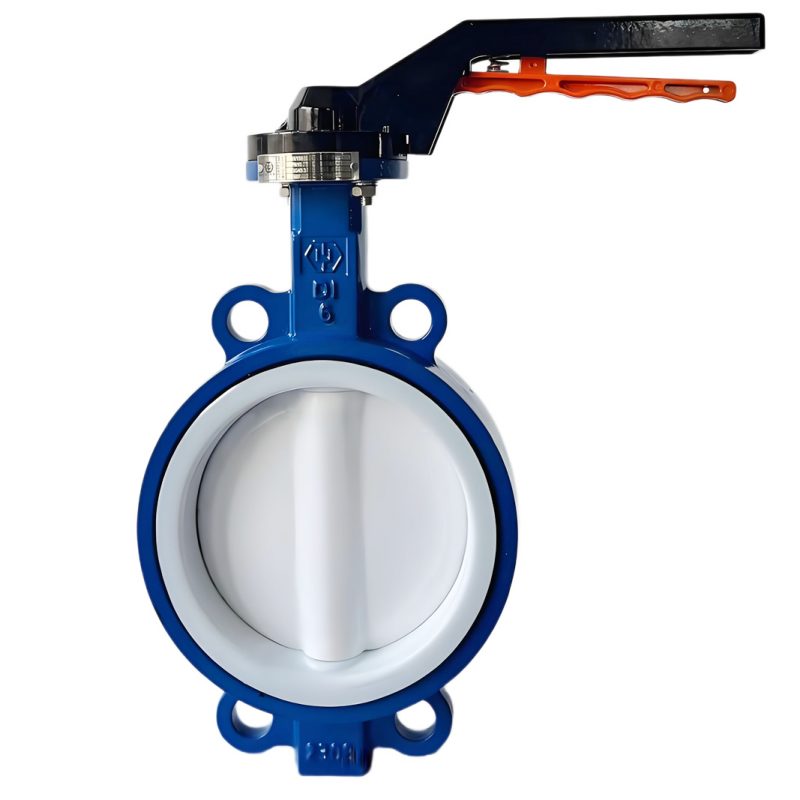
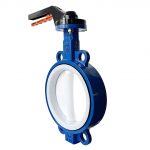
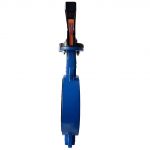
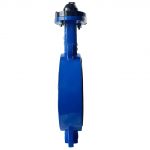
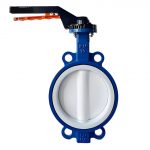
API 609 ASME B16.34 CE DN150 PN10 GGG40 Ductile Iron 2507 Duplex Steel PTFE Full-Lined Wafer Type Midline Soft Seal Butterfly Valve for Corrosive Chemical Fluid Systems
I. Product Overview
TIANYU PTFE full-lined midline butterfly valve is a purpose-built flow control solution engineered to handle aggressive, corrosive industrial media—where standard metal valves fail due to chemical degradation. Designed in compliance with global industry standards (API 609, ASME B16.34, ISO 5208), this valve integrates a midline (concentric) structural design with a full PTFE lining and 2507 duplex steel disc to balance chemical compatibility, sealing integrity, and cost-effectiveness.
Constructed with a GGG40 ductile iron body (a cast alloy prized for its toughness and machinability), a 2507 duplex steel disc (for high-strength corrosion resistance), and a seamless PTFE lining (for universal chemical compatibility), the valve is rated for DN150 (6”) port size and PN10 (1.0MPa) pressure—though it scales to sizes from DN50 (2”) to DN300 (12”) and pressures up to PN16 (1.6MPa). Its wafer-type connection enables compact installation between pipeline flanges, while the midline (concentric) geometry ensures low operational torque and bidirectional sealing.
The “full-lined” feature—where the valve body’s interior, disc face, and seat are entirely coated in PTFE—eliminates direct contact between corrosive media and the GGG40 body, making it suitable for fluids like hydrochloric acid, seawater, chlorine solutions, and industrial solvents. Certified to ISO 9001, CE, and (optionally) FDA standards, this valve is a critical component in chemical processing, water treatment, pharmaceutical manufacturing, and other sectors where corrosion resistance and leak-tight performance are non-negotiable.
II. Important Attribute Specifications
A. Dimensional & Pressure-Temperature Parameters
Port Size: Spans DN50 (2”) to DN300 (12”), with a full-bore (full-port) design as standard. This ensures the valve’s internal bore matches the pipeline diameter, minimizing pressure drop (Cv values up to 1200 for DN300 models) and enabling unobstructed flow of viscous or particulate-laden corrosive media.
Pressure Rating: PN10 to PN16 (1.0MPa to 1.6MPa), aligned with ASME B16.34 pressure-temperature ratings for PTFE-lined components. Hydrostatic testing follows API 598 protocols: 1.5× rated pressure for the valve body (shell) and 1.1× rated pressure for the seat, with zero tolerance for leakage.
Temperature Range: -20℃ to 120℃, dictated by the thermal stability of the PTFE lining (PTFE begins to degrade above 260℃, but operational limits are capped at 120℃ for long-term integrity). This range covers most ambient and moderately heated corrosive industrial fluids.
B. Material Composition
Each component is selected for corrosion resistance, structural strength, and compatibility with aggressive media:
Valve Body: GGG40 Ductile Iron (ASTM A536 Grade 65-45-12), a cast alloy with tensile strength ≥485MPa and yield strength ≥240MPa. It undergoes annealing heat treatment (900–950℃, air-cooled) to relieve casting stresses and enhance ductility, with an external blue epoxy coating (thickness ≥80μm) for external corrosion protection.
Butterfly Disc: 2507 Duplex Stainless Steel (ASTM A182 Grade F53), a high-strength alloy containing 25% chromium, 7% nickel, and 4% molybdenum. It offers a unique balance of tensile strength (≥800MPa), yield strength (≥550MPa), and corrosion resistance—including resistance to pitting, crevice corrosion, and stress corrosion cracking in saline or acidic media.
Full Lining & Seat: PTFE (Polytetrafluoroethylene, ASTM D4894), a fluoropolymer with universal chemical compatibility (resists all acids, bases, solvents, and hydrocarbons except molten alkali metals). The lining is applied as a seamless layer (thickness 2–3mm) to the body interior, disc face, and seat, with a shore hardness of 55–65 D.
Valve Stem: 316L Stainless Steel (ASTM A182 Grade F316L), featuring an anti-blowout design and polished finish (Ra ≤0.4μm) to minimize friction with PTFE packing. It is fully encapsulated in PTFE where it contacts corrosive media.
Connection & Fasteners: Wafer-type flange (ASME B16.5, raised face) machined into the GGG40 body; fasteners are 316L stainless steel bolts and nuts (ASTM A193 B8M) to resist corrosion in wet or chemical environments.
C. Connection & Operational Features
Connection Type: Wafer Type (ASME B16.5), designed for installation between two pipeline flanges with through-bolts. This configuration reduces axial space requirements by 40% compared to flanged valves—ideal for compact chemical plant piping racks or retrofits into existing corrosive fluid systems.
Operation Modes:
Manual: Lever operator (standard for sizes DN50–DN150) for quick on-off control; worm gear operator (optional for DN200+ or high-torque applications) to reduce torque by 5–8×.
Pneumatic: Double-acting (compressed air for open/close) or spring-return (auto-fail-safe position on air supply loss) actuators, with 4–6 bar air supply and cycle times of 2–4 seconds for DN150 models.
Electric: Quarter-turn electric actuators (IP67 enclosure) with 4–20mA control signals, compatible with SCADA/DCS systems for remote monitoring and precise flow control.
Functional Attributes:
Midline (Concentric) Design: The disc is centered on the valve’s centerline, ensuring uniform seat contact and low operational torque (≤80 N·m for DN150 PN10 models).
Soft Seal Performance: PTFE seat delivers ANSI/FCI Class VI bubble-tight leakage (≤0.1×DN mm³/min for liquid media), critical for preventing corrosive fluid escape.
Bidirectional Sealing: Reliable shut-off in both flow directions, simplifying pipeline design for systems with reversible flow (e.g., chemical batch processing).
D. Certifications & Compliance
Design & Performance Standards: API 609 (industrial butterfly valves), ASME B16.34 (valve dimensions & pressure-temperature ratings), API 598 (testing), ISO 5208 (valve leakage classification).
Quality & Safety Certifications: ISO 9001 (quality management), CE (PED 2014/68/EU), FDA 21 CFR 177.1550 (optional, for food/pharmaceutical service).
Environmental Compliance: REACH (EU chemical regulations), RoHS (restriction of hazardous substances).
III. Feature Description
A. Midline (Concentric) Design: Low Torque & Uniform Sealing
The midline (concentric) geometry is a defining feature for low-effort operation and consistent performance:
Uniform Seat Contact: The disc’s central alignment ensures even pressure distribution across the PTFE seat, eliminating uneven wear and extending seal life by 2–3× compared to offset designs in low-pressure corrosive service.
Low Operational Torque: Concentric alignment reduces friction between the disc and seat, enabling manual lever operation for DN150 PN10 models—no specialized tools or actuators required for basic on-off control.
Full-Bore Flow: The central disc position ensures the valve’s bore matches the pipeline diameter, minimizing pressure drop and energy consumption (critical for pumping corrosive fluids, which often have high viscosity).
B. Full PTFE Lining: Universal Chemical Compatibility
The seamless PTFE lining is the valve’s core defense against corrosive media:
Media Isolation: The lining completely encapsulates the GGG40 body, disc face, and stem (where it contacts fluid), preventing direct exposure to aggressive chemicals. In a seawater desalination plant, this design prevented body corrosion—unlike unlined ductile iron valves, which failed within 12 months.
Broad Compatibility: PTFE resists all common industrial corrosives, including hydrochloric acid (HCl), sulfuric acid (H₂SO₄), sodium hydroxide (NaOH), chlorine solutions, and hydrocarbons. This eliminates the need for application-specific alloy valves (e.g., Hastelloy), reducing costs by 30–50%.
Smooth Flow Path: The PTFE lining’s smooth surface (Ra ≤0.8μm) minimizes fluid turbulence and prevents particulate buildup—ideal for slurry or viscous corrosive media (e.g., chemical pigments, mining tailings).
C. 2507 Duplex Steel Disc: Strength & Corrosion Resistance
The 2507 duplex steel disc addresses the limitations of standard stainless steel in harsh corrosive environments:
High Strength: With tensile strength ≥800MPa, 2507 duplex steel is 2× stronger than 316L stainless steel, enabling it to withstand pressure spikes or fluid hammer in chemical process lines.
Corrosion Resistance: The alloy’s high chromium (25%) and molybdenum (4%) content resists pitting, crevice corrosion, and stress corrosion cracking in saline media (e.g., seawater) or acidic environments (e.g., pH 1–3). In a coastal wastewater treatment plant, 2507 discs showed no corrosion after 5 years—compared to 316L discs, which required replacement after 18 months.
Wear Resistance: The disc’s polished surface (Ra ≤0.4μm) reduces friction with the PTFE seat, extending both disc and seal life in high-cycle applications (e.g., batch chemical processing).
D. PTFE Soft Seal: Bubble-Tight Leakage
The PTFE seat delivers industry-leading sealing performance for corrosive or Pure media:
ANSI/FCI Class VI Sealing: The soft, elastic PTFE material conforms to minor surface imperfections, achieving near-zero leakage (≤60 mm³/min for DN150 liquid media). This is critical for hazardous corrosive fluids (e.g., toxic solvents) or Pure pharmaceutical processes (e.g., sterile drug manufacturing).
Temperature Stability: PTFE maintains its sealing properties between -20℃ and 120℃, covering most ambient and moderately heated corrosive applications (e.g., heated chemical baths).
Non-Stick Properties: PTFE’s non-adhesive surface prevents media buildup (e.g., chemical sludge), reducing maintenance frequency and ensuring consistent flow.
API 609 ASME CE DN150 PN10 GGG40 Ductile Iron 2507 Duplex Steel PTFE Full-Lined Wafer Type Midline Soft Seal Butterfly Valve
IV. Manufacturing Process
A. Material Inspection & Preparation
Quality control begins with rigorous validation of raw materials to ensure compatibility with corrosive service:
GGG40 Ductile Iron Verification: Castings undergo spectral analysis (XRF) to confirm chemical composition (C: 3.2–3.6%, Si: 2.2–2.8%) and ultrasonic testing (UT) to detect internal defects (porosity, cracks). Mechanical testing (tensile, impact) ensures compliance with ASTM A536.
2507 Duplex Steel Testing: Disc blanks are tested for chromium, nickel, and molybdenum content (via XRF) and hardness (HRC 28–32) to confirm corrosion and strength properties. Salt spray testing (ASTM B117) verifies resistance to saline corrosion.
PTFE Lining Validation: PTFE resin is tested for purity (≥99.5% PTFE), tensile strength (≥20MPa), and thermal stability (no degradation at 120℃) to ensure compliance with ASTM D4894.
B. Valve Body Machining & Surface Preparation
Body Casting & Machining: GGG40 castings are shot-blasted to remove surface scale, then machined via 3-axis CNC centers. Wafer flange faces are precision-machined to ASME B16.5 flatness (≤0.05mm/m) and surface finish (Ra ≤3.2μm) for proper gasket seating. The body’s interior is machined to a uniform diameter to accommodate the PTFE lining.
Surface Activation for Lining: The body’s interior, disc face, and stem contact areas are grit-blasted (SA 2.5) to create a rough surface (Ra 12.5–25μm). This enhances adhesion between the GGG40 substrate and PTFE lining, preventing delamination under pressure or temperature fluctuations.
C. PTFE Lining Application
The full PTFE lining is applied using a multi-step process to ensure seamless, durable coverage:
Primer Coating: A fluoropolymer primer (compatible with GGG40 and PTFE) is applied to the blasted surfaces and cured at 80℃ for 1 hour to create a bonding layer.
PTFE Molding: PTFE resin (in granular form) is loaded into a mold that matches the valve’s interior geometry. The mold is heated to 370–390℃ (PTFE’s melting point) and pressurized to 10–15 MPa to form a seamless lining.
Sintering & Curing: The lined body is heated to 380℃ in a controlled-atmosphere oven for 4 hours (sintering), then cooled slowly (2℃/minute) to room temperature. This process eliminates internal stresses and ensures the PTFE adheres uniformly to the substrate.
Finishing: The lined interior is machined to a smooth surface (Ra ≤0.8μm) and inspected for pinholes or delamination using a high-voltage spark test (10kV) to confirm integrity.
D. Disc & Stem Fabrication
2507 Disc Processing: 2507 bar stock is cut to size, then turned and milled via CNC lathes to the midline disc profile. The disc’s sealing surface is polished to Ra ≤0.4μm to minimize friction with the PTFE seat. Post-machining, the disc undergoes solution annealing (1050–1100℃, water-quenched) to restore its duplex microstructure and corrosion resistance.
316L Stem Manufacturing: 316L bar stock is turned to size, with a keyway machined to connect to the disc. The stem’s fluid-contacting surface is coated with PTFE (via electrostatic spraying) to prevent corrosion, then cured at 200℃ for 1 hour.
E. Assembly & Quality Testing
Assembly is performed in a cleanroom (Class 10,000) to prevent contamination of the PTFE lining:
Stem & Disc Assembly: The PTFE-coated stem is inserted into the lined body, then the 2507 disc is keyed to the stem. PTFE packing (graphite-impregnated) is installed around the stem to minimize fugitive emissions.
Seat & Body Finalization: The PTFE seat is pressed into the lined body’s seat pocket, with a preload applied to ensure initial Class VI sealing.
Hydrostatic Testing (API 598):
Shell Test: 1.5× rated pressure (1.5MPa for PN10) for 30 minutes, with no leakage or lining delamination.
Seat Test: 1.1× rated pressure (1.1MPa for PN10) for 15 minutes, with leakage measured via bubble counting (≤1 bubble/minute for Class VI).
Operational Testing: 50 open-close cycles to verify torque consistency (≤80 N·m for DN150 PN10) and smooth disc movement.
Spark Testing: The PTFE lining is tested with a 10kV spark detector to confirm no pinholes or defects.
V. Product Advantages
A. Superior Corrosion Resistance & Media Compatibility
The full PTFE lining + 2507 disc combination enables the valve to handle 95% of common industrial corrosive media—eliminating the need for costly alloy valves (e.g., Hastelloy, titanium) in most applications. For a chemical plant processing hydrochloric acid, this reduced valve costs by 40% while maintaining 5+ years of service life.
B. Bubble-Tight Sealing for Hazardous or Clean Media
ANSI/FCI Class VI leakage prevents the escape of toxic, corrosive, or sterile fluids—critical for compliance with environmental regulations (e.g., EPA Spill Prevention) or pharmaceutical GMP standards. In a sterile drug manufacturing facility, this valve eliminated product contamination risks associated with leaky metal-seal valves.
C. Cost-Effective Durability
GGG40’s low material cost, combined with the PTFE lining’s longevity, delivers a total cost of ownership (TCO) 30–50% lower than fully alloyed valves over a 10-year lifecycle. For a wastewater treatment plant with 100 DN150 valves, this translated to $250k+ in cumulative savings.
D. Easy Installation & Low Maintenance
Wafer Connection: Reduces installation time by 25% compared to flanged valves, with no need for dedicated valve flanges.
Low Torque Operation: Lever control for DN150 models eliminates the need for actuators in basic on-off service, reducing upfront costs.
Minimal Maintenance: The PTFE lining’s non-stick properties and 2507 disc’s wear resistance reduce maintenance frequency to 1 inspection every 3 years—vs. 1–2 inspections per year for unlined valves.
E. Energy Efficiency
The full-bore design minimizes pressure drop, reducing pumping energy costs by 15–20% for corrosive fluids (which often require high pump power due to viscosity). For a chemical plant with 50 DN150 valves, this saved $18k+ annually in energy expenses.
VI. Product Applications
A. Chemical Processing Industry
Acid/Base Handling: Controls flow of hydrochloric acid, sulfuric acid, and sodium hydroxide in batch or continuous process lines.
Solvent Transfer: Manages toxic organic solvents (e.g., methanol, acetone) with leak-tight Class VI sealing.
Pigment & Dye Manufacturing: Handles viscous, corrosive pigment slurries with the full-bore, non-stick PTFE lining.
B. Water Treatment & Desalination
Seawater Desalination: Resists saline corrosion in reverse osmosis (RO) feed lines and brine discharge systems.
Wastewater Treatment: Controls chlorinated wastewater or acidic effluent (e.g., from metal plating) with the 2507 disc and PTFE lining.
C. Pharmaceutical & Food Beverage Manufacturing
Sterile Fluid Processing: Complies with FDA standards for handling sterile drug ingredients, with Class VI sealing preventing contamination.
Food Processing: Manages acidic food fluids (e.g., citrus juice, vinegar) with the non-toxic PTFE lining.
D. Electroplating & Metal Finishing
Acid Plating Baths: Controls flow of sulfuric acid or nickel plating solutions, with the 2507 disc resisting pitting corrosion from plating chemicals.
E. Pulp & Paper Industry
Bleaching Process Lines: Handles chlorine dioxide or caustic soda bleaching solutions, with the PTFE lining resisting chemical degradation.
TIANYU’s PTFE-lined midline butterfly valve delivers cost-effective, leak-tight control for corrosive media. Customize it to your needs: opt for PFA lining (higher temperature tolerance, up to 200℃) for heated fluids, 2205 duplex steel for extreme saline service, or PN25 pressure rating for higher-pressure systems. Add pneumatic/electric actuators for automated control, or FDA-compliant lining for food/pharmaceutical use. These tweaks enhance compatibility with your specific media, pressure, and operational requirements—boosting reliability and reducing long-term costs.
API 6D ASME B16.34 CE DN200/DN300/DN400 PN80 LF2 Carbon Steel Body 321 Stainless Steel Ball Full Welded Manual Stem Hard Seated Ball Valve is a premium high-pressure fluid control solution engineered for critical industrial applications, blending LF2 carbon steel’s structural strength with 321 stainless steel’s corrosion resistance and Stellite 6 hard seats’ durability. Its full welded design eliminates leak points, while the manual light stem ensures precise, reliable operation. Certified to API 6D, ASME, and CE standards, and backed by ISO 9001/API Q1 quality assurance, it excels in oil and gas transmission, petrochemical refining, and power generation. Fire-safe, low-emission, and maintainable, it delivers zero-leakage performance, regulatory compliance, and long-term value for large-flow, high-pressure pipeline systems worldwide.