
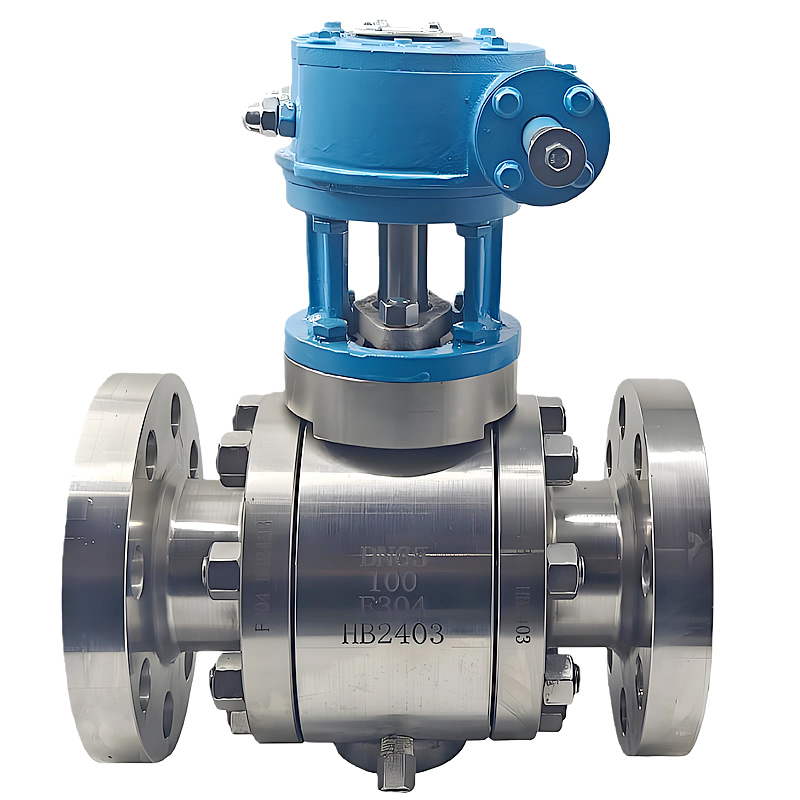
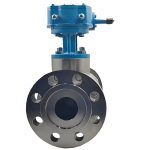
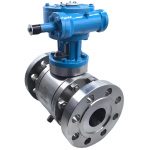
TIANYU API 608 GB/T 12237 ASME B16.34 CE Certified DN50-DN900 PN10-PN100 SS304/316 Forged 3PC Flange Trunnion Mounted Ball Valve – Manual/Pneumatic/Electric Operation for Petrochemical Water Treatment Power Industry
I. Product Overview
II. Important Attribute Specifications
A. Material Composition
- Valve Body, Bonnet & Flange: Forged SS304 (ASTM A182 F304) as standard—an austenitic stainless steel with chemical composition (Cr: 18–20%, Ni: 8–12%, C ≤0.08%) delivering tensile strength ≥515MPa, yield strength ≥205MPa, and excellent corrosion resistance to water, steam, and mild chemicals. Optional SS316 (ASTM A182 F316) for enhanced chloride resistance (ideal for coastal or chemical applications), duplex stainless steel (2205) for high strength and corrosion resistance, chrome-molybdenum steel (F22) for high-temperature service, and low-temperature steel (A350 LF2) for cryogenic applications down to -196℃. All forgings undergo ultrasonic testing (UT) to eliminate internal defects.
- Ball: Forged SS304/316 with special surface treatment (HF hardening) for wear resistance—Rockwell hardness ≥58 HRC. The ball features a full-port design to minimize pressure drop, with a precision-lapped sealing surface (Ra ≤0.4μm) ensuring uniform contact with the valve seat. For high-temperature or abrasive media, the ball is optionally coated with Stellite (cobalt-chromium alloy) to extend service life.
- Trunnions & Stem: SS304/316 stainless steel (ASTM A276) for trunnions and stem—providing corrosion resistance and structural stability. The stem features an anti-blowout design, with a enlarged shoulder that engages the bonnet to prevent ejection under excessive pressure. The trunnions are fitted with self-lubricating PTFE-impregnated bronze bearings, reducing operational torque and ensuring smooth rotation.
- Seat: Dual-material design with metal base (SS304/316) and replaceable inserts. EPDM (Ethylene Propylene Diene Monomer) inserts for general service (temperature range -40℃ to 120℃), compatible with water, steam, and mild alkalis. PTFE (Polytetrafluoroethylene) inserts for chemical compatibility (temperature -20℃ to 150℃), resistant to acids, solvents, and hydrocarbons. Graphite inserts for high-temperature service (up to 600℃), suitable for steam and hot oil applications. All seat inserts are preloaded with stainless steel springs for self-compensating sealing, accommodating minor wear or thermal expansion.
- Packing & Gaskets: Multi-layer flexible graphite packing with PTFE inner ring (complying with ISO 15848-1 Class AH for low fugitive emissions) for stem sealing. Bonnet gaskets are spiral-wound graphite with SS304/316 metal reinforcement (ASME B16.20), ensuring tight sealing under thermal cycling and pressure fluctuations. Flange gaskets are non-asbestos fiber-reinforced rubber or spiral-wound graphite, compatible with ASME B16.5/GB/T 9113 flanges.
- Fasteners: SS304/316 stainless steel bolts (ASTM A193 B8/B8M) and nuts (ASTM A194 8/8M) for corrosive environments; carbon steel bolts (ASTM A193 B7) and nuts (ASTM A194 2H) for general service—providing uniform clamping force across the flange and bonnet connections.
B. Dimensional & Pressure-Temperature Parameters
- Port Size (DN/NPS): DN50 (2”) to DN900 (36”), full-port design (bore diameter equal to nominal pipe size) to optimize flow efficiency. Flow coefficient (Cv) ranges from 120 (DN50) to 18,000 (DN900), minimizing pressure drop and energy consumption in high-flow applications (e.g., water transmission pipelines, petrochemical process lines).
- Pressure Rating: PN10 (1.0MPa), PN16 (1.6MPa), PN25 (2.5MPa), PN40 (4.0MPa), PN64 (6.4MPa), PN100 (10.0MPa)—aligned with ASME B16.34 and GB/T 12224 pressure-temperature ratings. At 20℃, PN100 models withstand 10.0MPa, making them suitable for high-pressure oil & gas and power generation applications.
- Temperature Range: -196℃ to 600℃, depending on seat material. Cryogenic service (-196℃) with low-temperature steel (A350 LF2) and PTFE seats; ambient to high-temperature service (up to 600℃) with graphite seats and F22 chrome-molybdenum steel body.
- End Connections: Flange (ASME B16.5, GB/T 9113, JB/T 79)—Raised Face (RF) as standard, Ring Type Joint (RTJ) optional for high-pressure PN64-PN100 service. Flange dimensions comply with global standards, ensuring compatibility with existing pipeline systems.
- Face-to-Face Dimensions: Compliant with API 608 and GB/T 12221, ranging from 178mm (DN50) to 1524mm (DN900)—ensuring interchangeability with valves from other manufacturers for easy retrofitting.
C. Operational Performance Parameters
- Sealing Performance: ANSI/FCI 70-2 Class IV (EPDM/PTFE seats) to Class V (graphite seats) sealing. For liquid media, leakage rate ≤0.01% of nominal flow; for gas media, leakage rate ≤0.1Nm³/h (DN50) under rated pressure—preventing media loss and environmental contamination.
- Actuation Options:
- Manual: Cast iron handwheel with anti-slip grip, worm gear operator for large-diameter valves (DN300+) to reduce operational torque (gear ratio 30:1 to 100:1).
- Pneumatic: Double-acting or spring-return pneumatic actuators (ISO 5211 mounting), explosion-proof (Ex d IIC T4) for hazardous environments, air supply pressure 0.4–0.6MPa, stroke time 5–30 seconds.
- Electric: AC/DC electric actuators (IEC 60534), with remote control, position feedback, and torque limiting functions, suitable for integration into SCADA systems, stroke time 10–60 seconds.
- Operating Torque: 50N·m (DN50, PN10) to 2500N·m (DN900, PN100) for manual operation; reduced by 40–60% with worm gear or actuator operation.
- Cycle Life: ≥100,000 open/close cycles under normal operating conditions, with maintenance interval of 24–36 months—extending service life and reducing downtime.
D. Certifications & Compliance
- Design & Manufacturing Standards: API 608, GB/T 12237, ASME B16.34, ISO 14313 (Pipeline Ball Valves), CE PED 2014/68/EU (Pressure Equipment Directive).
- Quality & Environmental Certifications: ISO 9001 (Quality Management System), ISO 14001 (Environmental Management), ISO 45001 (Occupational Health and Safety).
- Material Certifications: EN10204 3.1/3.2 Material Test Certificates (MTC), FDA 21 CFR 177.2600 (for food-grade applications), NACE MR0175 (for sour service).


III. Feature Description
A. Trunnion-Mounted Ball Design: Stability Under Extreme Pressure
- Pressure Load Distribution: The ball is secured by upper and lower trunnions, which absorb the thrust generated by media pressure—transferring loads to the valve body rather than the seats. This eliminates seat deformation and uneven wear, even under PN100 high pressure, ensuring consistent sealing performance over 100,000+ cycles.
- Low Operational Torque: Trunnion supports and self-lubricating bearings reduce friction between the ball and seats, lowering operational torque by 30–50% compared to floating ball valves of the same size. For DN600 PN100 valves, this enables manual operation with a worm gear operator, eliminating the need for expensive electric actuators in some scenarios.
- Bidirectional Sealing: The fixed ball alignment ensures uniform contact between the ball and dual seats, enabling reliable sealing in both flow directions—simplifying pipeline design and eliminating the need for check valves.
B. Three-Piece (3PC) Forged Body: Durability & Maintenance Flexibility
- Forged Integrity: Forging eliminates internal defects (porosity, shrinkage) common in cast bodies, delivering a dense, uniform grain structure that enhances tensile strength and resistance to cyclic pressure loads. Forged SS304/316 bodies withstand thermal shock and pressure surges without deformation—critical for high-temperature steam or cryogenic LNG service.
- On-Line Maintenance: The three-piece design (body, bonnet, end flanges) allows internal components (ball, seats, trunnions) to be inspected, repaired, or replaced without removing the valve from the pipeline. This reduces downtime by 60–70% compared to one-piece or two-piece valves, a key benefit for continuous-process facilities like refineries or water treatment plants.
- Modular Versatility: End flanges can be configured with different standards (ASME/GB) or sealing surfaces (RF/RTJ) on the same valve, accommodating non-standard pipeline setups and reducing the need for custom adapters.
C. Wide Temperature & Pressure Adaptability: Versatile Service Range
- Cryogenic Compatibility: With low-temperature steel (A350 LF2) body and PTFE seats, the valve operates reliably at -196℃—suitable for LNG storage and transfer, liquid nitrogen systems, and other cryogenic applications. The forged structure maintains toughness in low temperatures, preventing brittle fracture.
- High-Temperature Resilience: Graphite seats and F22 chrome-molybdenum steel body enable service up to 600℃—ideal for boiler steam lines, high-temperature oil processing, and power generation systems. Graphite’s inherent heat resistance ensures sealing integrity even under prolonged exposure to high temperatures.
- High-Pressure Stability: PN100 rating (10.0MPa) makes the valve suitable for high-pressure pipelines, wellhead equipment, and hydraulic systems. The trunnion design and forged body prevent blowout and leakage, meeting safety requirements for critical high-pressure service.
D. Advanced Sealing Systems: Reliable Closure & Emission Control
- Self-Compensating Seats: Stainless steel springs preload the seat inserts, ensuring constant contact with the ball. As the seat wears over time, the spring automatically pushes the seat forward—compensating for wear and maintaining sealing force. This extends seat life by 50% compared to non-compensating designs.
- Dual-Seal Options: EPDM/PTFE seats for general and chemical service deliver bubble-tight Class IV sealing, while graphite seats for high-temperature service provide Class V sealing—covering most industrial media requirements. For sour service (H₂S-containing media), optional metal-to-metal seats with Stellite overlay ensure corrosion and wear resistance.
- Low Fugitive Emissions: Multi-layer graphite packing meets ISO 15848-1 Class AH standards, limiting methane leakage to ≤100ppmv—complying with EU Industrial Emissions Directive and US EPA regulations, reducing environmental impact and avoiding fines.
E. Flexible Actuation: Tailored to System Requirements
- Manual Operation: Cost-effective for small-to-medium diameter valves (DN50-DN200) or systems with infrequent operation. The anti-slip handwheel and worm gear operator (for large valves) enable easy, tool-free control.
- Pneumatic Actuation: Fast, reliable operation for automated systems (e.g., batch processing lines). Spring-return actuators provide fail-safe functionality (open or closed on air failure), enhancing safety in hazardous environments.
- Electric Actuation: Ideal for remote or precision control (e.g., SCADA-integrated systems). Torque limiting and position feedback features prevent overloading and enable real-time monitoring of valve status.
IV. Manufacturing Process & Quality Control
A. Raw Material Procurement & Inspection
- Material Sourcing: Forged SS304/316 blanks, duplex steel, and low-temperature steel are sourced exclusively from ISO 9001-certified suppliers, with each batch accompanied by a Material Test Certificate (MTC) detailing chemical composition, mechanical properties, and heat treatment history.
- Material Verification: Incoming materials undergo spectral analysis (XRF) to confirm chemical compliance with ASTM/GB standards. Tensile, yield, and impact tests are performed on sample specimens—e.g., SS304 must meet tensile strength ≥515MPa and impact toughness ≥27J at -20℃.
- Non-Destructive Testing (NDT): Forged components (body, bonnet, ball, trunnions) undergo ultrasonic testing (UT) to detect internal cracks or inclusions, and magnetic particle testing (MPI) to inspect surface defects. Only defect-free materials proceed to machining.
B. Forging & Heat Treatment
- Precision Forging: Steel billets are heated in a controlled-atmosphere furnace to 1100–1250℃, then forged into body, bonnet, ball, and trunnion shapes using hydraulic presses (500–5000 tons). The forging ratio is maintained at ≥3:1 to ensure dense grain structure and uniform mechanical properties.
- Heat Treatment:
- SS304/316 components: Solution annealing (1040–1150℃, water-cooled) to restore corrosion resistance and relieve forging stress.
- Low-temperature steel (A350 LF2): Normalizing and tempering (890–920℃, air-cooled; 620–680℃, furnace-cooled) to enhance low-temperature toughness.
- Chrome-molybdenum steel (F22): Normalizing and tempering (900–940℃, air-cooled; 670–730℃, furnace-cooled) to improve high-temperature strength.
- Descaling & Cleaning: Forged parts are shot-blasted to remove surface oxide scale, then cleaned with ultrasonic baths to eliminate residual contaminants.
C. Precision Machining
- Body & Bonnet Machining: CNC lathes and mills process flange faces, seat pockets, and trunnion bores. Flange faces are machined to flatness ≤0.02mm/m and surface roughness Ra 1.6μm. Seat pockets are honed to coaxiality ≤0.01mm relative to the bore, ensuring uniform ball-seat contact. Trunnion bores are precision-drilled and reamed to fit bearings with clearance ≤0.02mm.
- Ball Machining: Forged balls are ground to spherical accuracy ≤0.005mm and lapped to Ra ≤0.4μm. Full-port bores are machined to match pipeline dimensions, with no sharp edges to minimize flow turbulence. HF hardening or Stellite overlay is applied to the sealing surface for wear resistance.
- Stem & Trunnion Machining: Stems are turned and ground to diameter tolerance ±0.01mm and polished to Ra ≤0.4μm. Trunnions are machined with precision threads for bearing installation, ensuring smooth rotation.
D. Assembly & Comprehensive Testing
- Component Cleaning: All parts (body, ball, seats, stem, packing) are degreased and ultrasonic-cleaned to remove oil, debris, and metal particles—preventing contamination of sealing surfaces.
- Assembly Sequence: Trunnion bearings are installed first, followed by the ball, stem, seats (with preloaded springs), packing, and bonnet. Fasteners are tightened in a crisscross pattern to uniform torque (per ASME B18.2.1) to ensure even clamping force.
- Pressure Testing:
- Hydrostatic Shell Test: 1.5× rated pressure applied to the body cavity for 30 minutes—no leakage, deformation, or pressure drop permitted.
- Hydrostatic Seat Test: 1.1× rated pressure applied to each seat (bidirectional) for 15 minutes—leakage measured via bubble counting, complying with ANSI/FCI Class IV/V.
- Pneumatic Test (Optional): 0.6MPa air pressure applied to the body and seats for 10 minutes—no audible leakage permitted.
- Operational Testing: The valve is cycled 50 times (open-close) to verify smooth operation, consistent torque, and correct actuator performance (for pneumatic/electric models).
- Specialized Testing:
- Cryogenic Test: For low-temperature models, testing at -196℃ to verify sealing and structural integrity.
- High-Temperature Test: For high-temperature models, testing at 600℃ to confirm seat performance.
- Fugitive Emissions Test: ISO 15848-1 Class AH compliance verified with methane and flame ionization detector (FID).
E. Final Inspection & Packaging
- Visual Inspection: Each valve is inspected for surface defects (scratches, dents), proper machining, and correct marking (DN, PN, TIANYU logo, standard certifications). Valves with surface scratches deeper than 0.05mm are rejected.
- Documentation: Each valve is shipped with a Documentation Package including MTC, Hydrostatic Test Certificate, EN10204 3.1/3.2 Certificate, and CE PED Declaration of Conformity.
- Packaging: Valves are packaged in plywood crates with foam insulation to prevent damage during transportation. Flange ends are capped with plastic protectors, and actuators are wrapped in waterproof film. Crates are labeled with handling instructions and product information for safe delivery.

V. Product Advantages
A. Exceptional Durability & Long Service Life
B. Reliable Sealing & Operational Safety
- Bubble-Tight Closure: Class IV/V sealing prevents media leakage—critical for handling toxic, flammable, or high-value fluids (e.g., crude oil, LNG). This eliminates product loss and environmental contamination risks.
- Safety Features: Anti-blowout stem, fire-safe design (optional API 607), and low fugitive emissions comply with global safety and environmental regulations. The trunnion design’s stability prevents valve failure under pressure surges, reducing accident risks in critical systems.
- Bidirectional Service: Eliminates the need for check valves, simplifying pipeline design and reducing potential failure points.
C. Low Lifecycle Costs
- Maintenance Savings: Three-piece design enables on-line maintenance, reducing downtime by 60% and labor costs by $15k–$50k per shutdown (depending on valve size). The 24–36 month maintenance interval minimizes operational disruptions.
- Energy Efficiency: Full-port design minimizes pressure drop, cutting pumping energy costs by 15–20% annually in continuous-flow systems (e.g., water transmission pipelines). For a DN500 PN40 valve handling 10,000m³/h of water, this saves ~$30k/year.
- Versatility: Wide material, pressure, and temperature ranges eliminate the need for multiple valve types across different process lines—reducing inventory costs and simplifying procurement.
D. Global Compatibility & Regulatory Compliance
E. Flexible Actuation & Adaptability
VI. Product Applications
A. Petrochemical & Oil & Gas Industry
- Upstream: Wellhead manifolds, production gathering lines, and drilling mud systems. The valve’s high-pressure rating (PN100) and corrosion resistance (SS316/duplex steel) handle crude oil, natural gas, and saltwater. Offshore platforms benefit from the valve’s durability and low maintenance needs.
- Midstream: Pipeline transmission systems for crude oil, natural gas, and LNG. Full-port design minimizes pressure drop, while cryogenic compatibility (A350 LF2) suits LNG transfer.
- Downstream: Refinery process lines (distillation, cracking), high-temperature steam systems, and product loading lines. The valve withstands 600℃ temperatures and corrosive process media (e.g., acids, solvents).
B. Power Generation Industry
- Thermal Power Plants: Boiler feedwater systems, steam lines, and flue gas desulfurization (FGD) systems. The valve’s high-temperature (up to 600℃) and high-pressure (PN100) capabilities handle steam and corrosive FGD media.
- Nuclear Power Plants: Auxiliary systems (cooling water, chemical injection) with low-temperature steel (A350 LF2) for cryogenic cooling water.
- Renewable Energy: Biogas processing and hydrogen production systems—corrosion-resistant materials handle aggressive media, while tight sealing prevents gas leakage.
C. Water Treatment & Municipal Services
- Municipal Water Supply: Large-diameter pipelines (DN300-DN900) for potable water transmission. SS304/316 materials prevent rust contamination, while full-port design ensures efficient flow.
- Wastewater Treatment: Sewage lift stations, chemical dosing lines, and disinfection systems. Corrosion-resistant materials withstand chlorinated water and treatment chemicals.
D. General Industrial & Specialized Applications
- Chemical Processing: Handling of acids, alkalis, solvents, and petrochemical intermediates. SS316 body and PTFE seats provide chemical compatibility.
- Cryogenic Industry: LNG storage and transfer, liquid nitrogen systems—low-temperature steel (A350 LF2) and PTFE seats operate reliably at -196℃.
- Food & Beverage: Sanitary water and steam lines (FDA-compliant materials) for processing plants—ensuring product safety and hygiene.
VII. Customization Advantages
RELATED
-
API 6D ASME B16.34 CE DN400 PN80 LF2 Carbon Steel Body 321 Stainless Steel Ball Full Welded Manual Light Stem Hard Seated Ball Valve
I. Product Overview & Core Specifications The TIANYU full welded ball valve stands as a high-performance fluid control component engineered for cr…
-
API 6D ASME B16.34 CE 2” 600LB A105 Carbon Steel Body DEVLON Soft Seated RF Flanged Connection Manual Handle DBB Double Block and Bleed Ball Valve
I. Product Overview & Core Specifications The TIANYU DBB double block and bleed ball valve is a precision-engineered fluid control solution purpos…
-
API 6D ASME B16.34 CE DN200/DN300/DN400 PN80 LF2 Carbon Steel Body 321 Stainless Steel Ball Full Welded Manual Stem Hard Seated Ball Valve
API 6D ASME B16.34 CE DN200/DN300/DN400 PN80 LF2 Carbon Steel Body 321 Stainless Steel Ball Full Welded Manual Stem Hard Seated Ball Valve is a premium high-pressure fluid control solution engineered for critical industrial applications, blending LF2 carbon steel’s structural strength with 321 stainless steel’s corrosion resistance and Stellite 6 hard seats’ durability. Its full welded design eliminates leak points, while the manual light stem ensures precise, reliable operation. Certified to API 6D, ASME, and CE standards, and backed by ISO 9001/API Q1 quality assurance, it excels in oil and gas transmission, petrochemical refining, and power generation. Fire-safe, low-emission, and maintainable, it delivers zero-leakage performance, regulatory compliance, and long-term value for large-flow, high-pressure pipeline systems worldwide.
-
API 600 EN 12516 CE DN80 PN10 WCB Carbon Steel Body EPDM Soft Seated Flanged Connection Pneumatic Actuated Diaphragm Valve
I. Product Overview & Core Specifications The TIANYU pneumatic actuated diaphragm valve stands as a robust, precision-engineered fluid control sol…
-
API 600 EN 12516 CE DN40 PN10 WCB Carbon Steel Body EPDM Soft Seated Flanged Connection Pneumatic Actuated Diaphragm Valve
I. Product Overview & Core Specifications The TIANYU pneumatic actuated diaphragm valve represents a precision-engineered fluid control solution t…
-
API 6D ANSI CLASS300 CE NACE MR0175 DN300 CF8/CF8M Stainless Steel 2PC Flanged Trunnion Mounted Ball Valve
API 6D ANSI CLASS300 CE NACE MR0175 DN300 CF8/CF8M Stainless Steel 2PC Flanged Trunnion Mounted Ball Valve by TIANYU I. Product Overview & Core Sp…