

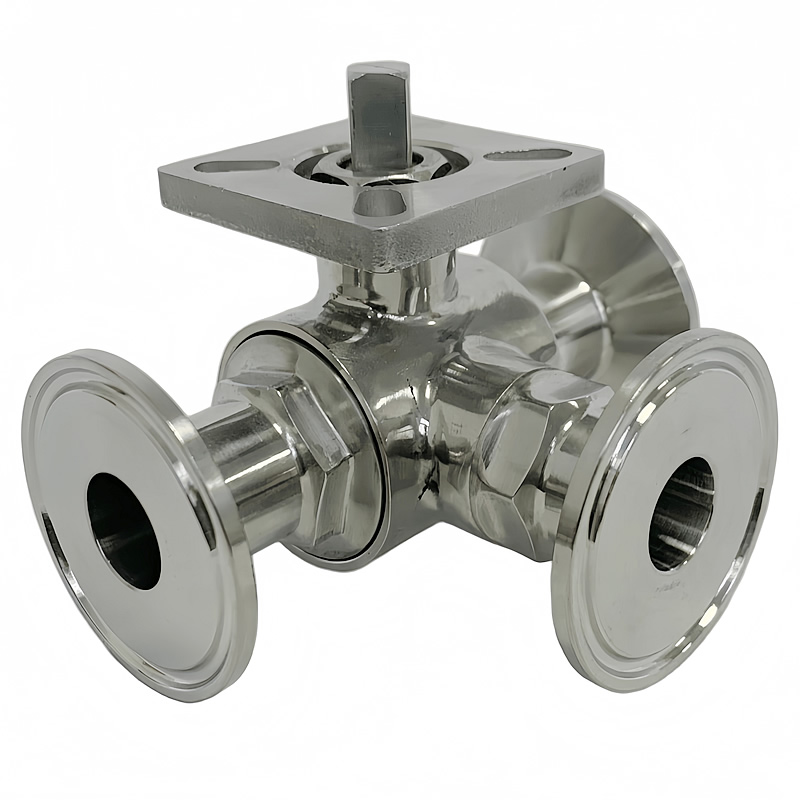
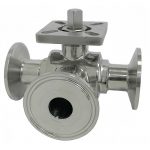
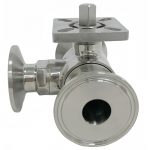
TIANYU API 608 ASME B16.34 CE Certified DN15-DN100 PN10-PN25 SS304/316 Forged 3-Way Ball Valve – Clamp Connection Manual/Pneumatic/Electric Operation for Fluid Diversion & Confluence
I. Product Overview
In industrial fluid control systems requiring flexible flow direction adjustment, 3-way ball valves emerge as indispensable solutions—enabling seamless diversion, confluence, or mixing of media without complex pipeline modifications. TIANYU’s Forged 3-Way Ball Valve, engineered to comply with API 608 (Steel Ball Valves), ASME B16.34 (Valves for Pressure Piping), and CE PED 2014/68/EU standards, merges the corrosion resistance of SS304/316 stainless steel, the hygienic reliability of clamp connections, and the versatility of 3-way flow design to serve diverse sectors.
Crafted via precision forging (eliminating porosity and defects common in cast alternatives), this valve features a one-piece 3-way ball (L-port or T-port), soft-seal (PTFE/EPDM) or metal-seal options, and tri-clamp (sanitary clamp) connections—ideal for hygiene-critical and general industrial applications. The clamp design enables tool-free, quick assembly and disassembly, simplifying cleaning and maintenance, while the forged SS304/316 construction resists rust, mild chemicals, and high-pressure loads.
Rated for nominal diameters from DN15 to DN100 and pressure classes from PN10 to PN25, the valve operates reliably across temperatures from -20℃ to 200℃—accommodating media such as water, steam, oil, food-grade fluids, and mild corrosives. Available in manual, pneumatic, or electric actuation, it delivers flexible control for small-to-medium flow systems, from laboratory setups to large-scale production lines. As a multifunctional flow control solution, it balances operational flexibility, durability, and hygienic performance to meet the demands of complex fluid management.
II. Important Attribute Specifications
A. Material Composition
Every component is selected to prioritize corrosion resistance, sealing integrity, and compatibility with diverse media—especially hygiene-critical and mild industrial fluids:
- Valve Body & Ball: Forged SS304 (ASTM A182 F304) as standard; optional SS316 (ASTM A182 F316) for enhanced chloride resistance. SS304’s chemical composition (Cr: 18–20%, Ni: 8–12%, C ≤0.08%) delivers tensile strength ≥515MPa, yield strength ≥205MPa, and excellent resistance to water, steam, and organic acids. SS316 adds 2–3% molybdenum, boosting resistance to saltwater and corrosive chemicals. The 3-way ball (L-port/T-port) is forged as a single piece to avoid welds or seams, ensuring structural integrity and smooth flow paths.
- Valve Seat: Soft-seal options include PTFE (Polytetrafluoroethylene, ASTM D4894) for chemical inertness (temperature -20℃ to 150℃) and EPDM (Ethylene Propylene Diene Monomer, ASTM D2000) for flexibility and steam compatibility (temperature -40℃ to 120℃). Both are FDA 21 CFR 177.2600-compliant for food-grade applications. Optional metal-seal (Stellite overlay) for high-temperature service (up to 200℃) and abrasive media. Seats are preloaded with stainless steel springs for self-compensating sealing.
- Valve Stem: Forged SS304/316 (ASTM A276) with anti-blowout design—preventing ejection under excessive pressure. The stem is precision-polished (Ra ≤0.4μm) to minimize friction with packing, ensuring smooth rotation and reducing fugitive emissions.
- Clamp & Fasteners: Tri-clamp components (compliant with DIN 32676/ISO 2852) are manufactured from SS304/316, ensuring corrosion resistance and hygienic compatibility. Fasteners are SS316 stainless steel bolts (ASTM A193 B8M) and nuts (ASTM A194 8M) for secure clamping.
- Packing & Gaskets: Multi-layer PTFE-impregnated graphite packing for stem sealing (meeting ISO 15848-1 Class AH for low fugitive emissions). Clamp gaskets are food-grade silicone or EPDM, ensuring leak-tight sealing and compliance with hygiene standards.
B. Dimensional & Pressure-Temperature Parameters
- Port Size (DN/NPS): DN15 (1/2”) to DN100 (4”), with full-port design for minimal pressure drop. Flow coefficient (Cv) ranges from 12 (DN15) to 180 (DN100), enabling efficient flow diversion or confluence without significant pressure loss.
- Pressure Rating: PN10 (1.0MPa), PN16 (1.6MPa), PN25 (2.5MPa)—aligned with ASME B16.34 pressure-temperature ratings. At 20℃, PN25 models withstand 2.5MPa, suitable for low-to-medium pressure systems.
- Temperature Range: -40℃ to 200℃, depending on seat material. PTFE seats: -20℃ to 150℃; EPDM seats: -40℃ to 120℃; metal seats: -20℃ to 200℃.
- End Connection: Tri-clamp (sanitary clamp) compliant with DIN 32676/ISO 2852, with clamp sizes matching DN15-DN100. Optional flange connections (ASME B16.5) for non-hygienic applications.
- Flow Configurations: L-port (diverts flow from one inlet to two outlets or vice versa) and T-port (mixes two inlet flows into one outlet or diverts one inlet to two outlets simultaneously).
- Face-to-Face Dimensions: Compliant with ISO 2852, ensuring interchangeability with valves from other manufacturers for easy retrofitting.
C. Operational Performance Parameters
- Sealing Performance: ANSI/FCI 70-2 Class VI (soft-seal) for bubble-tight closure—leakage rate ≤0.1×DN mm³/min for liquid media. Metal-seal variants achieve Class IV sealing, suitable for high-temperature and abrasive media.
- Actuation Options:
- Manual: Cast SS304 handwheel with anti-slip grip, enabling 90–180 degree rotation (depending on flow configuration) for flow adjustment.
- Pneumatic: Double-acting or spring-return pneumatic actuators (ISO 5211 mounting), explosion-proof (Ex d IIC T4) for hazardous environments, air supply pressure 0.4–0.6MPa.
- Electric: AC/DC electric actuators (IEC 60534), with remote control, position feedback, and torque limiting functions, compatible with SCADA systems.
- Operating Torque: 15N·m (DN15, PN10) to 120N·m (DN100, PN25) for manual operation—low enough for single-person control.
- Cycle Life: ≥50,000 open/close cycles under normal operating conditions, with maintenance interval of 24–36 months.
D. Certifications & Compliance
- Design & Manufacturing Standards: API 608, ASME B16.34, CE PED 2014/68/EU, ISO 2852 (sanitary clamp), DIN 32676.
- Quality & Hygiene Certifications: ISO 9001, FDA 21 CFR 177.2600 (food-grade), 3A 18-03 (dairy hygiene), ISO 15848-1 Class AH (fugitive emissions).
III. Feature Description
A. 3-Way Flow Design: Versatile Fluid Management
The core advantage of this valve lies in its 3-way ball configuration, offering two key flow patterns:
- L-Port Configuration: Ideal for diversion (one inlet → two outlets) or selection (two inlets → one outlet). Common in applications like switching between two fluid sources (e.g., tap water vs. purified water) or directing flow to two separate pipelines.
- T-Port Configuration: Enables mixing (two inlets → one outlet) or simultaneous diversion (one inlet → two outlets). Used in processes like blending chemicals, combining hot and cold water for temperature control, or distributing flow to parallel systems.
- Bidirectional Sealing: Both port types seal reliably in all flow directions, eliminating the need for check valves and simplifying pipeline design.
B. Tri-Clamp Connection: Hygienic & Easy Maintenance
The tri-clamp (sanitary clamp) connection is optimized for hygiene-critical and maintenance-intensive applications:
- Tool-Free Assembly: Clamp design allows quick attachment and removal without specialized tools—reducing installation time by 50% compared to flange connections. This is critical for frequent cleaning (CIP/SIP) in food and pharmaceutical plants.
- Hygienic Sealing: The clamp gasket creates a smooth, crevice-free seal, preventing media stagnation and bacterial growth. The design complies with 3A and FDA standards, making it suitable for potable water, food, and pharmaceutical media.
- Easy Cleaning: Quick disassembly enables thorough cleaning of internal surfaces (body cavity, ball, seat)—essential for preventing cross-contamination in batch processing.
C. Forged SS304/316 Construction: Durability & Corrosion Resistance
Forging and premium stainless steel materials ensure long-term performance in harsh conditions:
- Defect-Free Structure: Forging compacts the metal grain, eliminating porosity and internal cracks common in cast valves. This enhances structural integrity, enabling the valve to withstand pressure surges and thermal cycling without deformation.
- Corrosion Resistance: SS304 resists rust and mild chemicals (e.g., acetic acid, sodium hydroxide), while SS316 offers superior resistance to chlorides (e.g., saltwater, coastal environments) and aggressive media (e.g., sulfuric acid dilutions). Both materials maintain hygiene by preventing metal leaching into media.
- Wear Resistance: The forged 3-way ball’s surface is precision-lapped (Ra ≤0.4μm) to minimize wear against the seat, extending seal life and reducing maintenance needs.
D. Advanced Sealing Systems: Reliable Closure & Media Compatibility
Sealing performance is tailored to diverse media and operating conditions:
- Self-Compensating Soft Seats: PTFE/EPDM seats are preloaded with stainless steel springs, ensuring constant contact with the ball. As the seat wears, the spring automatically adjusts to maintain sealing force—extending seat life by 50% compared to non-compensating designs.
- Chemical Inertness: PTFE seats are inert to nearly all non-oxidizing media (acids, solvents, hydrocarbons), making the valve suitable for chemical processing. EPDM seats excel with water, steam, and mild alkalis, ideal for HVAC and water treatment.
- Low Fugitive Emissions: Multi-layer graphite packing meets ISO 15848-1 Class AH standards, limiting methane leakage to ≤100ppmv—complying with environmental regulations and reducing operational risks.
E. Flexible Actuation: Adaptable to System Requirements
The valve offers multiple actuation options to match operational needs:
- Manual Operation: Cost-effective for small-diameter valves (DN15-DN50) or systems with infrequent flow adjustments. The anti-slip handwheel provides clear visual confirmation of valve position.
- Pneumatic Actuation: Fast, reliable operation for automated batch processing (e.g., food filling lines). Spring-return actuators offer fail-safe functionality (maintaining flow direction on air failure), enhancing safety.
- Electric Actuation: Ideal for remote or precision control (e.g., SCADA-integrated chemical plants). Position feedback and torque limiting features enable real-time monitoring and prevent component damage.
IV. Manufacturing Process & Quality Control
A. Raw Material Procurement & Inspection
TIANYU maintains strict control over raw material sourcing to ensure quality and traceability:
- Material Sourcing: Forged SS304/316 blanks, clamp components, and seal materials are sourced exclusively from ISO 9001-certified suppliers, with each batch accompanied by a Material Test Certificate (MTC).
- Material Verification: Incoming SS304/316 components undergo spectral analysis (XRF) to confirm chemical compliance with ASTM standards. Tensile and impact tests verify mechanical properties (e.g., SS304 tensile strength ≥515MPa).
- Non-Destructive Testing (NDT): Forged bodies and balls undergo ultrasonic testing (UT) to detect internal defects and magnetic particle testing (MPI) to inspect surface flaws. Only defect-free materials proceed to machining.
B. Forging & Heat Treatment
Forging and heat treatment are critical to the valve’s structural integrity:
- Precision Forging: Steel billets are heated in a controlled-atmosphere furnace to 1100–1250℃, then forged into body and ball shapes using hydraulic presses (500–1000 tons). The forging ratio is maintained at ≥3:1 to ensure dense grain structure.
- Heat Treatment:
- SS304/316 components: Solution annealing (1040–1150℃, water-cooled) to relieve forging stress and restore corrosion resistance.
- Valve stem: Solution annealing and aging (for 17-4PH optional) to enhance strength and wear resistance.
- Descaling & Cleaning: Forged parts are shot-blasted to remove surface oxide scale, then cleaned with ultrasonic baths to eliminate residual contaminants.
C. Precision Machining
Machining is performed using high-precision CNC equipment to meet tight tolerances:
- Body & Ball Machining: CNC lathes and 5-axis mills process the valve body (clamp seats, cavity, stem bore) and 3-way ball (port channels, sealing surfaces). The ball’s port channels are machined to smooth finish (Ra ≤0.4μm) to minimize flow turbulence. Clamp seats are machined to DIN 32676 standards for compatibility with standard clamps.
- Stem Machining: The stem is turned and ground to diameter tolerance ±0.01mm and polished to Ra ≤0.4μm to minimize packing friction. The anti-blowout shoulder is precision-machined to engage the body securely.
- Dimensional Inspection: All components are inspected with coordinate measuring machines (CMMs) to verify compliance with design specifications. Surface finish is measured with a profilometer to ensure Ra ≤0.4μm for wetted surfaces.
D. Assembly & Comprehensive Testing
Assembly and testing adhere to API 598 and ISO 5208 standards:
- Component Cleaning: All parts (body, ball, seats, stem, packing) are degreased and ultrasonic-cleaned to remove oil, debris, and metal particles—critical for hygiene-critical applications.
- Assembly Sequence: The 3-way ball is installed first, followed by the seats (with preloaded springs), stem, packing, and clamp components. Fasteners are tightened to uniform torque to ensure secure clamping.
- Pressure Testing:
- Hydrostatic Shell Test: 1.5× rated pressure applied to the body cavity for 30 minutes—no leakage or deformation permitted.
- Hydrostatic Seat Test: 1.1× rated pressure applied to each port (all flow directions) for 15 minutes—leakage measured via bubble counting, complying with Class VI standards.
- Operational Testing: The valve is cycled 50 times (full rotation) to verify smooth operation, consistent torque, and correct flow direction switching. Actuated models are tested for stroke accuracy and response time.
- Hygiene Validation: For food-grade units, sample valves undergo swab testing for bacterial contamination (E. coli, Salmonella) after assembly—no contaminants permitted.
E. Final Inspection & Packaging
Before shipment:
- Visual Inspection: Each valve is inspected for surface defects (scratches, dents), proper machining, and correct marking (DN, PN, TIANYU logo, certifications). Valves with surface scratches deeper than 0.05mm are rejected.
- Documentation: Each valve is shipped with a Documentation Package including MTC, Hydrostatic Test Certificate, FDA/3A Compliance Certificate, and CE PED Declaration of Conformity.
- Hygienic Packaging: Valves are wrapped in food-grade polyethylene film, with clamp ends capped with sterile plastic protectors. Packing crates are labeled with handling instructions to maintain hygiene during transportation.


V. Product Advantages
A. Versatile Flow Control: One Valve, Multiple Functions
The 3-way design eliminates the need for multiple 2-way valves and complex piping to achieve diversion, confluence, or mixing—reducing system complexity and cost. For example, a single T-port valve can replace two 2-way valves in a hot/cold water mixing system, cutting installation and maintenance costs by 30%.
B. Hygienic & Easy Maintenance
- Clamp Connection: Tool-free disassembly enables quick CIP/SIP cleaning, critical for food, beverage, and pharmaceutical applications. This reduces downtime by 40% compared to flange-connected valves.
- Smooth Wetted Surfaces: Forged SS304/316 and precision polishing (Ra ≤0.4μm) prevent media stagnation and bacterial growth, ensuring compliance with hygiene standards.
C. Durable & Corrosion-Resistant
Forged construction and SS304/316 materials ensure a service life of 8–10 years in typical applications—vs. 3–5 years for cast or lower-grade valves. The materials resist rust, mild chemicals, and saltwater, making the valve suitable for coastal, chemical, and hygiene-critical environments.
D. Reliable Sealing & Operational Safety
Class VI soft-seal performance prevents media leakage, protecting high-value or hazardous fluids (e.g., specialty chemicals, sterile pharmaceuticals). The anti-blowout stem and low fugitive emissions comply with global safety and environmental regulations, reducing operational risks.
E. Flexible & Cost-Effective
- Actuation Options: Manual, pneumatic, and electric actuation adapt to diverse system requirements—from small manual setups to large automated lines.
- Reduced Inventory Costs: The valve’s versatility (diversion, confluence, mixing) eliminates the need for multiple valve types, simplifying procurement and inventory management.
VI. Product Applications
A. Food & Beverage Industry
- Beverage Processing: Switching between water, syrup, and cleaning solutions in bottling lines (L-port); blending flavors or mixing hot/cold water for temperature control (T-port). The hygienic clamp connection and FDA-compliant materials ensure product safety.
- Dairy Processing: Directing milk to storage tanks or pasteurizers (L-port); mixing cream with milk for fat content adjustment (T-port). 3A compliance ensures dairy hygiene standards are met.
B. Pharmaceutical & Biotechnology Industry
- Sterile Fluid Handling: Switching between sterile water and cleaning agents (L-port); blending APIs (Active Pharmaceutical Ingredients) with excipients (T-port). The clamp design enables frequent sterilization (SIP) without compromising sealing.
- Laboratory Applications: Diversion of reagents to multiple test stations (L-port); mixing buffer solutions (T-port). Compact size and manual operation suit small-scale laboratory setups.
C. Chemical & Petrochemical Industry
- Chemical Processing: Diversion of raw materials to different reactors (L-port); mixing two chemical intermediates (T-port). SS316 material and PTFE seats resist corrosive media (e.g., acids, solvents).
- Petrochemical Auxiliary Systems: Directing fuel oil to storage or burners (L-port); combining cooling water streams (T-port). The valve’s pressure rating (up to PN25) handles medium-pressure service.
D. Water Treatment & HVAC
- Municipal Water Treatment: Switching between raw water and treated water (L-port); mixing coagulants with water (T-port). Corrosion-resistant materials withstand chlorinated water.
- HVAC Systems: Mixing hot and cold water for room temperature control (T-port); diverting chilled water to different zones (L-port). EPDM seats excel with steam and water.
E. General Industrial & Specialty Applications
- Cosmetics Manufacturing: Diversion of base materials to filling lines (L-port); blending fragrances with creams (T-port). Hygienic design prevents product contamination.
- Automotive Industry: Directing coolant to engine or radiator (L-port); mixing lubricants (T-port). Durable construction withstands automotive fluids.
VII. Customization Advantages
TIANYU’s API 608-certified 3-way ball valve delivers versatile, hygienic flow control for food, pharmaceutical, and industrial sectors. Forged SS304/316 construction, clamp connection, and L/T-port options enable diversion, confluence, and mixing. Customize it: opt for SS316 (corrosion resistance), metal seats (high temperature), electric actuation (remote control), or larger DN (up to DN100). Tailored to your media, pressure, and flow needs, it balances flexibility, durability, and compliance—your trusted solution for complex fluid management.