
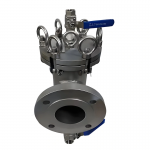
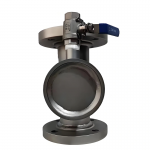
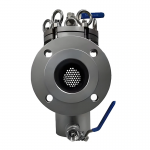
Specification
I. Product Overview
II. Key Attribute Parameters
-
Structure & Specifications
- Bore Range: DN15~DN400 (0.5″~16″), supporting reducing connections
- Flange Standards: ANSI 150Lb/300Lb, DIN, JIS 5K/10K, GB, etc.
- Housing Materials: 304 SS, 316 SS, 316L SS, carbon steel (Q235B)
- Mesh Precision: 5#~300# (≈4000μm~50μm), metal woven mesh or perforated plate
-
Performance Parameters
- Working Pressure: 1.6MPa (16Bar), shell hydrostatic test at 2.4MPa
- Temperature Range:
- 304 SS: -80℃~400℃ (extreme conditions)
- 316L SS: -196℃~650℃ (cryogenic/high-temperature scenarios)
- Flow Coefficient: Cv 20~1200 (water), pressure drop ≤0.05MPa
- Seal Rating: Bubble-tight (leakage rate ≤0.1L/h)
-
Material Configuration
- Seal Gaskets: NBR (-20℃~120℃), Viton (-25℃~200℃), PTFE (-100℃~260℃), metal-graphite composite (-200℃~650℃)
- Mesh Support: Stainless steel framework (thickness ≥2mm), anti-deformation design
Product Overview
III. Structural Design & Technical Features
-
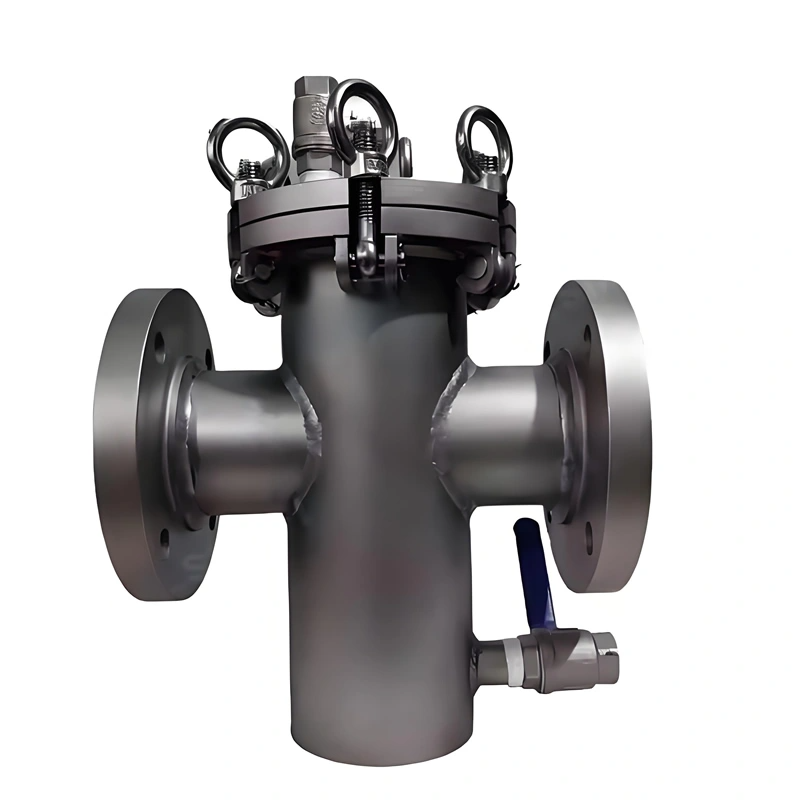
Quick-Opening Basket Structure
- Top flange quick-opening design enables disassembly within ≤3 minutes, improving mesh replacement efficiency by 50% vs. Y-type strainers.
- Tapered bottom (15° angle) minimizes debris accumulation, with residue ≤0.3L (DN100 size).
-
Multi-Application Adaptability
- Acid/alkali resistance: 316L material suits pH 2~12 media (e.g., sulfuric acid, NaOH solutions).
- Cryogenic tolerance: 316L+PTFE seals for LNG pipelines (-162℃).
- High-temperature resistance: 304+metal gaskets for steam systems (250℃).
-
Visual Maintenance Design
- Optional transparent sight glass (borosilicate glass) for real-time mesh clogging observation.
- Pressure gauge port (radial G1/2″) monitors differential pressure, with replacement threshold at 0.1MPa.
IV. Manufacturing Processes & Quality Control
-
Core Technologies
- Housing Forming:
- Stainless steel: CNC plate rolling & TIG welding, welds inspected via PTFE for porosity/slag.
- Carbon steel: Annealed at 650℃×2h to eliminate welding stress.
- Mesh Processing:
- 316 SS wire mesh (weaving accuracy ±5μm), heat-set at 850℃.
- Perforated plate mesh: hole tolerance ±0.1mm (≤10mm holes).
- Housing Forming:
-
Quality Certifications
- Pressure Testing: 1.5x rated pressure hydrostatic test (30-min hold) for every unit.
- Material Certification: Stainless steel with EN 10204 3.1 material reports.
- Surface Treatment: Stainless steel electropolished (Ra≤0.8μm); carbon steel epoxy-coated (thickness ≥100μm).
Valve Details
V. Core Product Advantages
| Advantage Dimension | Technical Details & Application Value |
|---|---|
| Multi-Standard Adaptability | Compatible with global flange standards, reducing retrofit costs for cross-border projects in oil platforms, overseas engineering, etc. |
| Longevity Design | 316L SS mesh resists erosion for ≥5 years (normal conditions), extending replacement cycles 3x vs. carbon steel. |
| Low Maintenance Cost | Quick-opening structure shortens maintenance to 15min/operation, cutting annual costs by 40% vs. bag filters. |
| Safety Redundancy Design | Dual-layered gasket protection (primary+backup seals) ensures zero leakage at 1.1x rated pressure, compliant with API 598. |
Application
VI. Application Fields & Case Studies
-
Petrochemical Industry
- Scenario: Catalytic cracking unit feed filtration to intercept catalyst particles.
- Configuration: 316L SS housing + 100# mesh, 1.6MPa pressure, 200℃ temperature.
- Effect: Filtrate particle size ≤150μm, protecting downstream pumps from wear.
-
Power Industry
- Scenario: Turbine lubricating oil system filtration.
- Configuration: 304 SS + Viton seals, 50# mesh (300μm precision).
- Advantage: Resists oil carbonization, stable pressure drop ≤0.03MPa, 6-month maintenance cycle.
-
Food & Beverage Industry
- Scenario: Beer brewing wort filtration.
- Configuration: 316L SS + PTFE seals, 200# mesh (75μm precision).
- Standard: Inner wall electropolished (Ra≤0.4μm), compliant with 3-A sanitary standards.
-
Wastewater Treatment
- Scenario: Municipal wastewater reuse pretreatment.
- Configuration: Carbon steel housing + 30# mesh (600μm precision), large-flow design (DN300 handles 120m³/h).
- Feature: Tapered bottom facilitates debris discharge, backwash cycle ≥24 hours.
VII. Selection & Installation Guide
-
Key Selection Parameters
- Medium Viscosity: Confirm cSt value (e.g., water ≤1cSt, heavy oil ≤1000cSt).
- Impurity Content: Basket filtration recommended for solid particles ≤5%; pre-filtration advised for >5%.
- Installation Space: Horizontal installation requires clearance ≥1.5x housing diameter for mesh extraction.
-
Installation Notes
- For horizontal installation, align the mesh basket axis perpendicular to the ground to avoid uneven debris accumulation.
- Install isolation valves on inlet/outlet pipes for system shutdown during maintenance.
- Apply cold insulation (thickness ≥50mm) for cryogenic services; insulate high-temperature applications.
RELATED
-
API 6D ASME B16.34 CE DN400 PN80 LF2 Carbon Steel Body 321 Stainless Steel Ball Full Welded Manual Light Stem Hard Seated Ball Valve
I. Product Overview & Core Specifications The TIANYU full welded ball valve stands as a high-performance fluid control component engineered for cr…
BALL VALVE 03/24/2026 -
API 6D ASME B16.34 CE 2” 600LB A105 Carbon Steel Body DEVLON Soft Seated RF Flanged Connection Manual Handle DBB Double Block and Bleed Ball Valve
I. Product Overview & Core Specifications The TIANYU DBB double block and bleed ball valve is a precision-engineered fluid control solution purpos…
BALL VALVE 03/18/2026 -
API 6D ASME B16.34 CE DN200/DN300/DN400 PN80 LF2 Carbon Steel Body 321 Stainless Steel Ball Full Welded Manual Stem Hard Seated Ball Valve
API 6D ASME B16.34 CE DN200/DN300/DN400 PN80 LF2 Carbon Steel Body 321 Stainless Steel Ball Full Welded Manual Stem Hard Seated Ball Valve is a premium high-pressure fluid control solution engineered for critical industrial applications, blending LF2 carbon steel’s structural strength with 321 stainless steel’s corrosion resistance and Stellite 6 hard seats’ durability. Its full welded design eliminates leak points, while the manual light stem ensures precise, reliable operation. Certified to API 6D, ASME, and CE standards, and backed by ISO 9001/API Q1 quality assurance, it excels in oil and gas transmission, petrochemical refining, and power generation. Fire-safe, low-emission, and maintainable, it delivers zero-leakage performance, regulatory compliance, and long-term value for large-flow, high-pressure pipeline systems worldwide.
BALL VALVE 03/17/2026 -
API 600 EN 12516 CE DN80 PN10 WCB Carbon Steel Body EPDM Soft Seated Flanged Connection Pneumatic Actuated Diaphragm Valve
I. Product Overview & Core Specifications The TIANYU pneumatic actuated diaphragm valve stands as a robust, precision-engineered fluid control sol…
Diaphragm Valve 03/17/2026 -
API 600 EN 12516 CE DN40 PN10 WCB Carbon Steel Body EPDM Soft Seated Flanged Connection Pneumatic Actuated Diaphragm Valve
I. Product Overview & Core Specifications The TIANYU pneumatic actuated diaphragm valve represents a precision-engineered fluid control solution t…
Diaphragm Valve 03/17/2026 -
API 6D ANSI CLASS300 CE NACE MR0175 DN300 CF8/CF8M Stainless Steel 2PC Flanged Trunnion Mounted Ball Valve
API 6D ANSI CLASS300 CE NACE MR0175 DN300 CF8/CF8M Stainless Steel 2PC Flanged Trunnion Mounted Ball Valve by TIANYU I. Product Overview & Core Sp…
BALL VALVE 03/05/2026


